2026 Honda Civic Hybrid vs. Toyota Corolla Hybrid vs. Hyundai Elantra Hybrid: Compact Sedan Shootout for Kansas City Metro Drivers
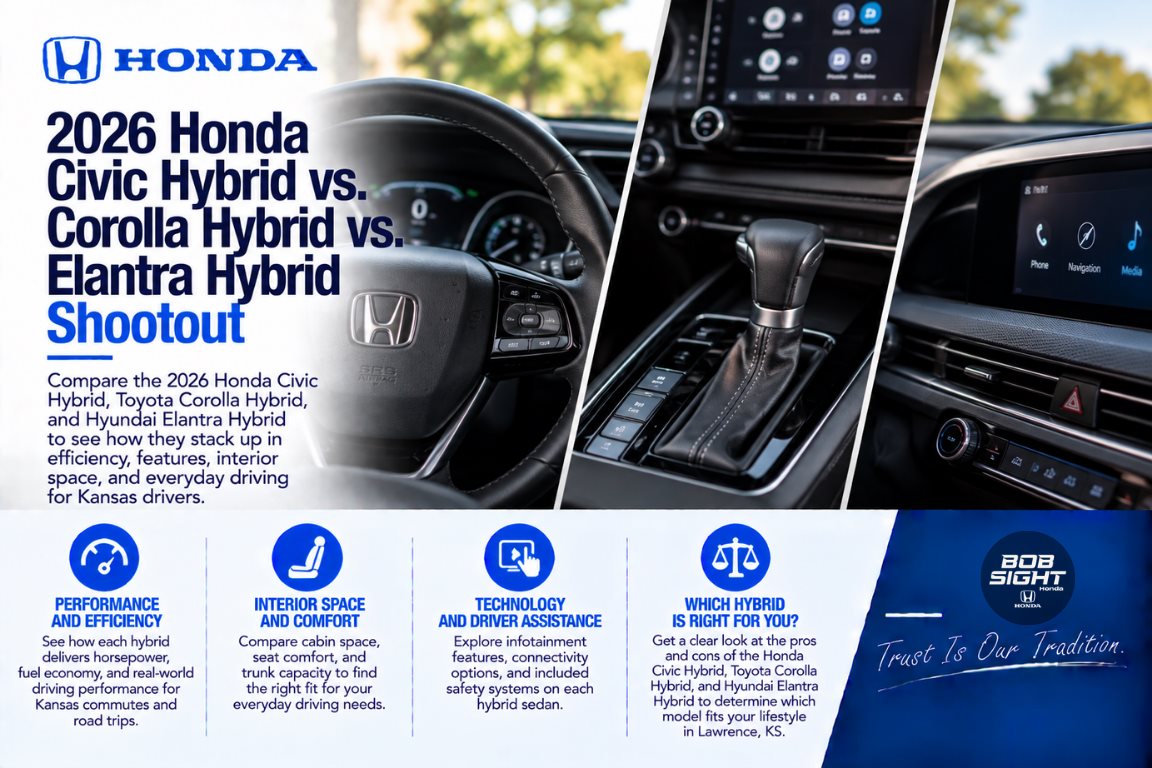
The compact hybrid sedan segment has reached peak competitiveness, with the 2026 Honda Civic Hybrid, Toyota Corolla Hybrid, and Hyundai Elantra Hybrid vying for top honors across the Kansas City metro. At Bob Sight Honda in Lawrence, Kansas, shoppers from Douglas County, Johnson County, and across Greater Kansas City frequently ask how the latest Civic Hybrid stacks up against its primary Japanese and Korean rivals. Commuting along Interstate 70 into downtown Kansas City, navigating Kansas Highway 10 into Olathe, or driving through the University of Kansas campus requires a hybrid vehicle that balances real-world fuel economy with robust horsepower, intuitive technology, quiet cabin acoustics, and cold-weather reliability. This comprehensive shootout compares the 2026 Honda Civic Hybrid, Toyota Corolla Hybrid, and Hyundai Elantra Hybrid across performance, efficiency, interior dimensions, safety features, long-term ownership costs, driving feel, and overall daily commuter value.
To view our latest hybrid inventory, check vehicle specs, or schedule a test drive, visit our 2026 Honda Civic sedan inventory at Bob Sight Honda today. Our dedicated automotive team is here to provide objective comparisons and help you find the ideal hybrid sedan for your daily drive.
In This Guide You'll Learn
Below is an overview of what this compact hybrid sedan comparison covers:
- Powertrain specs, horsepower output, and torque comparisons between Civic Hybrid, Corolla Hybrid, and Elantra Hybrid.
- Real-world MPG expectations during highway cruising along K-10 and urban stop-and-go driving near Iowa Street in Lawrence.
- Interior passenger volume, rear seat legroom, and trunk cargo capacity evaluations across all three vehicles.
- In-cabin technology, touchscreen usability, wireless Apple CarPlay and Android Auto integration, and available sound systems.
- Standard active safety suites including Honda Sensing, Toyota Safety Sense, and Hyundai SmartSense.
- Deep-dive chassis engineering, steering feel, and acoustic insulation differences across local Kansas roads.
- Real-world carpool scenarios, child safety seat fitments, and Midwest seasonal climate performance.
- Maintenance schedules, factory warranty coverage, and long-term Midwest reliability planning.
- JSON-LD structured data schema implementation for search engine optimization.
1. Powertrain Architecture, Horsepower, and Real-World Performance
When evaluating compact hybrid sedans, raw performance and throttle responsiveness vary dramatically depending on powertrain engineering. The 2026 Honda Civic Hybrid features Honda's fourth-generation two-motor hybrid system, pairing a direct-injected 2.0-liter Atkinson-cycle 4-cylinder engine with electric propulsion motors to produce a class-leading 200 total system horsepower and 232 lb-ft of instant torque. Power is routed through an electronic continuously variable transmission (e-CVT) with Linear Shift Control, providing immediate acceleration without the unpleasant engine drone often associated with traditional hybrids.
By contrast, the Toyota Corolla Hybrid uses a 1.8-liter 4-cylinder engine paired with an electric motor to generate a modest 138 horsepower and 105 lb-ft of torque. While the Corolla Hybrid offers an available electronic All-Wheel Drive (e-AWD) option, its lower horsepower output requires heavy throttle application when merging onto fast-flowing highways like I-470 or US-59, resulting in noticeable engine strain during steep grade climbs. The Hyundai Elantra Hybrid utilizes a 1.6-liter 4-cylinder engine paired with an electric motor and a 6-speed dual-clutch transmission (DCT) to produce 139 horsepower and 195 lb-ft of torque, delivering crisp gear shifts but lacking the sheer passing authority of the Civic Hybrid.
The table below provides a direct specification comparison across all three hybrid powertrains:
| Performance Metric | 2026 Honda Civic Hybrid | Toyota Corolla Hybrid | Hyundai Elantra Hybrid |
|---|---|---|---|
| Engine Architecture | 2.0L 4-Cylinder + 2-Motor Hybrid | 1.8L 4-Cylinder + Electric Motor | 1.6L 4-Cylinder + Electric Motor |
| Total System Horsepower | 200 HP | 138 HP | 139 HP |
| Total System Torque | 232 lb-ft | 105 lb-ft | 195 lb-ft |
| Transmission Type | e-CVT w/ Linear Shift Control | e-CVT | 6-Speed Dual-Clutch (DCT) |
| 0 to 60 MPH Acceleration | ~6.2 Seconds | ~9.0 Seconds | ~8.4 Seconds |
For drivers who regularly merge into fast-moving traffic along I-70 or need effortless passing power on two-lane roads in Douglas County, the Civic Hybrid's 200 horsepower offers a decisive performance advantage over both Toyota and Hyundai competitors.
2. Fuel Efficiency and Kansas City Commuter Range
All three competitors deliver outstanding fuel economy, but their real-world efficiency profiles cater to slightly different driving conditions. The 2026 Honda Civic Sport Hybrid sedan achieves an EPA-estimated rating of 50 MPG city and 47 MPG highway (49 MPG combined), while the top-tier Sport Touring Hybrid achieves 50 MPG city and 47 MPG highway. Equipped with a 10.6-gallon fuel tank, the Civic Hybrid offers a daily driving range exceeding 450 to 500 miles per fill-up.
The Toyota Corolla Hybrid LE carries EPA ratings of 53 MPG city and 46 MPG highway (50 MPG combined), whereas Corolla AWD trims dip to 51 MPG city and 44 MPG highway. The Hyundai Elantra Hybrid Blue leads maximum laboratory figures with 51 MPG city and 58 MPG highway (54 MPG combined), though higher Limited trims drop to 49 MPG city and 52 MPG highway. During real-world testing along flat highway stretches of K-10, all three models comfortably achieve high 40s to low 50s MPG when driven conservatively in ECON mode.
Where the Civic Hybrid stands out is its steering-wheel-mounted deceleration selector paddles. These paddles allow drivers to adjust regenerative braking resistance across four levels when descending grade drops or slowing down for traffic lights along 23rd Street in Lawrence. This feature maximizes energy recovery into the lithium-ion battery while minimizing friction wear on hydraulic brake pads.
3. Interior Dimensions, Cabin Volume, and Cargo Capacity
Daily usability hinges on cabin space, seating ergonomics, and rear-passenger legroom, areas where the Honda Civic Hybrid holds a distinct size advantage over the Toyota Corolla Hybrid. Featuring 99.0 cubic feet of passenger volume, the Civic Hybrid provides midsize-like roominess in a compact footprint. Front row occupants enjoy 42.3 inches of legroom, while rear passengers benefit from a class-leading 37.4 inches of legroom, easily accommodating tall adults or bulkier rear-facing child safety seats.
By comparison, the Toyota Corolla Hybrid feels noticeably tighter inside, offering just 88.6 cubic feet of passenger volume and a tight 34.8 inches of rear legroom. Tall rear passengers in the Corolla will find their knees touching the front seatbacks during extended trips. The Hyundai Elantra Hybrid matches the Civic closely in passenger space with 99.0 cubic feet of cabin volume and 38.0 inches of rear legroom, though its sloping roofline slightly reduces rear headroom.
In terms of trunk utility, the Civic Hybrid Sedan delivers 14.8 cubic feet of flat cargo space with a broad tailgate opening and low lift-over height. Crucially, Honda engineers placed the high-voltage battery beneath the rear seats, ensuring the Civic Hybrid loses zero trunk volume compared to gas models and retains full 60/40 split-folding rear seat utility. The Elantra Hybrid offers 14.2 cubic feet of trunk space, while the Corolla Hybrid trails significantly at 13.1 cubic feet.
4. Cabin Technology, Infotainment, and Connectivity
Modern commuters expect seamless smartphone integration, clear digital instrumentation, and intuitive audio controls. The 2026 Honda Civic Hybrid line starts with a 7-inch color touchscreen on the Sport Hybrid trim, featuring standard Apple CarPlay and Android Auto compatibility, an 8-speaker audio system, and a 7-inch digital driver cluster display. Upgrading to the Sport Touring Hybrid transforms the cockpit with a 9-inch HD touchscreen, a fully digital 10.2-inch driver instrument cluster, wireless Apple CarPlay and Android Auto, a Qi wireless phone charger, and a custom-engineered Bose 12-speaker premium sound system with Centerpoint surround technology.
Furthermore, the Civic Sport Touring Hybrid features Google built-in technology, providing native access to Google Maps for turn-by-turn navigation, Google Assistant for hands-free voice control, and third-party media apps via Google Play directly on the vehicle display without requiring a connected smartphone. Google Maps updates over the air, delivering real-time traffic updates and detour recommendations around unexpected highway construction on I-35 or US-59.
The Toyota Corolla Hybrid includes an 8-inch touchscreen running Toyota Audio Multimedia with wireless Apple CarPlay and Android Auto, but its standard 6-speaker audio system lacks the acoustic richness of Honda's Bose setup, and its digital driver display measures just 4.2 to 7 inches depending on trim. The Hyundai Elantra Hybrid features dual 10.25-inch displays on its Limited trim with wired/wireless Apple CarPlay, but user menus require navigating multi-layer digital screens that can cause distraction while driving.
5. Active Safety Systems and Driver-Assistive Technology
Safety is a fundamental priority for compact sedan buyers, and all three automakers equip their hybrid models with standard suite safety technology. Every 2026 Honda Civic Hybrid comes standard with the comprehensive Honda Sensing suite, utilizing a wide-angle camera system to monitor road boundaries, pedestrians, and surrounding vehicles.
The standard Honda Sensing suite includes:
- Collision Mitigation Braking System (CMBS): Automatically applies emergency braking if an unavoidable frontal impact is detected.
- Road Departure Mitigation System (RDM): Provides steering torque and braking assistance if the vehicle drifts off the paved road edge.
- Adaptive Cruise Control with Low-Speed Follow (ACC w/ LSF): Manages acceleration and braking to maintain a set distance in stop-and-go highway traffic on I-470.
- Lane Keeping Assist System (LKAS): Keeps the sedan centered within visible lane markings during long drives across Douglas and Johnson counties.
- Traffic Sign Recognition (TSR): Displays roadside speed limit icons on the driver display.
- Blind Spot Information System (BSI) with Cross Traffic Monitor: Standard on Civic Hybrid trims to alert drivers of hidden adjacent vehicles.
Toyota equips the Corolla Hybrid with Toyota Safety Sense 3.0, including Pre-Collision System, Lane Departure Alert, and Dynamic Radar Cruise Control. Hyundai outfits the Elantra Hybrid with Hyundai SmartSense, offering Forward Collision-Avoidance Assist, Lane Keeping Assist, and Blind-Spot Collision-Avoidance Assist. While all three systems earn top safety ratings, Honda's LKAS and Adaptive Cruise Control deliver noticeably smoother steering and braking inputs during heavy highway commuting.
6. Chassis Dynamics, Steering Precision, and Cabin Acoustics
A defining area where the 2026 Honda Civic Hybrid outperforms its compact rivals is in chassis refinement, cornering stability, and acoustic insulation. Built on Honda's rigid 11th-generation global architecture, the Civic Hybrid features a MacPherson strut front suspension paired with an independent multi-link rear suspension. This sophisticated rear multi-link setup allows each rear wheel to absorb bumps independently, suppressing expansion-joint harshness along I-70 and rough pavement cracks across freeze-thaw Kansas highways.
The steering calibration in the Civic Hybrid offers communicative, linear turn-in feel with weighted feedback that builds confidence through sweeping highway ramps near the K-10 and I-35 interchange in Olathe. Dual-pinion electric power steering reduces artificial center play, allowing the sedan to track straight with minimal steering corrections. Body roll during cornering remains strictly controlled, giving driver inputs an athletic, connected sensation that makes daily driving genuinely enjoyable.
By contrast, the Toyota Corolla Hybrid uses a lighter steering setup that feels over-assisted and vague around center. While comfortable over low-speed city bumps, the Corolla experiences pronounced body lean when pushed through turns, and its cabin lets in noticeable tire slap and wind whistle at 70 MPH highway speeds. The Hyundai Elantra Hybrid utilizes a multi-link rear suspension on hybrid trims that provides decent bump absorption, but its chassis feels less rigid overall, resulting in subtle cabin flex over offset driveway aprons or uneven railroad crossings near 23rd Street in Lawrence.
In terms of interior sound isolation, the Civic Hybrid benefits from standard Active Noise Cancellation (ANC). ANC monitors low-frequency road noise and engine rumble through cabin microphones, emitting inverted acoustic sound waves through the door speakers to neutralize harsh interior noise. Combined with sound-absorbing underbody covers, acoustic windshield glass, and liquid-applied sound deadener inside the floor pan, the Civic Hybrid delivers a whisper-quiet highway ride that reduces driver fatigue during long daily commutes.
7. Real-World Midwest Versatility: Carpools, Car Seats, and Winter Driving
Evaluating how a hybrid sedan handles daily family responsibilities in Eastern Kansas requires testing real-world cabin fitment across seasonal climate conditions. Midwest drivers face freezing winter temperatures, sudden ice storms, summer heatwaves exceeding 90 degrees, and daily carpool demands that stretch a compact car's capabilities.
In adult passenger carpool testing, the Civic Hybrid's 37.4 inches of rear legroom allow four 6-foot adults to ride comfortably without front occupants sliding their seats forward. The rear seat cushion height provides proper thigh support, preventing the low, knees-up seating posture common in smaller compact cars. In the Corolla Hybrid, rear passenger legroom measures just 34.8 inches, forcing front passengers to compromise their seating positions during full-occupant commutes into downtown Kansas City.
For parents installing child safety seats, the Civic Hybrid offers wide rear door opening angles that simplify loading infants or securing toddlers. Outboard lower LATCH anchors are clearly marked with accessible guidance slots, allowing quick click-in attachment for rear-facing carriers and convertible seats. The 37.4-inch rear legroom ensures that bulky rear-facing infant seats fit cleanly behind the front passenger seat without crowding front legroom space.
When Kansas winters bring sub-zero temperatures and snow, all three hybrid sedans rely on advanced battery thermal management to protect high-voltage lithium-ion cells. The Civic Hybrid uses an active heating and cooling loop that maintains optimal battery operating temperatures, ensuring reliable power delivery during freezing morning starts in Lawrence or Topeka. Standard multi-stage heated front seats on the Civic Sport Hybrid provide rapid driver warmth before engine coolant reaches full operating temperature, allowing the combustion engine to shut off earlier during low-speed driving and preserving high hybrid efficiency year-round.
8. Maintenance Planning, Warranty Coverage, and Reliability
Long-term ownership satisfaction requires evaluating factory warranty terms, routine maintenance costs, and Midwest cold-weather durability. All three hybrid sedans use advanced thermal management systems to protect high-voltage lithium-ion batteries during freezing Kansas winter temperatures.
Honda backs the 2026 Civic Hybrid with a 3-year/36,000-mile Limited Vehicle Warranty, a 5-year/60,000-mile Powertrain Limited Warranty, and a dedicated 8-year/100,000-mile High-Voltage Battery Warranty. Additionally, new Civic purchases include Honda Service Pass, which covers complimentary factory-scheduled maintenance (oil changes, tire rotations, multi-point inspections) for the first 2 years or 24,000 miles.
Because the Civic Hybrid uses regenerative braking for most routine slowdowns, physical brake pads experience minimal friction wear, routinely lasting 80,000 to 100,000 miles before requiring service. When maintenance is required, drivers can rely on our factory-trained technicians at the Bob Sight Honda service center. You can easily schedule appointments using our online Schedule Service page.
Quick Facts: 2026 Honda Civic Hybrid vs. Competitors
Below is a quick reference summary highlighting how the Civic Hybrid compares to its primary rivals:
- Horsepower Advantage: Civic Hybrid produces 200 HP vs. Corolla Hybrid (138 HP) and Elantra Hybrid (139 HP).
- Torque Advantage: Civic Hybrid delivers 232 lb-ft torque vs. Corolla Hybrid (105 lb-ft) and Elantra Hybrid (195 lb-ft).
- Rear Seat Legroom: Civic Hybrid offers 37.4 inches vs. Corolla Hybrid (34.8 inches) and Elantra Hybrid (38.0 inches).
- Trunk Volume: Civic Hybrid holds 14.8 cu ft vs. Corolla Hybrid (13.1 cu ft) and Elantra Hybrid (14.2 cu ft).
- Acoustic Insulation: Active Noise Cancellation (ANC) standard on Civic Hybrid for a quieter cabin at highway speeds.
- Complimentary Maintenance: Honda Service Pass covers 2 years or 24,000 miles of routine care.
Why Choose Bob Sight Honda in Lawrence, KS
Bob Sight Honda is dedicated to delivering a transparent, customer-first automotive experience for drivers across Lawrence, Eudora, Baldwin City, Olathe, and the Greater Kansas City area. As part of the family-owned Bob Sight Auto Group, our dealership operates on a foundation of upfront pricing, honest guidance, and long-term community relationships. We take pride in helping local drivers compare vehicle options and choose the ideal hybrid sedan for their commuting needs.
When you shop at Bob Sight Honda, you gain access to an extensive selection of new Civic Hybrid sedans, competitive finance and lease options, transparent trade appraisals, and a factory-certified service center equipped with specialized diagnostic tools. If you plan on trading in your current vehicle, get an instant appraisal online using our secure Value Your Trade tool. Visit our showroom on Iowa Street in Lawrence today to test drive the 2026 Honda Civic Hybrid firsthand.
Helpful Links
Proud To Be Part Of The Bob Sight Auto Group
Bob Sight Honda is proud to be part of the Bob Sight Auto Group, serving drivers across Kansas and Missouri with exceptional automotive sales, financing, and service. Whether you are looking for a new Honda in Lawrence, a Ford in Lee's Summit, or a Kia or CDJR vehicle in the area, our dealership group is committed to providing top-tier customer care at every location.