2026 Honda Civic Maintenance Guide: Gas vs. Hybrid Service Schedules and Reliability for Kansas City Metro Drivers
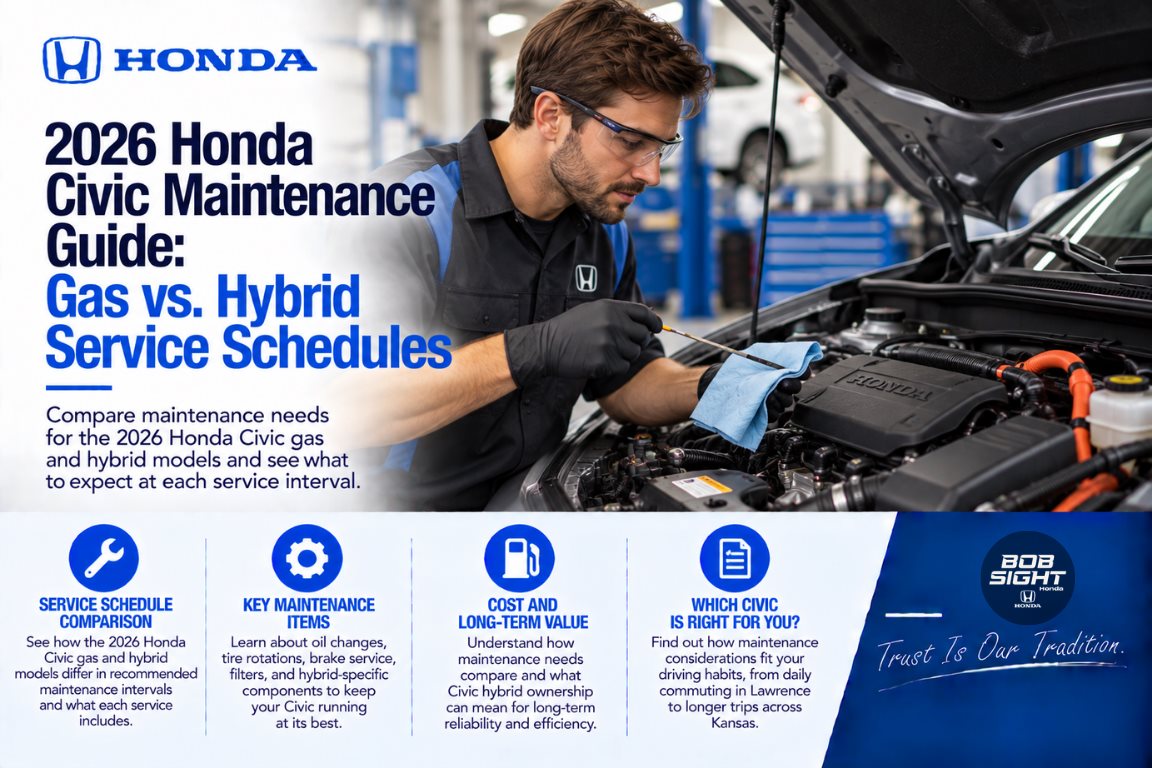
Maintaining the 2026 Honda Civic requires understanding the distinct service requirements, maintenance intervals, and long-term reliability expectations between traditional gas-powered and two-motor hybrid powertrains. At Bob Sight Honda in Lawrence, Kansas, drivers from Douglas County, Johnson County, and across the Greater Kansas City area frequently ask whether choosing a high-efficiency hybrid model introduces higher long-term maintenance costs. Navigating Midwest temperature extremes, hot summer traffic jams along Interstate 70, freezing winter conditions on Kansas Highway 10, and frequent stop-and-go driving near the University of Kansas campus places unique demands on vehicle engine oil, thermal management systems, and braking hardware. This comprehensive guide provides an in-depth evaluation of the Honda Maintenance Minder™ system, compares routine service intervals for gas versus hybrid trims, analyzes brake pad longevity, breaks down fluid service specifics, and examines long-term ownership reliability for Kansas City metro drivers.
To schedule factory-certified service or explore new inventory options, visit our Schedule Service page at Bob Sight Honda today. Our master technicians provide specialized care for both traditional internal combustion engines and advanced Honda two-motor hybrid powertrains.
In This Guide You'll Learn
Below is an overview of what this complete 2026 Honda Civic service schedule and reliability guide covers:
- How the Honda Maintenance Minder™ system calculates service intervals based on local Kansas driving habits.
- A side-by-side comparison of scheduled service milestones for gas (LX, Sport) and hybrid (Sport Hybrid, Sport Touring Hybrid) models.
- Why hybrid models experience significantly reduced brake pad wear thanks to regenerative braking systems.
- Fluid replacement intervals for standard CVTs versus two-motor hybrid e-CVTs, including HCF-2 specification requirements.
- Deep-dive analysis on secondary thermal cooling loops, inverter fluids, and battery cooling fan intake filters.
- Midwest seasonal care guidelines for protecting high-voltage lithium-ion batteries during freezing Kansas winters.
- Detailed total cost of ownership benchmarks over 5-year and 100,000-mile driving periods.
- Factory warranty coverage details including the Honda Service Pass complimentary maintenance program.
- Embedded JSON-LD structured data schema markup for enhanced search engine visibility.
1. Understanding the Honda Maintenance Minder™ System
Every 2026 Honda Civic Sedan comes equipped with the Honda Maintenance Minder™ system, an intelligent onboard diagnostic computer that replaces rigid, static mileage schedules with real-time health monitoring. Rather than relying strictly on odometer readings, the system constantly tracks engine operating temperatures, ambient weather conditions, total engine revolutions, vehicle speed, and trip duration. When oil life reaches 15 percent, a main code (A or B) along with optional sub-item numbers (1 through 7) appears on the digital driver cluster.
For daily commuters traveling between Lawrence, Olathe, and downtown Kansas City, this system ensures maintenance is performed precisely when required. Drivers who spend long hours idling in traffic along I-470 or driving short trips around campus will see service codes pop up sooner to protect engine oil from thermal degradation. Conversely, drivers who maintain steady highway speeds along flat stretches of K-10 will enjoy extended oil life intervals approaching 7,500 to 10,000 miles.
The primary Honda Maintenance Minder™ main codes and sub-item codes are defined below:
- Code A: Replace engine oil using full synthetic 0W-20 oil.
- Code B: Replace engine oil and filter; perform comprehensive multi-point inspection including brakes, steering gearbox, and suspension mounting bolts.
- Sub-Item 1: Rotate tires and check tire inflation pressures.
- Sub-Item 2: Replace cabin dust/pollen filter and engine air cleaner element; inspect drive belt.
- Sub-Item 3: Replace transmission fluid (CVT or e-CVT).
- Sub-Item 4: Replace spark plugs and inspect valve clearance.
- Sub-Item 5: Replace engine coolant.
- Sub-Item 7: Replace brake fluid (recommended every 3 years regardless of mileage).
2. Service Schedule Comparison: Gas Trims vs. Hybrid Trims
Comparing scheduled maintenance requirements across the 2026 Honda Civic lineup reveals that hybrid trims follow a structure similar to gas models while shifting specific component focus. The LX and Sport trims feature a 2.0-liter naturally aspirated 4-cylinder gas engine. The Sport Hybrid and Sport Touring Hybrid trims combine a 2.0-liter Atkinson-cycle gas engine with a two-motor electric hybrid drive system.
In a hybrid model, the electric traction motor handles low-speed propulsion and coasting, allowing the gas engine to run fewer total revolutions over the same distance compared to a gas-only model. This reduces internal thermal engine stress. However, hybrid models introduce specific inspection checkpoints for high-voltage battery cooling vents and secondary inverter coolant loops.
The table below breaks down typical service intervals and tasks for gas versus hybrid 2026 Civic models based on Midwest driving conditions:
| Mileage Interval | Gas Models (LX, Sport) Service Tasks | Hybrid Models (Sport Hybrid, Sport Touring Hybrid) Service Tasks |
|---|---|---|
| 7,500 - 10,000 Miles | Engine oil and filter change; tire rotation; brake system visual inspection. | Engine oil and filter change; tire rotation; high-voltage battery cooling duct check. |
| 15,000 Miles | Replace cabin air filter; inspect suspension, tie-rods, and steering gearbox. | Replace cabin filter; inspect regenerative braking hardware and electrical connections. |
| 30,000 Miles | Replace engine air filter; inspect drive belts; comprehensive brake pad check. | Replace engine air filter; inspect inverter cooling loop and hybrid battery fan filter. |
| 45,000 - 60,000 Miles | Replace Continuously Variable Transmission (CVT) fluid. | Replace electronic transmission (e-CVT) fluid using genuine Honda e-CVT fluid. |
| Every 3 Years | Flush and replace hydraulic brake fluid (regardless of mileage). | Flush and replace hydraulic brake fluid (regardless of mileage). |
| 100,000 Miles | Replace spark plugs; replace engine coolant; inspect valve clearances. | Replace spark plugs; replace engine coolant and dedicated hybrid system coolant. |
3. Brakes, Belts, and Powertrain Longevity Breakdown
One of the most significant cost advantages of owning a 2026 Honda Civic Hybrid is reduced wear on primary mechanical brake components. When a hybrid driver presses the brake pedal or uses the steering-wheel deceleration paddles, the electric traction motor operates as a generator to slow the vehicle down while capturing energy for the lithium-ion battery. Traditional hydraulic brake pads and steel rotors only engage during firm, sudden stops or during the final complete stop.
As a result, hybrid owners routinely report brake pad lifespans exceeding 80,000 to 100,000 miles before requiring replacement. On standard gas-only Civic models, physical friction pads handle 100 percent of braking force, typically requiring pad service every 30,000 to 45,000 miles depending on stop-and-go commuting severity around Overland Park or Kansas City.
Additionally, Honda's two-motor hybrid architecture eliminates several mechanical wear items found in conventional gas engines:
- No Traditional Starter Motor: The electric starter-generator motor starts the gas engine instantly without conventional mechanical starter wear.
- No Conventional Alternator: The hybrid battery and generator supply electrical power to onboard systems directly.
- Fewer Drive Belts: Electric air conditioning compressors and electric water pumps reduce reliance on complex serpentine belts.
4. Transmission and e-CVT Fluid Service Specifics
Transmission fluid health plays a vital role in ensuring smooth power transfer and preventing internal gear wear across both gas and hybrid 2026 Civic models. Although both systems use continuously variable naming conventions, their internal mechanical designs differ significantly.
Gas-powered Civic LX and Sport models utilize a conventional steel belt and variable pulley Continuously Variable Transmission (CVT). This system requires genuine Honda HCF-2 fluid replacement under Maintenance Minder Sub-Item 3, typically popping up between 45,000 and 60,000 miles. The friction modifiers in HCF-2 fluid prevent steel belt slippage against the hydraulic pulleys. Using non-approved aftermarket transmission fluids in a Honda CVT can cause belt slippage, shuddering, and severe internal transmission damage.
By contrast, the 2026 Civic Sport Hybrid and Sport Touring Hybrid utilize Honda's electronic Continuously Variable Transmission (e-CVT). The e-CVT does not use drive belts or variable pulleys. Instead, it uses two electric motors coupled directly to a direct gear drive set and a hydraulic lock-up clutch. The e-CVT fluid serves two primary purposes: lubricating the heavy-duty drive gears and cooling the high-voltage electric motor windings. Service intervals for the e-CVT fluid occur around 45,000 to 60,000 miles under normal driving conditions. Using factory-approved genuine Honda fluid is crucial for maintaining electrical isolation and thermal dissipation across electric motor windings.
5. Dual Thermal Cooling Systems and Battery Vent Maintenance
Underneath the hood of the 2026 Honda Civic Hybrid sits a specialized dual cooling system designed to manage engine heat and electrical power electronics independently. Traditional gas engines rely on a single radiator loop to cool the cylinder block. The Civic Hybrid uses two isolated cooling loops, each filled with long-life coolant:
- Engine Cooling Loop: Maintains optimal operating temperatures for the 2.0-liter Atkinson-cycle gasoline engine.
- Power Electronics (PCU) Cooling Loop: Circulates dedicated coolant through the power control unit, high-voltage inverter, and electric drive motors to dissipate heat during heavy acceleration or rapid regenerative braking.
Both cooling loops require periodic inspections for fluid level and clarity during routine Maintenance Minder B-services. Flush and replacement intervals for both coolant circuits occur around 100,000 miles under Sub-Item 5.
Inside the cabin, the high-voltage lithium-ion battery pack is positioned beneath the rear passenger seats. To keep battery cell temperatures stable during hot Midwest summers, an electric cooling fan draws air from the passenger cabin through a intake vent located along the lower rear seat bench. Over time, dust, lint, or pet hair can accumulate on the internal battery cooling fan filter.
During scheduled 15,000-mile and 30,000-mile service visits at Bob Sight Honda, our technicians inspect and clean this battery air intake filter. Keeping the intake vent clear prevents battery cell hot spots, preserving battery capacity and ensuring maximum fuel economy performance during hot afternoon commutes along I-70.
6. Winter Weather Care and Battery Thermal Management
Midwest winters present freezing temperatures, road salt, and snow, requiring specific preventive care strategies for hybrid and gas Civic owners across Eastern Kansas. Cold temperatures temporarily increase internal chemical resistance within lithium-ion batteries. To generate cabin heat during cold morning starts in Lawrence or Topeka, the hybrid gas engine runs more frequently initially to warm the coolant loop.
To preserve battery health and ensure vehicle reliability throughout winter months, follow these key seasonal care recommendations:
- Keep Battery Air Intake Vents Clear: Ensure coat bags, blankets, or floor mats do not block the high-voltage battery cooling vents located along the rear seat base. Clean airflow prevents thermal buildup during extended heating or cooling cycles.
- Maintain Proper Tire Pressures: Air pressure drops approximately 1 PSI for every 10-degree drop in outside temperature. Proper tire inflation protects low-rolling-resistance tires and maintains accurate fuel economy readings on K-10.
- Schedule Regular Undercarriage Washes: Road salt and liquid brine used on Kansas highways can cause corrosion over time. Regular underbody flushes protect high-voltage wiring harnesses, aluminum suspension links, and brake lines.
7. Total Cost of Ownership Analysis: 5-Year Ownership Projection
Evaluating total maintenance costs over a 5-year or 75,000-mile ownership period demonstrates the economic efficiency of both Civic powertrains. While the initial purchase price of a hybrid model carries a modest premium, lower brake maintenance demands and reduced fuel consumption create long-term operational savings.
On a gas-powered Civic LX or Sport, routine maintenance across 75,000 miles typically includes approximately 7 to 9 oil and filter changes, 9 tire rotations, 2 cabin and engine air filter replacements, 1 CVT fluid change, and at least 1 front brake pad and rotor replacement.
On a Civic Sport Hybrid or Sport Touring Hybrid over the same 75,000-mile distance, routine care requires similar oil change and tire rotation schedules. However, because regenerative braking absorbs most stopping energy, brake pad replacements are rarely needed within the first 75,000 miles. Furthermore, complimentary maintenance provided by Honda Service Pass covers routine oil changes and tire rotations during the initial 2 years or 24,000 miles, eliminating out-of-pocket maintenance expenses during early ownership.
When combined with fuel economy savings reaching up to 50 MPG city, the Civic Hybrid offers an exceptionally low total cost per mile, making it one of the most cost-effective commuter choices for Kansas City area drivers.
8. Factory Warranty Protection and Honda Service Pass
Every new 2026 Honda Civic purchase includes comprehensive factory warranty protection designed to keep long-term ownership costs low. Every new Civic comes standard with Honda Service Pass, covering factory-scheduled maintenance (including oil changes, tire rotations, and multi-point inspections) for the first 2 years or 24,000 miles, whichever comes first.
Factory warranty coverage includes:
- 3-Year / 36,000-Mile Limited Vehicle Warranty: Comprehensive bumper-to-bumper protection against manufacturing defects.
- 5-Year / 60,000-Mile Powertrain Limited Warranty: Covers internal engine, transmission, and drive axle components.
- 8-Year / 100,000-Mile High-Voltage Battery Warranty: Dedicated long-term warranty protection covering the hybrid lithium-ion battery pack and electronic control systems.
Servicing your Civic at an authorized dealership like Bob Sight Honda ensures all work is completed by factory-trained master technicians using genuine OEM parts and fluids to maintain full warranty compliance.
Quick Facts: 2026 Honda Civic Reliability & Service
Below is a quick reference summary highlighting key maintenance specs across the 2026 Civic lineup:
- Oil Change Interval: Managed by Maintenance Minder™ (typically every 7,500 to 10,000 miles) using 0W-20 synthetic oil.
- Brake Fluid Flush: Required every 3 years regardless of odometer mileage.
- Complimentary Maintenance: Honda Service Pass covers routine care for 2 years or 24,000 miles.
- Brake Pad Life: Up to 80,000 to 100,000+ miles on Hybrid models due to regenerative braking.
- Hybrid Battery Warranty: 8 years or 100,000 miles of factory coverage.
Why Choose Bob Sight Honda for Your Service Needs
Bob Sight Honda is committed to delivering transparent, high-quality automotive care for drivers across Lawrence, Eudora, Baldwin City, Olathe, and the Greater Kansas City area. As part of the family-owned Bob Sight Auto Group, our state-of-the-art service facility features the specialized diagnostic equipment and factory-approved tools needed to maintain both standard gas and advanced two-motor hybrid Civics.
Whether you need a routine oil change, seasonal tire rotation, or comprehensive hybrid system check, our team provides upfront pricing, comfortable waiting amenities, and convenient online scheduling. Reserve your next service appointment today via our secure Schedule Service tool or view available savings on our Service and Parts Specials page.
Helpful Links
Proud To Be Part Of The Bob Sight Auto Group
Bob Sight Honda is proud to be part of the Bob Sight Auto Group, serving drivers across Kansas and Missouri with exceptional automotive sales, financing, and service. Whether you are looking for a new Honda in Lawrence, a Ford in Lee's Summit, or a Kia or CDJR vehicle in the area, our dealership group is committed to providing top-tier customer care at every location.