2026 Honda Civic Sport Hybrid Sedan: MPG and Maintenance Guide for Lawrence and Kansas City Metro Drivers
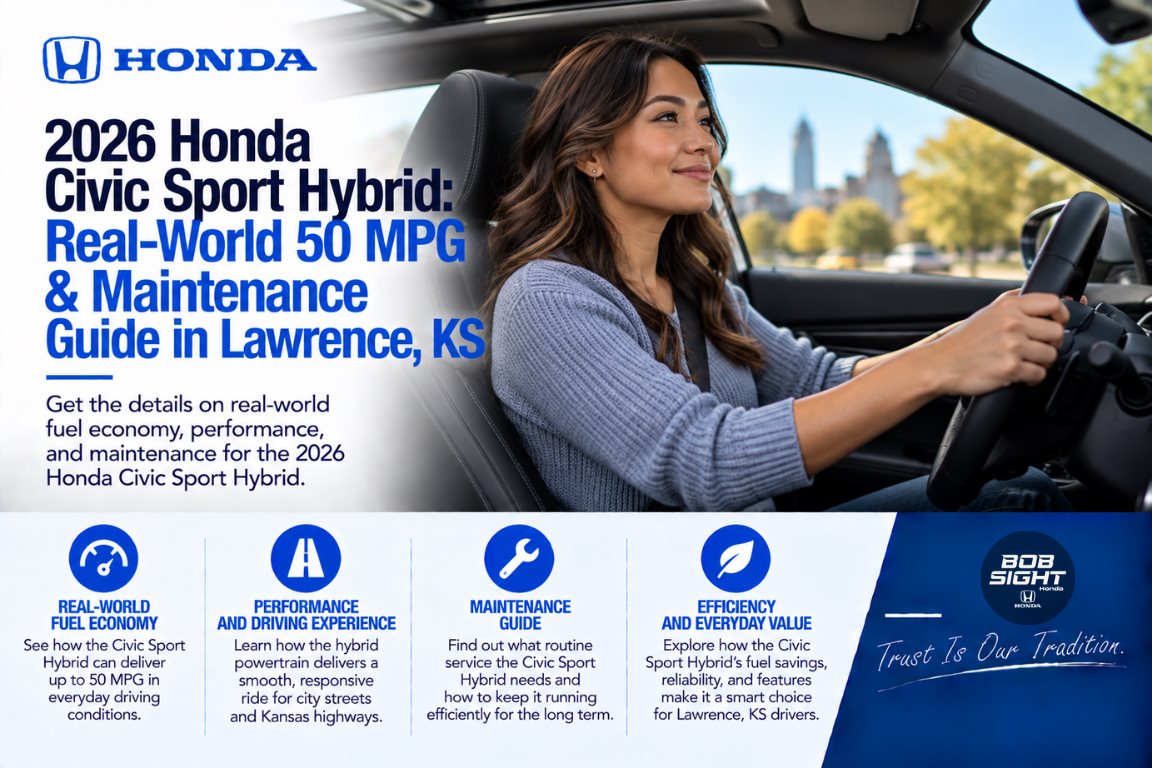
The 2026 Honda Civic Sport Hybrid Sedan combines fuel-conscious commuting with responsive performance for drivers across Lawrence and the Kansas City metro. At Bob Sight Honda in Lawrence, Kansas, shoppers can explore how this hybrid sedan fits daily travel through Douglas County, Johnson County, and nearby communities. Whether your commute includes Interstate 70, Kansas Highway 10, or stop-and-go traffic near the University of Kansas campus, understanding fuel economy and maintenance helps you make an informed ownership decision.
The starting point is knowing the difference between an EPA estimate and your own results. The 2026 Civic Sport Hybrid Sedan carries EPA-estimated ratings of 50 MPG city, 47 MPG highway, and 49 MPG combined. These ratings help shoppers compare vehicles, but they do not promise 50 MPG on every trip. Your mileage will vary with driving conditions, vehicle maintenance, weather, load, and driving habits.
This guide explains those ratings, outlines practical maintenance planning, and highlights features worth trying during a test drive. Explore our new Honda inventory for available Civic sedans, then ask our team about the model year, trim, and equipment of a specific vehicle. Inventory changes, so confirming availability before visiting is helpful.
In This Guide You Will Learn
- What the Civic Sport Hybrid Sedan's EPA fuel economy ratings mean for daily commuting.
- How the two-motor hybrid system uses gasoline and electricity without plug-in charging.
- How to plan maintenance using Honda's Maintenance Minder and the owner's manual.
- What to compare when choosing between a gas Civic Sport and a Civic Sport Hybrid.
- How seasonal weather and driving habits can influence fuel consumption.
- Which comfort and technology features come with the Sport Hybrid trim.
- What to ask about financing, warranty coverage, and ownership costs before purchasing.
1. Understanding Civic Sport Hybrid MPG and Two-Motor Hybrid Performance
The 2026 Honda Civic Sport Hybrid Sedan pairs a 2.0-liter four-cylinder engine with Honda's two-motor hybrid system. It produces 200 total system horsepower. Honda separately lists the electric drive motor's torque at 232 lb-ft. That distinction matters: the motor torque figure should not be presented as a combined engine-and-motor torque rating.
The system can use battery power to drive the vehicle, use the gasoline engine to generate electricity, or send engine power directly to the wheels under suitable conditions. The vehicle manages these operating choices automatically. You do not need to select a different propulsion setting every time traffic speeds change along Iowa Street or K-10.
Electric-only operation depends on factors such as battery charge, temperature, speed, and power demand. A low-speed drive through Lawrence does not guarantee that the gasoline engine will remain off. Likewise, highway travel does not mean the engine stays in one fixed operating mode throughout the trip. The system adjusts as conditions change.
The sedan's 50 MPG city rating is higher than its 47 MPG highway rating, with a 49 MPG combined estimate. Use the combined number as a comparison point for mixed driving rather than assuming every route will return the city figure. A winter commute, short errands, or sustained higher-speed driving can produce different results.
The fuel tank holds 10.6 gallons, but tank capacity multiplied by an EPA rating is only a theoretical calculation, not a guaranteed driving range. For trip planning, use your recent observed economy and fuel gauge, allow a reserve, and choose reasonable refueling stops. How many days you can commute between fill-ups depends on your actual route, mileage, and operating conditions.
2. Practical Ways to Support Fuel Economy Around Lawrence
Consistent driving habits can help you make effective use of the hybrid system without chasing a particular MPG number on every trip. The Sport Hybrid offers ECON, Normal, and Sport drive modes, along with steering-wheel-mounted deceleration selectors. Familiarize yourself with their operation while parked and follow the owner's manual when using them on the road.
For daily trips between Lawrence, Eudora, and nearby communities, focus on these practical habits:
- Accelerate smoothly: Leave enough space to respond gradually to traffic changes. Avoid repeated hard acceleration followed by unnecessary braking. Safe, predictable progress is more useful than trying to force electric-only operation.
- Try ECON mode: Compare its response with Normal mode during ordinary driving. Choose the mode that suits conditions and your preferences. Selecting ECON does not guarantee a specific fuel economy result.
- Learn the deceleration selectors: These paddles adjust deceleration associated with regenerative braking. They are different from the gas Sport's transmission paddle shifters. Regeneration availability can change with operating conditions, so use the brake pedal whenever needed.
- Review economy information after driving: Compare results over several tanks rather than judging the vehicle from one short trip. Check displays only when it is safe, and keep your attention on traffic.
There is no need to use pulse-and-glide techniques, coast in neutral, or drive below a safe traffic speed to pursue a better number. Maintain appropriate following distance, obey posted limits, and anticipate stops when conditions allow. A comfortable driving routine is easier to maintain than constant adjustments made solely to influence the MPG display.
Vehicle condition also matters. Check cold tire pressures against the driver's doorjamb label, address warning lights, and avoid carrying unnecessary cargo. If you notice a sustained economy decline, compare weather, trip length, and tire condition before assuming the hybrid battery needs replacement.
3. Scheduled Maintenance and Ownership Cost Planning
The Civic Sport Hybrid still needs engine oil service, tire care, brake inspections, filters, and other maintenance. Hybrid operation does not eliminate those responsibilities. For service timing, use the vehicle's Maintenance Minder messages together with the model-specific owner's manual, including its time-based requirements and guidance for demanding operating conditions.
A general mileage chart should not replace those instructions. Two owners may accumulate similar mileage under very different conditions. Bring your current maintenance codes, service history, and any concerns to the Bob Sight Honda service department so the recommended work can be explained for your vehicle.
- Engine oil and filter: Follow the indicated service and manual requirements. Confirm the correct oil specification for the hybrid engine. Do not automatically apply a universal 7,500-mile or 10,000-mile interval simply because the car uses a hybrid powertrain.
- Tires and alignment: Follow rotation guidance, check pressures, and inspect tread. An alignment inspection may be appropriate after an impact or when the vehicle pulls or develops uneven wear. Tire rotation and alignment are different services.
- Brake system: Inspect the friction brakes and address changes in pedal feel, unusual noise, or vibration. Regenerative braking may reduce friction-brake use, but it does not establish a guaranteed replacement mileage.
- Filters and cooling systems: Follow the indicated service and manual guidance. Dusty conditions can affect filter needs. Ask the technician to identify the relevant component rather than treating every filter and fluid as due at the same mileage.
- Transmission or drive-unit fluid: Use the exact fluid and procedure specified for the hybrid model. Its drive system differs from the gas Civic's conventional CVT. A generic product described as "e-CVT fluid" is not a sufficient specification.
For a realistic budget, request an itemized estimate showing the services due, parts or fluids, labor, and applicable fees. Ask which work is required by the maintenance guidance and which work is being recommended because of an observed condition. That conversation provides more useful cost planning than an unsupported promise that hybrid maintenance will always cost less.
Keep receipts and record the date and mileage of each visit. If you split your service between different providers, bring those records so completed work is not unnecessarily repeated. A clear history also helps when comparing upcoming maintenance with your household budget.
What to Share When Scheduling a Maintenance Visit
Include the vehicle's mileage, the maintenance message shown on the display, and the date of its last service. Mention whether most trips are short errands, longer highway drives, or a mixture of both. If something has changed, describe when you notice it rather than trying to diagnose the cause yourself.
For example, tell the service advisor whether a vibration occurs while braking, at a certain speed, or only after the vehicle has been parked overnight. Let the team know about a recent pothole impact, tire replacement, or repair. These details help make the appointment more productive and give the technician useful context.
4. Comparing the Gas Civic Sport and Civic Sport Hybrid
Choosing between the gas Civic Sport and Civic Sport Hybrid involves more than comparing monthly payments. Consider the purchase price, expected mileage, fuel consumption, insurance quotes, and how each vehicle feels on the road. Both trims offer a sporty appearance, but their powertrains and driving responses differ.
The 2026 gas Civic Sport Sedan uses a 2.0-liter engine rated at 150 horsepower and 133 lb-ft of engine torque, paired with a conventional continuously variable transmission. Its EPA-estimated ratings are 31 MPG city, 39 MPG highway, and 34 MPG combined. It can be worth considering if its available purchase terms and equipment fit your needs.
The Sport Hybrid adds electric assistance and has a higher total system horsepower rating. Its fuel economy advantage on the EPA combined cycle provides a useful starting point for comparison, but the financial benefit depends on what you pay for each vehicle and how much you drive.
To estimate annual fuel use, divide your yearly mileage by the MPG figure you are using. Multiply those gallons by an assumed fuel price, using the same price for both vehicles. Treat the result as a planning scenario. Actual fuel prices and your observed mileage can change the outcome.
A back-to-back test drive can help you judge acceleration, braking feel, ride comfort, and visibility. Ask about both configurations when reviewing our available new Honda vehicles. Compare written quotes for the actual vehicles under consideration, including equipment and any optional products, before deciding which offers the better ownership fit.
5. Winter Weather and Seasonal Commuting in Kansas
Cold weather can change fuel economy, so a winter MPG decrease does not automatically indicate a defect. Short trips and cabin heating needs can affect how often the gasoline engine runs. Comparing a brief January errand with a longer mild-weather commute is unlikely to provide a fair picture of the vehicle's overall efficiency.
For Lawrence drivers, seasonal preparation should focus on visibility, traction, and dependable operation. Clear snow and ice from the vehicle before driving, keep washer fluid appropriate for expected temperatures, and inspect wiper performance. Leave additional following distance when pavement is wet, snowy, or icy.
The Sport Hybrid's heated front seats can add comfort, but they do not replace the need to maintain a clear windshield and appropriate cabin temperature. Use the defroster whenever necessary. Avoid treating any climate-control setting as a guaranteed way to keep the engine off or achieve a specific fuel economy result.
Check cold tire pressures as temperatures change, using the doorjamb label rather than the maximum pressure molded into the tire sidewall. Inspect tread and ask about tire choices that suit your driving needs. The Bob Sight Honda Tire Center is a useful next step when you need help evaluating tire condition or replacement options.
Road salt and grime also deserve attention. Clean the vehicle according to the owner's manual and use a wash facility suitable for the vehicle when needed. Have persistent brake noise, warning messages, or unusual operation checked rather than assuming they are normal winter behavior.
6. Cabin Technology and Daily Commuter Comfort
The Sport Hybrid trim includes convenience features that are useful to evaluate during an ordinary commute. Standard equipment includes heated front seats, dual-zone automatic climate control, and a one-touch power moonroof. Active Noise Cancellation is also included, although perceived cabin noise depends on pavement, tires, speed, and other conditions.
Its infotainment equipment includes a 7-inch color touchscreen and a 180-watt audio system with eight speakers. Apple CarPlay and Android Auto compatibility use a wired connection on this trim. Do not assume that wireless smartphone integration or the larger screen from the Sport Touring Hybrid is included on the Sport Hybrid.
During a visit, connect your compatible phone and check the functions you use most often. Try navigation prompts, audio controls, and the placement of charging connections while parked. This is also a good opportunity to adjust the seat and steering wheel and confirm that the displays are comfortable to read.
The sedan has seating for five, a 60/40 split-folding rear seatback, and a listed trunk volume of 14.8 cubic feet. Cargo volume alone cannot tell you whether a particular stroller, suitcase, or sports bag will fit easily. If practical, bring the items you regularly carry and check the opening, loading height, and available space.
For households traveling between Lawrence, Topeka, and the Kansas City area, comfort deserves as much attention as the specification sheet. Have regular passengers try the rear seat, assess visibility from your driving position, and consider whether the sedan body style works for your usual errands and longer trips.
7. Honda Sensing and Other Driver Assistance Features
The 2026 Civic Sport Hybrid includes Honda Sensing driver assistance features. These systems support the driver within their operating limits. They do not make the vehicle autonomous, guarantee collision avoidance, or remove the need to watch the road and control the vehicle.
- Collision Mitigation Braking System: Can provide warnings and braking assistance when it detects certain potential frontal collisions. Detection and response depend on conditions.
- Adaptive Cruise Control with Low-Speed Follow: Can help maintain a selected following interval behind a detected vehicle, subject to operating limits.
- Lane Keeping Assist System: Can provide steering assistance when applicable lane markings and other operating conditions permit.
- Road Departure Mitigation System: Can provide alerts and assistance in certain detected road-departure situations.
The Sport Hybrid also includes a Blind Spot Information System and rear Cross Traffic Monitor. Ask for a demonstration of their indicators and controls. Review the owner's manual for operating conditions, limitations, and circumstances that can affect detection.
Rain, snow, dirty sensors or camera areas, and unclear road markings can affect driver assistance performance. Before relying on any feature during a commute, understand what it can detect and what actions remain your responsibility. No system replaces checking mirrors, looking over your shoulder when appropriate, or verifying that the path is clear.
8. A Buyer Checklist for Transitioning to a Hybrid Sedan
A practical buying process connects the Civic Sport Hybrid's features with your actual driving needs and budget. Bring a list of questions so your visit covers more than exterior color and monthly payment. These steps can help organize the conversation:
- Review your driving pattern: Estimate annual mileage and how much driving involves city streets, highways, and short trips. Use those details when comparing fuel economy and ownership scenarios.
- Prepare your trade information: Gather mileage, payoff information if applicable, service records, and details about condition. Start with our Value Your Trade tool, understanding that an online estimate is not a guaranteed final offer.
- Confirm availability and arrange a test drive: Ask which Civic trims are available and compare suitable vehicles when possible. Evaluate acceleration, braking response, seating, and the controls you will use daily.
- Review financing and ownership terms: Visit our finance department resources and discuss available options. An application does not guarantee approval, a particular rate, or a particular payment. Review the written terms before agreeing.
Ask for the out-the-door price, loan term, APR, amount financed, and total payment information. Separate the vehicle purchase from optional protection products so you understand what each item costs. Request a clear explanation of included factory warranty coverage and any separately purchased service contract.
Build a Test Drive Around Your Everyday Priorities
Before arriving, choose three things that matter most to you. These might be a comfortable driving position, straightforward phone connectivity, and enough cargo space for your weekly routine. Having specific priorities helps you evaluate the vehicle without being distracted by features you may rarely use.
Ask the dealership about an appropriate test route and available appointment time. When conditions permit, experience a mix of local streets and higher-speed travel. Notice whether you can reach the controls comfortably, how the brakes respond, and how easily you can see surrounding traffic. Compare your observations with the gas model if both vehicles are available.
Quick Facts: 2026 Honda Civic Sport Hybrid Sedan
- Powertrain: 2.0-liter four-cylinder engine with a two-motor hybrid system and front-wheel drive.
- Output: 200 total system horsepower; electric drive motor torque is rated at 232 lb-ft.
- EPA fuel economy: 50 MPG city, 47 MPG highway, and 49 MPG combined. Actual mileage varies.
- Fuel: Regular unleaded gasoline; no plug-in charging required.
- Drive modes: ECON, Normal, and Sport.
- Wheels: 18-inch gloss-black alloy wheels.
- Comfort: Heated front seats, dual-zone automatic climate control, and a power moonroof.
- Connectivity: 7-inch touchscreen with wired Apple CarPlay and Android Auto compatibility.
- Driver assistance: Honda Sensing features, Blind Spot Information, and rear Cross Traffic Monitor.
Ownership Planning for Kansas City Metro Drivers
Long-term ownership planning starts with realistic expectations and a record of what your vehicle actually needs. Track fuel use over several tanks, keep service receipts, and note any changes in starting, braking, or driving behavior. Those details help turn a vague concern into a more useful service conversation.
Consider expenses beyond fuel, including insurance, tires, registration, financing, and maintenance. A vehicle can have a strong EPA economy rating and still require a careful household budget. Comparing the full ownership picture helps you decide whether the Sport Hybrid fits your priorities over the time you expect to keep it.
Before a service visit, review the displayed maintenance messages and your recent records. Ask for the specified fluids and an explanation of the work being recommended. You can schedule Honda service in Lawrence and discuss current concerns with our team.
Use Your First Few Months to Refine Your Budget
Once you have several months of driving information, compare your original assumptions with your actual experience. Review fuel purchases, mileage, insurance costs, and any service expenses. Your own records provide a better basis for planning than a single dashboard reading or another owner's results.
Revisit the budget when your routine changes. A new job, more highway travel, or additional family errands can change annual mileage and fuel spending. Keeping the estimate current helps you plan for upcoming care while understanding how the vehicle fits your household over time.
Frequently Asked Questions
Does the 2026 Honda Civic Sport Hybrid require plug-in charging?
No. The Civic Sport Hybrid does not require an outlet or public charging station. Its battery receives energy through regenerative braking and engine-driven generation. You refuel with gasoline rather than connecting a charging cable. This can be convenient for drivers whose homes or apartments do not have charging equipment.
The battery is an energy storage component, not a source of unlimited free energy. Your driving conditions still influence gasoline consumption, and the engine may operate even at low speeds. The vehicle manages the energy flow automatically during normal use.
Is 50 MPG guaranteed during my commute?
No. The 50 MPG figure is the EPA city estimate for the 2026 Civic Sport Hybrid Sedan. The highway and combined estimates are different. Your actual mileage depends on conditions such as temperature, speed, trip length, traffic, load, and maintenance. Compare results across several tanks instead of relying on a single drive.
If your commute is mostly highway driving between Lawrence and another community, do not budget fuel costs using the city rating alone. Use an appropriate comparison estimate and adjust the budget after you have reliable information from your own driving.
What warranty applies to the hybrid battery?
Honda describes high-voltage battery capacity limited warranty coverage of eight years or 100,000 miles, whichever comes first. Coverage is subject to the applicable warranty terms, exclusions, and eligibility requirements. This is not a promise that every hybrid component or every type of battery concern receives identical coverage.
Ask Bob Sight Honda to review the warranty booklet applicable to the vehicle you are considering. Confirm the original in-service date, mileage, component involved, and any state-specific provisions. Factory warranty coverage and an optional vehicle service contract are separate items and should be explained separately.
How long will the brake pads last?
There is no single brake-pad replacement mileage that can be promised for every Civic Sport Hybrid. Regenerative braking can reduce friction-brake use, but wear also depends on driving habits, operating conditions, and component condition. Do not assume the pads will last 80,000 or 100,000 miles without inspection.
The friction brakes remain part of normal vehicle operation. Have them inspected as directed and address symptoms promptly. If a technician recommends replacement, ask about measured wear and the condition of the related components so you understand the reason for the recommendation.
What should I do if a hybrid system warning appears?
Follow the message displayed by the vehicle and the instructions in the owner's manual. A hybrid system fault is different from the normal movement of the battery charge display. Do not assume the vehicle can continue on gasoline alone or that a special backup mode will let you reach a service facility.
If the vehicle instructs you to stop, or it loses power or behaves abnormally, move to a safe location when possible and arrange assistance. Do not attempt to repair high-voltage components. Describe the message and symptoms when contacting a service professional, and confirm any roadside assistance eligibility rather than assuming coverage.
Why Shop or Schedule Service at Bob Sight Honda in Lawrence?
Bob Sight Honda helps drivers in Lawrence, Eudora, Baldwin City, Topeka, Olathe, and surrounding communities explore Honda vehicles and plan ongoing care. Whether you are comparing the Civic Sport Hybrid with another Honda or asking about a maintenance message, a useful conversation begins with your needs, driving habits, and budget.
Bring your questions about trim equipment, smartphone compatibility, cargo space, financing, or service. Our team can help you review available vehicles and discuss the next step. For an existing vehicle, providing mileage, maintenance records, and the exact warning or service code makes it easier to explain your concern.
Visit Bob Sight Honda at 2851 Iowa Street, Lawrence, KS 66046. Confirm current hours and vehicle availability before making the trip. Trust Is Our Tradition.
Helpful Links
- Shop New Honda Inventory
- Value Your Trade
- Explore Honda Financing
- Schedule Honda Service
- Honda Service Department
- Service Specials
- Honda Tire Center
Explore More from Bob Sight Auto Group
Bob Sight Honda is part of Bob Sight Auto Group, with Honda and CDJR dealerships in Lawrence, Kansas, Ford in Lee's Summit, Missouri, and Kia in Independence, Missouri. Explore our locations for vehicle shopping and service information across the group.