2026 Honda Odyssey vs. Toyota Sienna for Lawrence Families: Which Handles Car Seats, Carpools, and Road Trips Better?
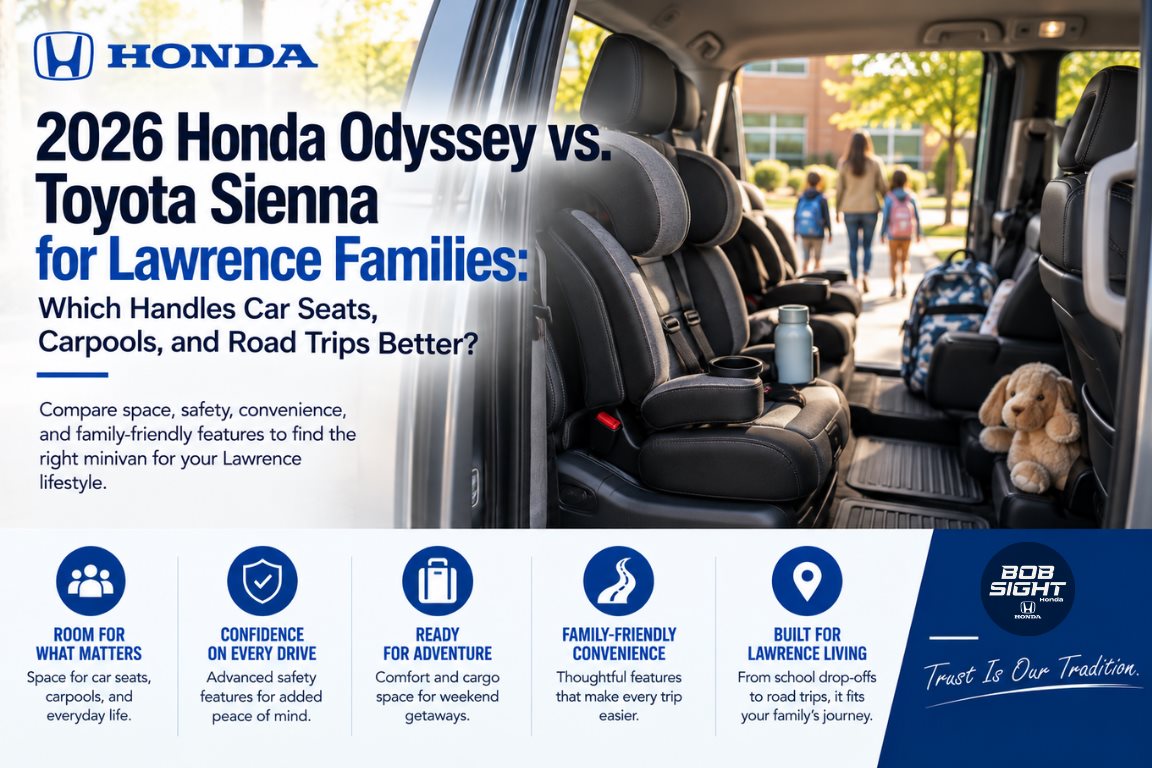
Browse the 2026 Honda Odyssey at Bob Sight Honda
The 2026 Honda Odyssey is the stronger minivan for many Lawrence families focused on car-seat access, flexible second-row seating, carpools, and maximum cargo versatility, while the Toyota Sienna emphasizes hybrid efficiency and available all-wheel drive. The Odyssey's Magic Slide second-row seats can move laterally when the center seat is removed, helping parents reach children or open a pathway to the third row. Its second-row seats can also be removed when maximum cargo space is needed. The Sienna offers a standard hybrid powertrain and available electronic all-wheel drive, but its second-row packaging follows a different approach.
This comparison is intentionally centered on real family routines rather than repeating a broad minivan-versus-minivan overview. Parents need to know how sliding doors, second-row seats, child-restraint access, third-row entry, cargo space, cabin monitoring, and road-trip comfort work together. A specification can look impressive while creating a compromise during school drop-off or a long trip. The better minivan is the one that makes the family's busiest normal day easier.
At Bob Sight Honda in Lawrence, Kansas, families can explore how the Odyssey's seating and cargo systems fit their routines. This guide also provides a fair comparison with the 2026 Toyota Sienna's hybrid and AWD strengths. Shoppers from Topeka, Eudora, Baldwin City, Olathe, Overland Park, Douglas County, and the Kansas City Metro can use these details to decide which features deserve hands-on testing.
In This Guide You’ll Learn
This guide compares the 2026 Odyssey and Sienna by examining the family tasks that place the greatest demands on a minivan. It focuses on child-restraint installation, second-row flexibility, third-row access, carpool seating, luggage space, road-trip comfort, winter driving, and everyday powertrain behavior. It also explains which features should be tested with your own family. The goal is to help shoppers choose a usable cabin rather than the longest equipment list.
- How Odyssey Magic Slide seats differ from Sienna second-row seating
- Which minivan better supports multiple car seats
- How third-row access changes when child restraints are installed
- Which van provides more maximum cargo flexibility
- How V6 and hybrid powertrains compare during family travel
- Why the Sienna's available AWD matters to some Kansas drivers
- What to test before choosing a family minivan
Features, seating arrangements, child-restraint anchors, cargo measurements, and powertrains vary by trim and configuration. Always inspect the exact vehicle and review both the vehicle owner's manual and child-restraint instructions. A safe installation depends on the specific seat, seating position, passenger needs, and manufacturer guidance. Dealership staff can demonstrate vehicle features but should not replace a qualified child-passenger-safety professional.
2026 Honda Odyssey vs. Toyota Sienna at a Glance
The Odyssey leads in maximum cargo capacity, removable second-row flexibility, and V6 output, while the Sienna leads in fuel economy and offers available all-wheel drive. Both minivans can seat seven or eight depending on configuration. Both provide dual sliding side doors, fold-flat third rows, family-focused storage, and modern driver-assistance technology. Their strongest differences involve the powertrain and second-row design.
| 2026 Family Comparison | Honda Odyssey | Toyota Sienna |
|---|---|---|
| Powertrain | 3.5-liter V6 | 2.5-liter four-cylinder hybrid system |
| Output | 280 horsepower | 245 net combined horsepower |
| Transmission | 10-speed automatic | Electronically controlled continuously variable transmission |
| Drivetrain | Front-wheel drive | Front-wheel drive or available electronic all-wheel drive |
| Seating | Up to eight | Seven or eight, depending on configuration |
| Second-Row Design | Magic Slide seats with removable center seat and removable outboard seats | Long-slide captain's chairs on qualifying seven-seat versions or second-row bench on eight-seat configurations |
| Cargo Behind Third Row | 32.8 cubic feet | Approximately 33.5 cubic feet |
| Maximum Cargo Volume | Up to 140.7 cubic feet with second-row seats removed | Up to approximately 101.0 cubic feet |
| EPA Fuel Economy | 19 city, 28 highway, and 22 combined mpg | Hybrid estimates vary by drivetrain, with front-wheel-drive versions reaching approximately 36 mpg combined |
| Primary Family Strength | Seating access and maximum cabin reconfiguration | Hybrid efficiency and available AWD |
The Sienna has a slight published advantage in cargo volume behind the third row, which can help when every seat remains in use. The Odyssey creates its largest advantage when the third row is folded and the second-row seats are removed. This allows the cargo floor to support significantly larger loads. The tradeoff is that the removable seats must be taken out manually and stored outside the vehicle.
The powertrain difference affects the ownership experience. The Odyssey's V6 and conventional 10-speed automatic provide strong acceleration with a familiar gasoline-only layout. The Sienna's hybrid system emphasizes fuel efficiency, particularly during repeated city and suburban driving. Families should test both because sound, acceleration, braking feel, and power delivery differ.
Which Minivan Is Better for Car Seats?
The Honda Odyssey is often the more flexible car-seat minivan because its second-row Magic Slide seats can move laterally when the center seat is removed, helping parents create access to children or the third row. The best installation still depends on the child-restraint model and the seating positions approved by both manufacturers. The Odyssey's flexible seat movement can reduce the need to climb across the cabin. The Sienna provides useful second-row travel but does not offer the same lateral Magic Slide function.
Car-seat compatibility involves more than finding a lower anchor. Parents should check the complete vehicle seat shape, head restraint, seat-belt geometry, top-tether anchor, recline angle, and space needed by the child restraint. Some installations use lower anchors, while others require the vehicle seat belt. Follow the child-restraint manual and vehicle owner's manual together.
The Odyssey supports multiple child-restraint positions across its three rows, but anchor availability and approved methods vary by seating position. The center and outboard second-row positions can serve different family arrangements. The third row also provides tether and lower-anchor locations specified by Honda. Parents should verify the exact 2026 manual rather than relying on a diagram from another model year.
The Sienna also provides LATCH locations across selected second- and third-row positions. Seven-passenger and eight-passenger configurations use different second-row seating. Long-slide captain's chairs can create generous legroom and fore-aft adjustment, while the eight-passenger bench adds a center seating position. Neither arrangement should be assumed to fit every combination of rear-facing, forward-facing, and booster seats.
Use this car-seat comparison process:
- Bring the actual child restraints. A demonstration seat may have different dimensions or installation requirements.
- Read both manuals. Confirm approved positions, anchors, recline, and seat-belt routing.
- Set the front seats for regular drivers. Make sure a rear-facing seat does not force an unsafe driving position.
- Install each seat using one approved method. Do not combine lower anchors and a seat belt unless both manufacturers explicitly permit it.
- Test third-row access. Determine whether passengers can enter without disturbing an installed restraint.
- Check buckle access. Booster riders must be able to reach and use the correct buckle.
- Consult a qualified technician. A certified child-passenger-safety technician can help verify installation.
A Lawrence family with two rear-facing seats and an older child using the third row may find the Odyssey's lateral seat movement valuable. Moving an outboard second-row seat toward the center can create an aisle along one side. The Sienna's sliding captain's chairs move forward and backward over a long range, which can also support passenger access. Test the exact family arrangement rather than declaring one design universally superior.
How Magic Slide Seats Change Daily Family Use
Honda Magic Slide second-row seats allow Odyssey owners to change the cabin around passengers instead of asking passengers to work around a fixed layout. After the removable center seat is taken out, the outboard seats can slide laterally. This can create an aisle along one side, move a child closer to the front passenger, or separate siblings. The seats also slide forward and backward.
The lateral function can simplify school drop-off. A child seated in the third row may use an open pathway on the curb side while another child remains secured in the second row. Parents can move a second-row passenger closer to the center for easier reach from the front. The system also provides flexibility when an adult needs to sit beside a child.
Magic Slide can support carpools because seat positions can change when the passenger mix changes. A family may use the second-row center seat for maximum eight-person capacity on one day and remove it for easier third-row access on another. The outboard seats are also removable, creating additional cargo capacity when passenger seating is not needed. Removal requires physical handling and suitable storage outside the vehicle.
The Sienna's second row follows a different philosophy. Qualifying seven-passenger configurations use long-slide captain's chairs that can move through a wide fore-aft range. This can provide substantial second-row legroom or create access to the third row. The seats are not designed around the Odyssey's lateral sliding and removal strategy.
Families should compare the effort required to reconfigure each van. Operate every handle, slide each seat, move a captain's chair, fold the third row, and practice access with child restraints. A feature is valuable only if regular caregivers can use it confidently. Grandparents, babysitters, and older children may interact with the seating differently.
Which Minivan Is Better for Carpools?
The Odyssey is the more adaptable carpool minivan because it combines eight-passenger capacity with a removable center seat and lateral second-row movement. The Sienna also offers seven- and eight-passenger configurations, but its seating arrangement is more dependent on the selected trim. Carpool usefulness involves entry, buckle access, seating separation, and storage for backpacks or sports equipment. Maximum capacity alone does not reveal how easily children can use the cabin.
Sliding doors are an important advantage in both minivans. They create a wide entry without swinging into nearby vehicles in a school or activity parking lot. Power operation can help when the driver's hands are full. Children must still wait until the door is fully open and the driver confirms that exiting is safe.
The Odyssey's removable second-row center seat makes it possible to preserve eight-person capacity or create an open center area. When the center seat is removed, the outboard Magic Slide seats can move toward or away from the center. This helps families create a preferred pathway and separate passengers. It can also improve adult reach to a child.
The Sienna's eight-passenger configuration uses a second-row bench, while many higher trims use captain's chairs and seat seven. Buyers must select the desired passenger count at the trim and configuration stage. A seven-seat Sienna may provide easier movement between captain's chairs, while an eight-seat Sienna supports one additional passenger. Confirm seating before becoming attached to a particular trim.
For a carpool around Lawrence, check where backpacks and sports gear will go while every passenger seat is occupied. Both vans provide substantial space behind the third row, but the Sienna has a slight published advantage in that specific measurement. The Odyssey's deep rear cargo area remains practical for daily bags. Load management is important because loose items can become hazards during sudden braking.
Third-Row Access With Children and Car Seats
The Odyssey provides more ways to create a third-row path around installed second-row car seats, while the Sienna provides long fore-aft seat travel on qualifying captain's-chair configurations. Neither van guarantees easy access with every child-restraint combination. A seat installed with a top tether or rigid lower anchors may limit how the vehicle seat moves. Families should test access after installing the seats they own.
Many vehicles advertise seats that tilt or slide for third-row access, but an installed child restraint can change the process. Tilting a seat may not be permitted or practical with a child restraint attached. Removing the child and restraint at each stop defeats the convenience. The Odyssey's ability to create a side aisle can reduce reliance on tilting.
In an Odyssey, removing the second-row center seat allows an outboard Magic Slide seat to move laterally. A third-row passenger may enter along the opposite side without folding the occupied seat. This can be useful when a rear-facing child remains installed in the second row. The exact arrangement depends on seat dimensions and approved positions.
In a seven-passenger Sienna, the open space between captain's chairs can provide a central pathway. The long-slide seats can also adjust fore and aft to redistribute legroom. This arrangement may work well when the second-row car seats do not extend into the center aisle. Wide or rotating child restraints can change available space.
Third-row passengers also need usable buckle and tether access. A booster rider should be able to buckle correctly without placing the shoulder belt under an arm or behind the back. Forward-facing restraints should use the top tether when required. Ask a certified child-passenger-safety technician to evaluate the installation if you are uncertain.
Which Has Better Cargo Space for Road Trips?
The Odyssey provides the greater maximum cargo capacity, while the Sienna offers slightly more published space behind the third row when all rows remain in use. Honda lists 32.8 cubic feet behind the Odyssey's third row and up to 140.7 cubic feet behind the first row with second-row seats removed. Toyota lists approximately 33.5 cubic feet behind the Sienna's third row and about 101.0 cubic feet at maximum. The difference reflects their second-row designs.
| Family Cargo Situation | 2026 Honda Odyssey | 2026 Toyota Sienna |
|---|---|---|
| All Three Rows in Use | 32.8 cubic feet behind third row | Approximately 33.5 cubic feet behind third row |
| Third Row Folded | Up to 86.6 cubic feet behind second row | Approximately 75.2 cubic feet behind second row |
| Maximum Cargo Configuration | Up to 140.7 cubic feet with second-row seats removed | Approximately 101.0 cubic feet |
| Second-Row Removal | Second-row seats can be removed | Second-row seats are not designed for routine removal |
The Sienna's small advantage behind the third row can be useful for a seven- or eight-person trip. Families often need every seat while still carrying luggage, groceries, a stroller, or sports gear. The shape and depth of the rear well matter as much as the total measurement. Test the largest recurring items with the third row upright.
The Odyssey's advantage grows when passenger seating can be reduced. Folding the third row creates a broad cargo area, and removing the second-row seats unlocks its maximum capacity. This can support furniture, bicycles, home-project materials, or moving supplies. Owners need a safe place to store the removed seats because they do not fold into the floor.
Sienna second-row seats remain in the vehicle and slide forward when additional rear cargo length is needed. This reduces the physical work and storage needs associated with seat removal. It also limits the maximum open cargo floor compared with the Odyssey. Families should decide whether they value maximum volume or easier retention of the second-row seats.
Use this road-trip cargo test:
- Set every seat for the actual passenger count. Avoid beginning with an unrealistic empty cabin.
- Load the largest items first. Start with strollers, coolers, suitcases, mobility equipment, or sports bags.
- Preserve rear visibility. Do not stack unsecured items into the driver's sightline.
- Keep emergency items accessible. Do not bury roadside supplies beneath the entire load.
- Check liftgate clearance. Confirm that the door can close without pressing against cargo.
- Secure loose objects. Use appropriate tie-down points and cargo organizers.
- Recheck tire pressure and load limits. A fully loaded minivan operates differently from an empty one.
A family driving from Lawrence to Kansas City International Airport may prefer the slight Sienna advantage behind the third row if every seat is filled. A family of four carrying bicycles or large equipment may prefer the Odyssey's removable-seat versatility. The best cargo design depends on how often the van carries maximum passengers versus maximum gear. Do not choose by one maximum number.
V6 Performance vs. Hybrid Efficiency
The Odyssey provides stronger published output and a conventional V6 driving experience, while the Sienna uses a hybrid system to deliver substantially higher fuel-economy estimates. Honda equips the 2026 Odyssey with a 3.5-liter V6 producing 280 horsepower and 262 pound-feet of torque. A 10-speed automatic transmission sends power to the front wheels. Toyota equips the Sienna with a 2.5-liter four-cylinder hybrid system producing 245 net combined horsepower.
The Odyssey's V6 provides confident acceleration for merging, passing, and carrying a full passenger load. The 10-speed automatic selects from defined gear ratios and includes paddle shifters. Families entering K-10 from a short ramp may appreciate the responsive power delivery. Actual performance depends on load, road grade, weather, and driver input.
The Sienna's hybrid system combines gasoline and electric power through an electronically controlled continuously variable transmission. Electric-motor assistance supports low-speed operation and city driving. Regenerative braking captures some energy during deceleration and stores it in the hybrid battery. The van refuels with gasoline and does not require external charging.
The Odyssey carries EPA estimates of 19 mpg city, 28 mpg highway, and 22 mpg combined. Sienna front-wheel-drive configurations reach approximately 36 mpg combined, while available AWD versions carry slightly different estimates. Actual fuel economy varies with temperature, speed, trip length, traffic, passenger load, climate control, tire pressure, and driving habits. Kansas winter temperatures can reduce hybrid and gasoline efficiency.
Families should test both powertrains rather than deciding from horsepower or mpg alone. The Odyssey and Sienna sound and respond differently during acceleration. Hybrid regenerative braking can also feel different from a conventional system. A back-to-back test should include city speeds, highway merging, gradual braking, and a simulated full-family load when practical.
Front-Wheel Drive vs. Available AWD in Kansas
The Toyota Sienna has the drivetrain advantage for buyers who specifically require all-wheel drive, while the front-wheel-drive Odyssey can remain a practical year-round family vehicle with suitable tires and responsible winter driving. The Odyssey does not offer AWD for 2026. The Sienna offers electronic on-demand all-wheel drive on qualifying configurations. Neither drivetrain eliminates the importance of tire grip.
All-wheel drive can direct power to additional wheels during acceleration. This can help a minivan begin moving on snow, climb a slippery grade, or maintain traction as road conditions change. It does not provide an equal improvement in braking distance because every modern minivan already uses brakes at all four wheels. Ice can limit acceleration, steering, and braking regardless of drivetrain.
Front-wheel drive places the engine and driven wheels at the front, which provides predictable daily behavior and efficient packaging. A front-wheel-drive Odyssey with high-quality winter tires may outperform an AWD minivan with worn all-season tires during braking and cornering. Tires create the connection between the vehicle and road. Tread, rubber compound, pressure, and temperature all matter.
Lawrence winters include dry cold, snow, freezing rain, slush, and rapid temperature changes. A family able to delay travel during severe weather may not need AWD as much as one that must use rural roads before they are treated. Drivers near Baldwin City or Eudora may encounter different plowing and road conditions from commuters using central Lawrence streets. Evaluate the most demanding recurring route.
The Sienna's AWD option is a legitimate advantage for families that prioritize power distribution during winter acceleration. The Odyssey counters with stronger maximum cargo flexibility and Magic Slide seating. Choosing AWD may require accepting a different cabin system and driving experience. The decision should reflect how often drivetrain capability matters compared with daily seating access.
Which Minivan Has Better Family Technology?
The Odyssey emphasizes family communication and cabin visibility through available CabinWatch and CabinTalk features, while both minivans offer infotainment, smartphone integration, driver-assistance technology, and available rear entertainment. Families should focus on which systems solve real problems. A larger screen does not automatically improve a trip. Controls should remain understandable and easy to use.
CabinWatch uses an interior camera to help the front occupants view rear passengers on the center display. The infrared capability can support visibility in low-light conditions. This can help a parent check whether a child dropped an item, removed a blanket, or needs attention. The system does not replace safely stopping when hands-on assistance is required.
CabinTalk allows the driver's voice to be broadcast through rear speakers or compatible headphones, depending on the configuration. This can reduce the need to turn around or raise one's voice. It can be useful during carpools and long trips. Drivers should still keep attention on the road and avoid prolonged interaction.
The Sienna offers its own family-focused technology, including available digital rearview mirror, camera systems, multimedia displays, connected services, and rear entertainment depending on trim. Toyota's available Driver Easy Speak feature can amplify the driver's voice through rear speakers on qualifying configurations. Equipment varies significantly, so compare exact trims rather than model-level marketing.
Both minivans include driver-assistance systems intended to support an attentive driver. The Odyssey includes Honda Sensing features such as Collision Mitigation Braking, Road Departure Mitigation, Lane Keeping Assist, and Adaptive Cruise Control with Low-Speed Follow. The Sienna includes Toyota Safety Sense technology. Weather, blocked sensors, lane markings, and other conditions can limit either suite.
Road-Trip Comfort From Lawrence to Kansas City and Beyond
The Odyssey is the stronger road-trip choice for families who prioritize seat flexibility, V6 passing power, cabin monitoring, and maximum cargo versatility, while the Sienna appeals to families focused on hybrid efficiency and available AWD. Both can support long-distance travel with three rows of passengers. Comfort depends on seating position, child-restraint placement, luggage, climate airflow, road noise, and stop frequency. Every regular passenger should test the cabin.
Second-row comfort differs by configuration. Odyssey Magic Slide seats can be repositioned laterally and fore-aft after the center seat is removed. Sienna long-slide captain's chairs can provide extensive legroom in seven-seat configurations. Greater legroom can reduce cargo or third-row space, so all rows should be adjusted together.
Third-row passengers need adequate legroom, headroom, airflow, charging access, and visibility. Both minivans provide adult-usable third rows, but comfort varies by body size and trip duration. Ask adults or teenagers who will use the third row to test it. Do not evaluate the rear cabin only from the driver's seat.
Climate control becomes important during Kansas temperature extremes. Multiple zones can help front and rear occupants remain comfortable. Sunshades, heated or ventilated seats, and remote-start capability vary by trim. Remote functions and connected services may require compatible equipment, subscriptions, or network availability.
Before a long trip from Lawrence:
- Set tire pressure while cold. Follow the driver's door-jamb label.
- Review maintenance reminders. Complete approaching service before adding substantial mileage.
- Inspect tires, brakes, lights, and wipers. Address wear or damage before departure.
- Secure every child restraint. Recheck installation and harness fit.
- Load cargo low and securely. Preserve visibility and passenger space.
- Test rear climate and charging. Avoid discovering a problem after departure.
- Plan stops. Children and adults benefit from regular breaks.
- Check weather and road conditions. Adjust the route or timing when necessary.
A trip to Kansas City, Topeka, or another Midwest destination can involve wind, construction, temperature changes, and heavy traffic. The Odyssey's stronger output may feel useful during loaded highway driving. The Sienna's fuel economy may reduce fuel stops. The better road-trip van is the one that balances passenger needs with the family's preferred powertrain.
Odyssey vs. Sienna Quick Facts for Families
The Odyssey is the more configurable family cabin, while the Sienna is the more fuel-efficient drivetrain choice with available AWD. Both seat large families and provide sliding doors, fold-flat third rows, and modern safety technology. The Odyssey's advantage is strongest when car-seat access and cargo conversion matter. The Sienna's advantage is strongest when hybrid efficiency and AWD are priorities.
- The 2026 Odyssey uses a 280-horsepower 3.5-liter V6.
- The 2026 Sienna uses a 245-horsepower hybrid system.
- The Odyssey is front-wheel drive.
- The Sienna offers front-wheel drive or available electronic AWD.
- The Odyssey seats up to eight passengers.
- The Sienna seats seven or eight, depending on configuration.
- Odyssey Magic Slide seats move laterally after the center seat is removed.
- Odyssey second-row seats can be removed for maximum cargo space.
- Sienna captain's chairs offer long fore-aft travel on qualifying seven-seat versions.
- The Odyssey provides 32.8 cubic feet behind the third row.
- The Sienna provides approximately 33.5 cubic feet behind the third row.
- The Odyssey provides up to 140.7 cubic feet of maximum cargo volume.
- The Sienna provides approximately 101.0 cubic feet of maximum cargo volume.
- The Odyssey carries an EPA combined estimate of 22 mpg.
- Front-wheel-drive Sienna configurations reach approximately 36 mpg combined.
A family with multiple car seats should begin with the Odyssey's Magic Slide system. Its ability to create a side aisle or move a child closer to the center can improve daily access. The removable second-row seats also make the Odyssey useful for large cargo when family seating is not needed. These benefits require owners to handle and store the seats during maximum cargo use.
A family with a long commute and a strong preference for AWD should compare the Sienna carefully. Its hybrid system can provide a substantial fuel-economy advantage. Available AWD may also support acceleration in changing winter conditions. Those strengths should be weighed against the Odyssey's cabin flexibility and performance.
Ownership Planning for a Family Minivan
Long-term minivan ownership requires planning for maintenance, tires, brakes, child-restraint changes, interior cleaning, passenger growth, and cargo needs. A family may own the same van through several child-seat stages. Rear-facing seats become forward-facing seats, then boosters, and eventually adult passengers. The cabin should remain useful through those transitions.
The Odyssey uses Honda's Maintenance Minder system to display oil life and maintenance codes. Codes can identify engine oil, filter, tire rotation, transmission fluid, spark plugs, coolant, brake fluid, and inspection needs. Follow the 2026 Odyssey owner's manual and keep repair records. Do not apply a generic Honda schedule without checking the exact vehicle.
The Sienna's hybrid system has different maintenance components and procedures. It does not use the same conventional powertrain arrangement as the Odyssey. Hybrid service should follow Toyota's specific guidance. AWD versions also include rear electric-drive components not found on front-wheel-drive configurations.
Both vans need tire care, brake inspection, wiper service, cabin filters, fluid checks, and seasonal preparation. A family minivan often carries substantial passenger and cargo loads, making tire pressure and condition important. Sliding-door tracks and cabin mechanisms should be kept free of debris. Child-restraint areas should be inspected for items that interfere with correct installation.
Odyssey owners can use the Bob Sight Honda Service Department for model-specific maintenance in Lawrence. Appointments can be requested through the online service scheduler. Keep service records and note any concerns involving sliding doors, seating, climate control, warning lights, or vehicle operation. Consistent maintenance supports long-term family use.
Frequently Asked Questions About the Odyssey and Sienna
Is the Honda Odyssey or Toyota Sienna better for multiple car seats?
The Honda Odyssey is often better for multiple car seats because Magic Slide second-row seats can move laterally after the center seat is removed. This can create a side aisle or move a child closer to the front. The Odyssey also provides multiple approved child-restraint positions across the second and third rows. Every installation must follow the correct manuals.
The Sienna also supports multiple child restraints, but its second-row design depends on whether the van seats seven or eight. Captain's-chair configurations provide a center aisle, while bench configurations add a center seat. Long fore-aft travel can help manage legroom. It does not duplicate the Odyssey's lateral sliding function.
Lawrence families should bring their actual child restraints to the comparison. Install them with the front seats positioned for regular drivers. Test third-row access, buckle use, and daily loading. A certified child-passenger-safety technician can help verify correct installation.
Can the second-row seats be removed from the Honda Odyssey?
Yes. The Odyssey's second-row seats can be removed to create its maximum cargo configuration. Removing them helps the van reach up to 140.7 cubic feet of cargo volume behind the first row. The seats must be lifted out manually. Owners need a safe and dry storage location.
The removable design creates more open cargo space than the Sienna provides. It can support bicycles, furniture, home-project materials, or moving supplies. The third row folds into the floor, while the second-row seats are removed separately. Restoring passenger capacity requires reinstalling them correctly.
Before buying, every regular driver should practice the removal process. Consider seat weight, storage, and how often maximum cargo mode will be used. A family that rarely removes seats may place less value on this feature. A household using the van for both passengers and large cargo may find it highly useful.
Does the Toyota Sienna get better fuel economy than the Honda Odyssey?
Yes. The Sienna's standard hybrid system carries substantially higher EPA fuel-economy estimates than the Odyssey's V6 powertrain. Front-wheel-drive Sienna configurations reach approximately 36 mpg combined. The Odyssey is rated at 19 mpg city, 28 mpg highway, and 22 mpg combined. Actual mileage varies.
The Odyssey counters with higher published output and a conventional 10-speed automatic. Its V6 produces 280 horsepower, while the Sienna hybrid system produces 245 net combined horsepower. Families should compare acceleration, noise, braking feel, and highway response. Fuel economy is one part of the decision.
A Lawrence household with extensive city mileage may find the Sienna's hybrid efficiency compelling. A family prioritizing Magic Slide access and maximum cargo capacity may prefer the Odyssey. Calculate likely annual use without relying on a guaranteed result. Weather, speed, load, tire pressure, and driving habits affect both vans.
Does the Honda Odyssey offer all-wheel drive?
No. The 2026 Honda Odyssey is front-wheel drive, while the Toyota Sienna offers available electronic all-wheel drive. AWD can assist acceleration on slippery surfaces by sending power to additional wheels. It does not provide an equal improvement in braking distance. Tires remain essential to winter control.
A front-wheel-drive Odyssey with suitable winter tires can be practical in Kansas conditions. Winter tires can improve acceleration, braking, and turning because they directly affect road grip. Drivers should still reduce speed and increase following distance. Severe ice can exceed the capability of any minivan.
Families who regularly travel on rural or untreated roads may prioritize Sienna AWD. Families using maintained streets and highways may place more value on Odyssey seating flexibility. Review the routes driven most often around Lawrence, Topeka, Eudora, or Baldwin City. Choose the drivetrain and tires that fit those conditions.
Which minivan is better for long road trips?
The Odyssey is often better for road trips requiring flexible seating, strong V6 acceleration, cabin monitoring, and large cargo configurations, while the Sienna is better for families prioritizing hybrid efficiency. Both provide three rows, sliding doors, rear climate control, and family technology. Comfort depends on trim and seating arrangement. Every regular passenger should test the cabin.
The Odyssey's Magic Slide seats can make third-row access easier around certain child-restraint arrangements. CabinWatch and CabinTalk can help front occupants monitor and communicate with rear passengers on qualifying trims. The Sienna's long-slide captain's chairs can provide generous second-row legroom. Available AWD may appeal to families traveling through winter weather.
A trip from Lawrence to Kansas City or farther across the Midwest should be planned around passengers and cargo together. Load the van without blocking visibility or leaving loose items unsecured. Check tire pressure, maintenance status, weather, and road conditions. The best road-trip minivan is the one that makes family logistics easier before the trip begins.
Compare the 2026 Honda Odyssey at Bob Sight Honda
The 2026 Honda Odyssey is the stronger choice for many Kansas families whose priorities include car-seat access, carpool flexibility, third-row entry, and maximum cargo versatility. The Sienna remains a compelling alternative for shoppers who prioritize hybrid efficiency and available AWD. Neither advantage should be considered in isolation. The cabin must fit the family's actual seating and cargo arrangement.
Shopping locally lets Lawrence families bring child restraints, strollers, sports gear, and regular passengers to the comparison. Test the sliding doors, Magic Slide seats, third-row folding, cargo well, climate controls, CabinWatch, and CabinTalk where equipped. Adjust every seat as it would be used on a normal day. A realistic test can reveal issues that specifications cannot.
Browse the 2026 Honda Odyssey inventory at Bob Sight Honda to review current availability. Trim, color, equipment, and in-stock status can change. Confirm the model year and features on the exact vehicle. A product specialist can demonstrate the seating and cargo systems.
Bob Sight Honda serves families from Lawrence, Topeka, Eudora, Baldwin City, Douglas County, Olathe, Overland Park, and the Kansas City Metro. Bring a list of regular passengers, child-restraint positions, cargo items, commute distance, and winter-driving needs. The right family minivan should make daily routines easier and remain useful as children grow. A focused comparison can help determine whether the Odyssey's flexibility is the better long-term fit.
Helpful Links
- Honda Odyssey Inventory
- New Honda Inventory
- New Honda Specials
- Value Your Trade
- Honda Finance Department
Proud to be part of the Bob Sight Auto Group
Bob Sight Honda is proud to serve Lawrence and surrounding Kansas communities as part of the Bob Sight Auto Group. Our family of dealerships supports drivers shopping for Honda, Chrysler, Dodge, Jeep, Ram, Ford, and Kia vehicles across the region. Customers can also turn to the Bob Sight Collision Center for professional collision-repair support. Across every location, our goal is to build lasting relationships through helpful guidance, dependable service, and a customer-first approach.
Bob Sight Honda serves drivers from Lawrence, Topeka, Eudora, Baldwin City, Douglas County, Olathe, Overland Park, and the Greater Kansas City area. Whether you are comparing family minivans, installing child restraints, arranging financing, or planning long-term maintenance, our team is ready to help. We believe dealership relationships should continue throughout ownership rather than end after a purchase. Trust Is Our Tradition.
Vehicle specifications, EPA estimates, cargo measurements, seating configurations, and feature descriptions are based on official 2026 manufacturer information available at the time of writing. Features vary by trim and configuration. Child-restraint installation must follow both the vehicle owner's manual and restraint manufacturer's instructions. Verify all information for the exact vehicle before purchase.