How Often Should a Honda 12-Volt Battery Be Tested? Seasonal Timing and Warning Signs for Lawrence Drivers
Schedule Honda service in Lawrence
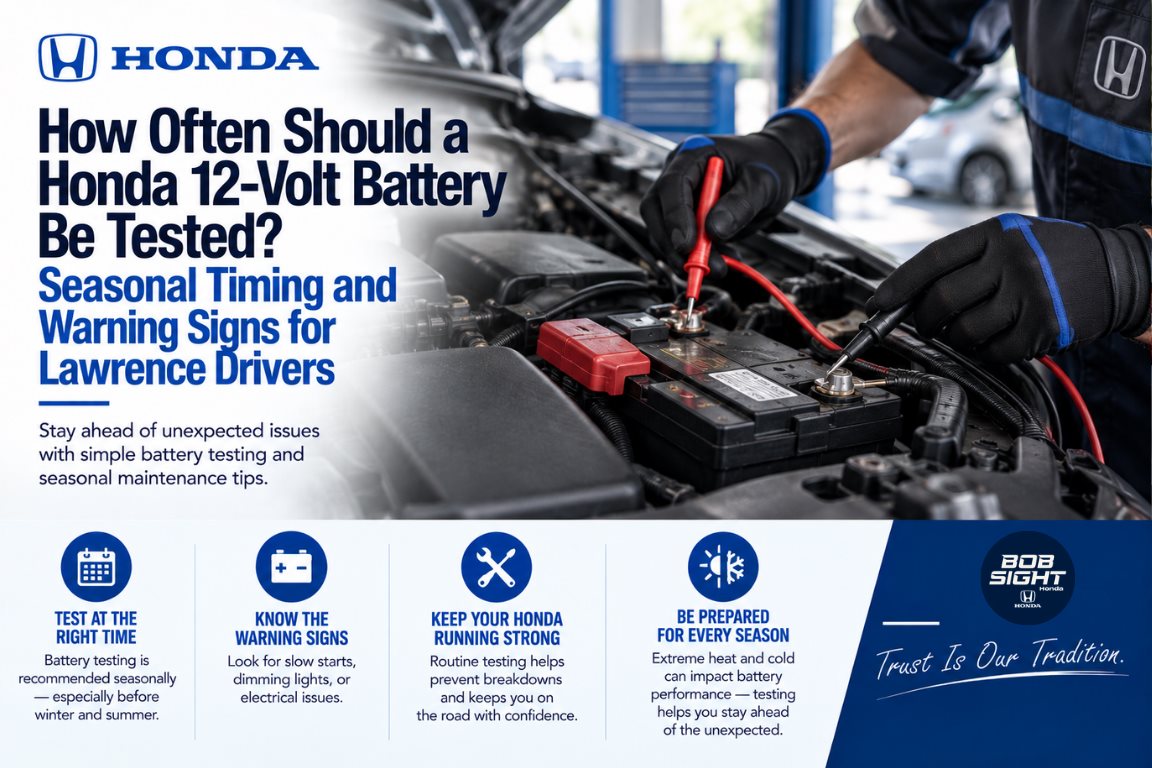
A Honda 12-volt battery should be tested when symptoms appear, and regular checks become more useful as the battery ages. There is no single testing interval that fits every Honda and every driver. For owners in Lawrence, Kansas, a sensible plan is to note the battery’s age, discuss its condition during routine service, and consider a test before a season or trip when dependable starting matters most. Bob Sight Honda serves drivers from Lawrence, Topeka, Eudora, Baldwin City, and nearby communities whose schedules leave little room for an unexpected no-start.
In This Guide You’ll Learn
Use your battery’s age, your driving pattern, and your Honda’s behavior to decide when a test is worthwhile.
- How often to consider testing a Honda 12-volt battery
- Why a seasonal check can be useful in Northeast Kansas
- Which symptoms call for testing sooner
- What a battery test can and cannot tell you
- Why gas and hybrid Honda owners should identify the battery being discussed
- What to ask before approving a replacement
Quick Facts About Honda 12-Volt Battery Testing
Test timing depends on battery age, symptoms, and how the vehicle is used. An occasional check during service can establish a useful baseline, while a slow start or repeated jump-start calls for attention sooner. Your owner’s manual and the findings for your specific vehicle should guide the next step.
- No universal Honda test interval: Do not treat one calendar date as a manufacturer-required schedule for every model.
- An age-based reference: AAA recommends yearly battery testing after a conventional car battery reaches three years of age.
- Test sooner for symptoms: Slow cranking, repeated starting trouble, or a recent jump-start deserves investigation.
- Seasonal planning: A check before winter or a demanding summer travel period may be useful, particularly for an older battery.
- Check the system: A starting or charging problem is not automatically proof that the battery itself needs replacement.
- Know the battery type: A Honda hybrid has a 12-volt battery and a separate high-voltage propulsion battery.
AAA’s battery guidance provides the age-based testing reference. It is general automotive advice, not a Honda-specific replacement rule. If you do not know how old your battery is, ask a technician to identify what can be confirmed from its label or service history.
How Often Should a Honda 12-Volt Battery Be Tested?
Ask for a test when starting behavior changes, and consider regular testing as the battery gets older. AAA recommends testing a conventional car battery yearly after its third year. A technician can help you decide whether an earlier or more frequent check makes sense for your Honda’s condition and use.
The battery’s installation date is a better starting point than the vehicle’s model year. A used Honda may have received a replacement battery recently, while another vehicle may still have an older battery. Look for an invoice or service entry showing when it was installed. If you cannot verify its age, a current test gives you information to use in future service conversations.
Routine service is a convenient time to ask whether a battery check is appropriate. You already have the vehicle at the shop, and a prior result may be available for comparison later. A check does not mean the battery must be replaced. It gives you an opportunity to discuss its condition, the cable connections, and any symptoms you have noticed.
Think about how you rely on the car. A driver who commutes from Lawrence toward Topeka most weekdays may prioritize a check before a stretch of cold morning departures. A vehicle used mainly for brief trips around downtown Lawrence has a different driving pattern. Neither routine creates a fixed Honda testing requirement, but both provide context a service advisor can use.
If your Honda has been starting normally and the battery is relatively new, you may simply discuss it at the next service visit. If the battery is older or its history is unknown, testing provides a clearer baseline. If the vehicle hesitates to start, request an evaluation promptly rather than waiting for a seasonal appointment. Symptoms take priority over a calendar.
Why Test Before Winter or Summer Travel in Kansas?
A seasonal battery check can help you assess an older or uncertain battery before you depend on it during demanding travel. Northeast Kansas brings both cold mornings and hot weather. Seasonal timing is a practical planning choice, not a guarantee that a vehicle will start every time after passing a test.
Cold weather can make a starting problem more noticeable, while heat can contribute to battery deterioration over time. AAA identifies time, heat, and vibration as factors that affect conventional battery life. A battery that performed normally in mild weather may deserve a closer look if it is aging or has begun showing symptoms. The test result should be considered alongside the vehicle’s starting and charging behavior.
Before winter, think through your actual schedule. You might leave early for work along I-70, drive children to school in Lawrence, or regularly travel from Baldwin City for appointments. If a weak start has occurred even once, tell the technician when it happened and what you observed. That detail is more useful than simply asking whether the battery is “good.”
Summer planning matters too. A family preparing for a long drive across Kansas may want the 12-volt system evaluated during a routine service visit, particularly if the battery is older. A trip check can also include tires, fluids, and other vehicle-specific items. Keep the battery question focused: you want to know whether the available evidence suggests it needs further diagnosis, monitoring, or replacement.
Seasonal tests should not replace attention to symptoms between appointments. A vehicle can develop a loose connection or charging-system concern after a prior check. If a warning appears or starting behavior changes during a Lawrence heat wave or a winter cold snap, arrange an evaluation then. A recent normal result is useful history, but it does not override a new problem.
Which Warning Signs Call for Testing Sooner?
Slow cranking, repeated starting difficulty, or a need for a jump-start are reasons to investigate the 12-volt system promptly. Those symptoms may involve the battery, its connections, the charging system, or another component. A test and diagnosis help identify which issue is present.
For a gas-powered Honda, notice whether the engine turns over more slowly than usual. Pay attention to repeated clicking, inconsistent starts, or a vehicle that starts only after assistance. Make a note of when the symptom occurred: after sitting overnight, following a short trip, or after several days parked. That timeline can help a technician reproduce or narrow down an intermittent concern.
Electrical symptoms also deserve context. Dim or unusual lighting, an unexpected warning, or accessories behaving differently may be related to several possible issues. A battery or charging-system warning should not be interpreted as a simple instruction to buy a battery. Follow the owner’s manual guidance for the exact warning and have the vehicle evaluated.
AAA lists slow cranking, frequent jump-starts, and certain electrical issues among signs that warrant attention. Its battery warning-sign guide also notes that a starting concern can involve a bad connection. That is why describing the symptom accurately matters. The test should answer a question about the vehicle, rather than confirm a replacement decision made in advance.
Imagine a Honda that struggles to start after a grocery stop along Iowa Street but starts normally the next morning. Do not dismiss the event because it happened only once. Record what you saw and ask for the relevant checks, particularly if you have a commute to Eudora or Topeka coming up. Intermittent symptoms can be harder to diagnose when no one knows when they occur.
What Does a 12-Volt Battery Test Tell You?
A battery test provides information about the battery’s condition at the time of testing. A technician can also examine connections and consider whether the charging system or another issue needs evaluation. The exact procedure and interpretation depend on the vehicle, battery, and symptoms.
Ask what was tested and what the result means in plain language. Was the concern a low state of charge, reduced starting capability, or an issue that requires further diagnosis? If the battery is discharged, the next question is why. A battery that needs charging is not automatically a battery that has permanently failed.
A reading taken in isolation may not explain every complaint. A vehicle that will not start could have a loose or corroded connection, an electrical drain while parked, or a charging issue. Tell the service team if your Honda recently needed a jump-start, sat unused for an extended period, or had electrical work performed. That history helps them decide what else to check.
Ask for the finding to be recorded with the service visit. If the result supports continued use, you will have a reference for the next check. If replacement is recommended, ask what finding supports that recommendation and whether another part of the system needs attention. Clear answers make the next step easier to understand.
A Lawrence driver may hear the phrase cold-cranking amps, often shortened to CCA. It describes a battery’s rated ability to supply starting power under a standardized cold-temperature test. The required battery specification depends on the Honda model and application. You do not need to choose a replacement from a generic number; ask the service team to verify the correct type and specifications for your vehicle.
Do Short Trips or Long Periods Parked Change the Plan?
Frequent short trips and extended periods parked are useful reasons to discuss battery condition, particularly if starting has changed. AAA notes that short trips may not fully recharge a conventional car battery and that a vehicle left parked can lose charge over time. The effect on your Honda depends on its condition and how it is used.
A driver who makes several brief trips near the University of Kansas may have a different routine from someone regularly traveling K-10 toward the Kansas City area. Do not assume that the highway driver’s battery is automatically healthy or that the local driver’s battery is failing. Use the driving pattern as information for the technician. The test and any further checks should determine what the vehicle needs.
If your Honda sits for days at a time, tell the service advisor how long it typically remains parked. Note whether any starting difficulty follows those periods. A recently installed battery that repeatedly loses charge may need more investigation than another battery that simply requires a one-time recharge. Replacing it without finding the cause may leave the original problem unresolved.
Changing routines are another reason to revisit the issue. Someone who now works from home in Lawrence may drive far less than when they commuted to Topeka. Another household may start using a second vehicle only on weekends. Mention those changes when scheduling service, because a technician cannot infer your recent use from the odometer alone.
A battery maintainer may be relevant for a vehicle that remains parked regularly, but equipment choice and connection procedures should follow the vehicle and product instructions. Ask for model-specific guidance before using one. For most owners, the immediate step is simpler: explain the driving pattern and request an appropriate evaluation if the battery’s condition is uncertain.
How Are Hybrid Honda Batteries Different?
A Honda hybrid’s 12-volt battery is separate from its high-voltage propulsion battery. If you ask for a routine 12-volt battery check, make clear which battery you mean. The two systems have different functions and require different service considerations.
Honda’s CR-V Hybrid owner information identifies a standard 12-volt battery for conventional electrical systems and a high-voltage battery used by the hybrid propulsion system. A concern about the 12-volt system should not be described as proof that the hybrid propulsion battery has failed. Likewise, a hybrid-system warning requires attention to the specific message and the applicable owner instructions.
A hybrid may behave differently during startup from a gas-only Honda. Rather than relying on the sound of an engine cranking, report exactly what the vehicle displayed or failed to do. Did it enter its ready-to-drive state? Was there a warning message? Did accessories operate normally? Those observations help the technician evaluate the correct system.
For a Lawrence owner driving a CR-V Hybrid or Accord Hybrid, identify the model and year when requesting service. Battery location and procedures may vary. Do not attempt to handle or diagnose high-voltage components yourself. Honda’s owner information directs high-voltage system maintenance and repairs to qualified service personnel.
This article’s age-based testing discussion concerns the conventional 12-volt battery. It is not a schedule for testing or replacing a hybrid’s high-voltage battery. If you are unsure which system a symptom involves, describe the behavior and dashboard messages to Bob Sight Honda rather than assigning the problem to either battery.
What Should You Ask Before Replacing a Battery?
Ask what the test found, whether the battery is the cause of the symptom, and which replacement specification fits your Honda. A replacement decision should follow the vehicle-specific findings. Battery age alone does not establish that every battery must be replaced on a particular date.
- Describe the symptom. Include slow starts, jump-starts, warning messages, or how long the vehicle sat before the problem appeared.
- Ask for the test result. Have the service advisor explain the finding and whether further charging or diagnosis is needed.
- Discuss related checks. Ask whether cable connections and the charging system have been evaluated as appropriate.
- Verify the replacement type. Confirm the battery selected for your specific Honda model, year, and equipment.
- Keep the service record. Save the installation date and battery details for future checks.
AAA notes that replacement batteries are not one-size-fits-all. Battery type, physical fit, terminal arrangement, and electrical specifications matter. A technician should verify the correct application instead of choosing a battery only because it appears similar to the old one. This is relevant for gas and hybrid Hondas alike when discussing their 12-volt systems.
Before approving work, also ask whether any observed issue remains unexplained. If the battery repeatedly discharged while the car was parked, what was found about the charging system or possible electrical draw? If a warning indicator appeared, was its cause confirmed? The goal is a repair that addresses the actual problem.
Bob Sight Honda’s parts department and service team can help identify the appropriate battery for a Honda in Lawrence. Bring any prior test results or replacement records. They provide context when comparing a new finding with the vehicle’s recent history.
Ownership Planning for Dependable Starts in Northeast Kansas
Build battery checks into your broader ownership routine while staying alert to changes between service visits. Record when the 12-volt battery was installed, note test results, and describe symptoms as soon as they appear. This makes future recommendations easier to understand.
Keep the battery question separate from a general maintenance reminder. Honda’s Maintenance Minder provides information about specified maintenance items, but a driver should not assume that the absence of a battery-specific reminder proves the battery is healthy. Ask about the 12-volt system when you have a concern. Review your owner’s manual for the messages and procedures that apply to your model year.
Plan around your driving. A household using a Honda daily for school trips along 23rd Street may notice starting changes quickly. Someone who parks a second Honda for long stretches may discover an issue only when preparing for a trip. Both owners benefit from knowing the installation date and sharing their driving pattern with the technician.
Before a demanding season, combine relevant questions into one service visit. You may ask about the battery, tires, and other items that matter for upcoming travel. Keep each recommendation tied to an actual finding. A check before winter or summer is meant to reduce uncertainty, not to promise that future problems are impossible.
Bob Sight Honda’s service department supports owners from Lawrence and surrounding Northeast Kansas communities. If you have an intermittent issue, write down its timing before your appointment. Specific observations help the team investigate more effectively than a general description that the car “seems off.”
Frequently Asked Questions About Honda 12-Volt Batteries
Should I test my Honda battery every year?
Yearly testing becomes a useful reference as a conventional 12-volt battery ages, but it is not a universal Honda-required interval. AAA recommends annual testing after a car battery reaches three years of age. Your vehicle’s symptoms and battery history may call for a check sooner. Discuss the right approach for your particular Honda.
Start by identifying when the battery was installed. The vehicle’s age and the battery’s age may be different. If you cannot confirm the installation date, a test during service can establish a current baseline. Keep the result for later comparison.
A Lawrence driver with an older battery and daily travel toward Topeka may choose a check before winter commuting. Another driver might have a newer battery but request testing after a slow start. Both decisions respond to useful information. A calendar should never take priority over a developing symptom.
Does a Honda need a battery test before winter?
A prewinter test can be sensible when the battery is older, its age is unknown, or starting has become less consistent. It gives a technician a chance to evaluate the battery before cold mornings become part of your routine. It is a planning step rather than a requirement that applies to every Honda. A normal test also cannot guarantee every future start.
Describe any recent change when requesting the check. Mention slow cranking, a jump-start, or a warning message. Ask whether the battery and related connections should be evaluated. If the findings suggest a charging-system problem, testing the battery alone may not answer the full question.
For a family leaving Baldwin City early to reach work or school in Lawrence, reliable transportation matters during winter. A check before that routine begins may provide useful information. Keep monitoring the vehicle afterward, since new issues can arise. Respond to a new symptom even if an earlier test was normal.
Does a weak start always mean my Honda needs a new battery?
No. A weak start is a reason for diagnosis, not automatic proof that the battery needs replacement. The battery may be discharged or deteriorated, but connections and other parts of the starting or charging system can also be involved. Tell the technician exactly what happened. Ask what testing supports the recommended next step.
Note whether the problem appeared after the vehicle sat, after a short trip, or repeatedly over several days. If a jump-start was needed, include that detail. Ask whether a low charge has an identifiable cause. Replacing a battery without addressing another fault may not resolve the symptom.
A Honda that hesitates outside a Lawrence grocery store may start normally later, making the issue seem temporary. Record the circumstances anyway. If you commute on K-10 or I-70, it is more useful to investigate before the next demanding travel day. An intermittent problem deserves a clear explanation.
Is the 12-volt battery the same as a Honda hybrid battery?
No. A Honda hybrid has a 12-volt battery and a separate high-voltage battery used by the hybrid propulsion system. The systems have different roles. Specify the 12-volt battery when asking about a routine battery check. Describe any warning message rather than assuming which battery caused it.
Honda’s CR-V Hybrid owner information distinguishes the two battery types. A test of the 12-volt battery does not by itself evaluate the high-voltage propulsion battery. High-voltage components require the procedures and qualified personnel specified by Honda. Consult the owner information for your exact model and year.
A Lawrence CR-V Hybrid owner might notice that the vehicle does not enter its ready-to-drive state as expected. That observation is more useful to the service team than saying only that “the hybrid battery is dead.” Report what happened and what appeared on the display. The diagnosis can then focus on the appropriate system.
Know When to Ask for a Honda Battery Test in Lawrence
Use battery age, symptoms, and upcoming driving demands to decide when a 12-volt battery test makes sense. AAA’s yearly-testing advice after three years is a useful general reference. A slow start, jump-start, or unexpected warning is a reason to seek an evaluation sooner.
Lawrence drivers balance short in-town trips, commutes toward Topeka and Eudora, and seasonal travel across Kansas. Tell the service team how you use your Honda and what you have observed. Ask for the test findings and a clear explanation of any recommended work. That conversation is more valuable than following an arbitrary replacement date.
Bob Sight Honda in Lawrence can help you evaluate a 12-volt battery concern as part of caring for your specific vehicle. Bring its battery installation history if you have it and note any recent starting behavior. With that information, you can make a more informed decision about testing, further diagnosis, or replacement.
Helpful Links
- Schedule Honda service
- Explore the Honda service department
- Explore Honda Express Service
- Contact the Honda parts department
- View current service and parts specials
Proud to Be Part of the Bob Sight Auto Group
Bob Sight Honda serves drivers in Lawrence, Kansas, and nearby communities including Topeka, Eudora, Baldwin City, and Ottawa. As part of the Bob Sight Auto Group, our dealership is connected to a family of automotive stores across Kansas and Missouri. Each location helps drivers find vehicle and service resources suited to their needs.