Comprehensive Honda Accord Hybrid vs Toyota Camry Hybrid Comparison for Kansas City Drivers
Explore new Honda Accord Hybrid models for sale at Bob Sight Honda in Lawrence, KS today
In This Guide You'll Learn
Compare the market's top two midsize hybrid sedans to make the most informed decision for your daily commuting across Douglas County and the greater Kansas City metro area:
- How the Honda two-motor hybrid electric drive system compares to Toyota's THS parallel hybrid architecture
- Real-world fuel economy expectations, highway range, and city efficiency across eastern Kansas
- Detailed passenger space comparisons, including rear legroom measurements and cargo trunk volume
- Infotainment display technology, touchscreen sizes, and digital cockpit features
- Comparing long-term routine maintenance requirements, oil specifications, and ownership costs
- A step-by-step test-drive and selection guide for buyers evaluating midsize hybrid sedans
- Why the refined chassis tuning and spacious cabin of the Accord Hybrid make it ideal for Midwest drivers
Accord Hybrid vs Camry Hybrid: Performance and Dynamic Driving Comparison
The Honda Accord Hybrid delivers a responsive, linear acceleration experience powered by its two-motor hybrid system that outperforms traditional hybrid rubber-band powertrain feel during daily highway merging. Delivering a combined 204 horsepower and an impressive 247 pound-feet of electric torque, the Accord Hybrid utilizes its high-output electric propulsion motor as the primary driver at low and mid-range speeds. When accelerating onto Highway 10 or passing slower traffic along Highway 59 near Baldwin City, the engine operates as a generator or locks directly to the drive wheels via a high-efficiency direct-drive clutch. This sophisticated arrangement eliminates the high-RPM drone common in traditional continuously variable transmissions, creating a whisper-quiet cabin environment for long commutes.
The Toyota Camry Hybrid utilizes a 2.5-liter four-cylinder engine paired with an electric motor generator set through a planetary gear e-CVT, producing 225 total system horsepower in front-wheel drive configuration. While the Toyota possesses a slight peak horsepower advantage on paper, real-world road tests frequently show the Accord Hybrid matching or beating the Camry in zero-to-sixty acceleration runs due to immediate electric torque application. Driving the Camry under heavy acceleration triggers noticeable engine revs as the planetary gearset balances engine and motor speeds. Drivers who value a smooth, direct connection between pedal pressure and forward movement consistently prefer the quiet acceleration characteristics of the Honda hybrid setup.
Chassis dynamics and ride refinement further separate these two iconic midsize sedans across rough Midwest road surfaces. The Honda Accord Hybrid features a sophisticated multi-link rear suspension and MacPherson front struts tuned specifically to balance highway compliance with precise cornering control. Navigating the winding stretches of Iowa Street or absorbing expansion joint impacts along Interstate 70 toward Topeka feels controlled and composed in the Accord. The Toyota Camry offers a stable ride, but its suspension dampening transmits more sharp pavement harshness into the cabin over neglected road surfaces. For daily drivers seeking a peaceful balance of ride comfort and athletic road handling, the Accord Hybrid stands out as a clear class leader.
Fuel Economy Ratings and Real-World Range for Kansas Commuters
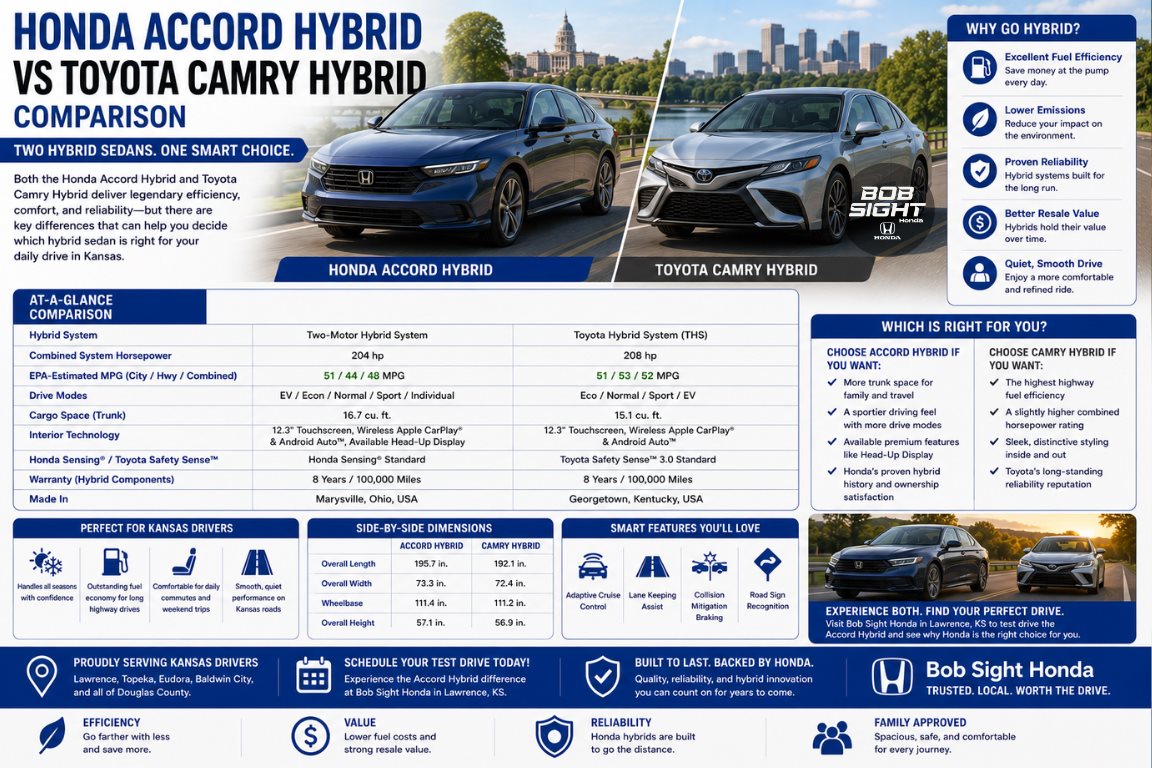
Both midsize hybrid sedans offer outstanding EPA fuel economy estimates capable of topping 45 to 50 miles per gallon, making them ideal commuting choices for driving between Lawrence and Kansas City. Efficiency remains a primary priority for hybrid shoppers evaluating daily operational expenses across eastern Kansas. The Honda Accord Hybrid EX-L achieves an EPA-estimated 51 MPG in city driving and 44 MPG on the highway, resulting in a combined rating of 48 MPG. Sport and Touring trims, which ride on larger 19-inch alloy wheels, earn an EPA-estimated 46 MPG city and 41 MPG highway, delivering continuous fuel savings whether cruising across town or making daily highway trips.
The base Toyota Camry LE trim earns an impressive EPA-estimated rating of 52 MPG city and 49 MPG highway, while higher trim levels like the SE, XLE, and XSE drop down to 46 MPG combined. While the entry-level Camry holds a marginal EPA paper advantage on highway cycles, real-world driving results across variable Midwest topography show nearly identical fuel consumption between both models. The Accord Hybrid features a 12.8-gallon fuel tank that provides a total driving range exceeding 600 miles on a single fill-up. This massive range allows local drivers to travel back and forth from Lawrence to downtown Kansas City for weeks between gas station visits.
Maximizing hybrid fuel economy requires understanding how environmental conditions and regenerative braking settings impact battery charge management. The Accord Hybrid features steering-wheel-mounted deceleration paddle shifters that allow drivers to adjust regenerative braking resistance on demand. Selecting higher regeneration levels while descending rolling hills near Clinton Lake recharges the lithium-ion battery pack without applying physical brake pads. Combined with active grille shutters that optimize aerodynamic efficiency at high highway speeds, the Accord Hybrid consistently minimizes fuel consumption across all seasonal driving scenarios.
Interior Dimensions, Rear Legroom, and Cargo Capacity Breakdown
The Honda Accord Hybrid provides class-leading interior passenger volume and a significantly larger trunk capacity than the Toyota Camry Hybrid, offering unmatched practical utility for families and adult passengers. Interior space design is a major differentiator for shoppers who routinely carry passengers, luggage, or bulky cargo. The Accord features a cavernous total passenger volume of 102.8 cubic feet compared to 99.9 cubic feet inside the Camry. This extra volume translates directly into broader shoulder room, generous hip room, and an overall airier cabin ambiance that feels closer to a full-size luxury sedan than a standard midsize vehicle.
Comparing rear-seat legroom demonstrates the Honda engineering advantage for growing families and carpooling professionals across Douglas County. The table below highlights key interior dimension and cargo specifications between both competing hybrid models:
| Interior Measurement & Utility Feature | Honda Accord Hybrid | Toyota Camry Hybrid |
|---|---|---|
| Total Passenger Volume | 102.8 cubic feet | 99.9 cubic feet |
| Rear Seat Legroom | 40.8 inches | 38.0 inches |
| Trunk Cargo Volume | 16.7 cubic feet | 15.1 cubic feet |
| Front Headroom / Legroom | 39.5 inches / 42.3 inches | 38.3 inches / 42.1 inches |
| Standard Infotainment Touchscreen | 12.3-inch color touchscreen display | 8.0-inch color touchscreen display |
With nearly three full inches of additional rear legroom, the Accord Hybrid easily accommodates tall adult passengers and bulky rear-facing infant car seats without forcing front seat occupants to slide forward. The Accord trunk provides a massive 16.7 cubic feet of flat, wide cargo capacity capable of holding multiple large suitcases or full golf bag setups. By comparison, the Camry trunk offers 15.1 cubic feet with narrower wheel well cutouts. Whether packing luggage for a weekend trip to Kansas City or loading up weekly groceries near Sixth Street in Lawrence, the Accord Hybrid offers superior cargo versatility.
Technology Features, Infotainment Displays, and Safety Suites
Every Honda Accord Hybrid comes standard with a massive 12.3-inch touchscreen display featuring wireless smartphone integration, offering clearer digital visibility and faster responses than the base Toyota system. High-tech interior features play a central role in modern vehicle ownership satisfaction. The Accord Hybrid includes an intuitive infotainment display with a physical volume knob, customizable digital tile menus, and wireless Apple CarPlay and Android Auto compatibility across all hybrid trims. Upper Touring trims add Google built-in technology, allowing drivers to utilize native Google Maps navigation, Google Assistant voice commands, and Google Play apps directly through the vehicle display.
The Toyota Camry starts with a much smaller 8.0-inch touchscreen display on its base trim levels, requiring buyers to step up to expensive top-tier packages to acquire a comparable 12.3-inch screen. Furthermore, the overall digital user interface in the Accord feels cleaner, featuring crisp graphics, low-glare screen coatings, and rapid touch response. A standard 10.2-inch digital driver instrument cluster behind the Accord steering wheel presents real-world energy flow diagrams, driver assistance graphics, and turn-by-turn navigation alerts directly within the driver line of sight without creating visual clutter.
Safety engineering remains a hallmark for both automotive brands, with both sedans earning top crash-test marks and advanced driver assistance suites. The Accord Hybrid includes standard Honda Sensing, a comprehensive safety suite incorporating Collision Mitigation Braking System, Road Departure Mitigation, Adaptive Cruise Control with Low-Speed Follow, Lane Keeping Assist System, and Traffic Sign Recognition. Honda's advanced wide-angle camera and radar units provide smooth driver assist inputs along congested highway routes like K-10, minimizing fatigue and protecting passengers through active accident avoidance.
Understanding Hybrid Drivetrain Architecture: Honda 2-Motor vs Toyota THS
The Honda two-motor hybrid system operates primarily as an electric-drive platform where the gas engine generates electricity for the traction motor, delivering smooth EV-like responsiveness without complex transmission gearsets. Understanding the underlying mechanical architecture helps buyers appreciate why these two hybrid sedans feel fundamentally different behind the wheel. The Honda powertrain utilizes two inline electric motors paired with a naturally aspirated 2.0-liter Atkinson-cycle four-cylinder engine. The primary traction motor generates 247 pound-feet of torque instantly from zero RPM, driving the front wheels directly in most urban driving scenarios while the engine drives the second generator motor.
To help prospective buyers evaluate these competing mechanical designs, here is a plain-language guide outlining how Honda's innovative hybrid system operates across different driving modes:
- EV Drive Mode: The lithium-ion traction battery supplies electrical power exclusively to the electric propulsion motor, allowing silent zero-emission driving during low-speed suburban cruising and parking maneuvers.
- Hybrid Drive Mode: The 2.0-liter gas engine turns on to spin the generator motor, which supplies electric power directly to the main traction motor while excess power recharges the hybrid battery pack during heavy acceleration.
- Engine Drive Mode: At steady high-speed highway cruising velocity, a specialized lock-up clutch engages to connect the gas engine directly to the front drive wheels through a fixed gear ratio for maximum long-distance fuel efficiency.
- Regenerative Braking Mode: Deceleration forces reverse the main electric motor into a generator, capturing kinetic braking energy to recharge the lithium-ion battery during urban stop-and-go driving.
By contrast, Toyota's Hybrid Synergy Drive (THS II) relies on a complex planetary gear transmission that constantly blends torque output from both the 2.5-liter engine and two internal motor-generators. While effective, the Toyota design forces the gas engine to rev up and down continually based on planetary gear speed demands rather than vehicle velocity. Honda's direct-drive unit eliminates traditional transmission gear slipping entirely, providing instantaneous electric acceleration that feels remarkably refined whether navigating daily traffic in downtown Lawrence or accelerating up highway grades near Eudora.
Maintenance Requirements, Ownership Costs, and Reliability Comparison
Both the Honda Accord Hybrid and Toyota Camry Hybrid offer exceptionally low long-term maintenance costs and proven mechanical reliability, but the Accord utilizes standard synthetic oil formulations that simplify routine servicing. Hybrid vehicles inherently reduce mechanical wear on routine consumables like brake pads and rotors thanks to regenerative braking systems that absorb stopping forces electrically. Owners routinely achieve over 100,000 miles on factory original brake pads when servicing their vehicles regularly at an authorized dealership like Bob Sight Honda.
Comparing routine service requirements reveals subtle maintenance differences that favor the Honda owner experience. The Accord Hybrid 2.0-liter engine utilizes standard 0W-20 full synthetic motor oil, a widely available formulation certified under strict ILSAC GF-6 standards that provides robust high-temperature breakdown protection. Some late-model Toyota engines recommend ultra-thin 0W-8 or 0W-16 oil weights, which can be harder to source at general automotive facilities and cost more per oil change service. Sticking with 0W-20 synthetic oil in the Accord guarantees reliable cold-weather flow during freezing Kansas winters without increasing fluid service expenses.
Deciding between purchasing new or exploring certified pre-owned options like used hondas lawrence ks represents another practical decision path for local shoppers. A factory-certified pre-owned Accord Hybrid undergoes a rigorous 182-point mechanical inspection, includes an extended powertrain warranty, and offers substantial value retention over years of ownership. Scheduling routine maintenance at a local dealership guarantees that factory-trained technicians use genuine OEM filters, test hybrid battery conditioning, and update onboard control unit software to preserve total mechanical reliability over the life of your vehicle.
Step-by-Step Buying Guide: How to Test Drive and Select Your Ideal Hybrid Sedan
Selecting the right midsize hybrid sedan requires a structured evaluation process that tests real-world acceleration, cabin comfort, infotainment usability, and passenger space under realistic commuting conditions. A quick five-minute drive around a dealership parking lot is never enough to evaluate how a hybrid sedan handles daily driving demands. Following a methodical test-drive routine allows shoppers to verify seat support, visibility, noise insulation, and hybrid powertrain smoothness before making a final purchasing decision.
To ensure you choose the ideal vehicle for your personal commuting needs, follow this step-by-step test-drive and evaluation process:
- Position the driver seat and side mirrors properly, noting front sightlines, blind-spot visibility, and the natural reach of center console controls and steering wheel paddles.
- Sit in the rear passenger seat directly behind your preferred driving position to evaluate legroom, knee clearance, headroom, and rear seat cushion support.
- Test low-speed EV drive smoothness by accelerating gently from a complete stop, listening for seamless transitions when the gas engine engages in Hybrid Drive mode.
- Merge onto a high-speed highway corridor like K-10, applying firm throttle pressure to evaluate cabin noise levels, passing power, and engine pitch under hard acceleration.
- Engage the steering-wheel deceleration paddles during highway slowdowns to experience how adjustable regenerative braking changes deceleration feel and brake pedal modulation.
- Inspect trunk loading width and depth, testing rear seat 60/40 split fold-down functionality to ensure cargo versatility meets your equipment transport needs.
Taking time to complete these evaluation steps reveals why so many local drivers choose the refined chassis and spacious interior of the Honda Accord Hybrid. Shopping at an authorized dealership like Bob Sight Honda gives buyers access to knowledgeable product specialists who can demonstrate advanced technology features, assist with phone pairing, and explain available lease or finance programs. Taking a thorough test drive ensures total confidence in your vehicle selection.
Quick Facts: Honda Accord Hybrid vs Toyota Camry Hybrid Specification Summary
Quick reference technical specifications allow hybrid buyers to easily compare key performance figures, interior dimensions, and factory warranty coverage between both top-rated midsize sedans. Reviewing essential engineering details side-by-side provides a clear visual summary of how these two industry-leading vehicles stack up.
- Accord Hybrid Powertrain: 2.0L 4-cylinder engine + 2-motor electric drive system (204 total system hp / 247 lb-ft motor torque)
- Camry Hybrid Powertrain: 2.5L 4-cylinder engine + planetary e-CVT motor setup (225 FWD hp / 232 AWD hp)
- Accord EPA Fuel Economy: Up to 51 MPG City / 44 MPG Highway / 48 MPG Combined (EX-L trim)
- Camry EPA Fuel Economy: Up to 52 MPG City / 49 MPG Highway / 51 MPG Combined (LE trim)
- Accord Interior Passenger Volume: 102.8 cubic feet (40.8 inches rear legroom)
- Camry Interior Passenger Volume: 99.9 cubic feet (38.0 inches rear legroom)
- Accord Trunk Cargo Volume: 16.7 cubic feet flat-floor cargo hold
- Factory Warranty Coverage: 3-Year/36,000-Mile Limited Bumper-to-Bumper & 8-Year/100,000-Mile Hybrid Component Warranty
These factory specifications demonstrate how the Honda Accord Hybrid prioritizes passenger comfort, cabin utility, and immediate electric motor torque without sacrificing real-world fuel economy. Utilizing high-efficiency lithium-ion battery technology paired with a responsive 2.0-liter Atkinson-cycle engine guarantees exceptional performance and long-term mechanical reliability for everyday Midwest driving.
Long-Term Ownership Planning for Lawrence and Kansas City Metro Hybrid Drivers
Developing a long-term maintenance strategy preserves hybrid battery health, minimizes total ownership costs, and protects trade-in value over hundreds of thousands of miles. Modern hybrid vehicles are engineered for outstanding durability, with high-voltage traction batteries and electric drive motors designed to perform reliably over long ownership spans. Establishing consistent fluid maintenance habits, monitoring tire wear patterns, and keeping cooling fans clear of interior dust ensures your hybrid powertrain continues running efficiently year after year.
Local weather variations across northeast Kansas introduce unique operational factors that make proactive vehicle care important. Extreme summer heat stresses hybrid battery cooling fans, while icy winter road conditions require proper tire tread depth and alignment to maintain traction on slick pavement along I-70 or Highway 59. Proactively replacing cabin air filters prevents dust accumulation in battery cooling ducts, keeping high-voltage electronics operating within optimal temperature ranges through every season.
Documenting routine service visits at a certified dealership like Bob Sight Honda creates a complete vehicle maintenance record that adds significant trade-in value when upgrading to a newer model down the road. Utilizing local dealer conveniences like honda pickup and delivery service lawrence ks makes managing scheduled maintenance effortless, fitting smoothly into busy work schedules. Entrusting your hybrid sedan to factory-certified technicians using genuine OEM parts ensures continuous reliability, maximum fuel efficiency, and peace of mind on every journey.
Frequently Asked Questions About Honda Accord Hybrid vs Toyota Camry Hybrid
Which hybrid sedan offers more rear passenger space and trunk cargo room?
The Honda Accord Hybrid provides significantly more rear passenger space and trunk cargo capacity than the Toyota Camry Hybrid. The Accord Hybrid features 40.8 inches of rear seat legroom compared to 38.0 inches in the Camry, giving rear passengers nearly three additional inches of stretch-out leg room. Total passenger volume inside the Accord reaches 102.8 cubic feet, creating an expansive cabin atmosphere that easily accommodates tall adults or bulky rear-facing child safety seats.
In terms of cargo utility, the Honda Accord Hybrid boasts a class-leading 16.7 cubic feet trunk with a wide, flat load floor that easily accommodates multiple large suitcases or sports gear. The Toyota Camry trunk provides 15.1 cubic feet of cargo volume with narrower side cutouts that limit overall loading flexibility. Families and daily commuters who prioritize interior space and cargo carrying ability consistently favor the spacious packaging of the Accord Hybrid.
Visiting your local honda dealer lawrence ks allows prospective buyers to experience this interior advantage firsthand. Testing rear seat entry, legroom, and trunk volume side-by-side demonstrates why the Accord Hybrid remains the top-rated midsize family sedan for daily passenger comfort.
How does the Honda two-motor hybrid system differ from Toyota's hybrid setup?
The Honda two-motor hybrid system operates primarily as an electric-drive platform, while the Toyota hybrid system uses a planetary gearset to constantly blend engine and motor output. In the Accord Hybrid, a powerful electric motor drives the front wheels directly in most low- and mid-speed driving conditions, while the 2.0-liter gas engine operates a generator motor to produce electricity. At high highway cruising speeds, a direct-drive clutch engages to lock the gas engine directly to the drive wheels without using a traditional transmission gearset.
Toyota's Hybrid Synergy Drive utilizes a 2.5-liter engine connected to electric motor-generators through a planetary e-CVT gear unit. Under hard acceleration, the Toyota system causes engine RPM to climb independently of vehicle speed, creating a noticeable transmission slippage feel known as the rubber-band effect. Drivers who prefer prompt electric torque response, quiet acceleration, and a linear pedal feel consistently prefer the Honda two-motor architecture.
Scheduling a test drive at Bob Sight Honda allows buyers to evaluate this smooth power delivery along local routes like K-10 or Iowa Street. Experience how instant electric torque elevates daily commuting comfort without the high-rev noise common in competing hybrid systems.
What is the real-world fuel economy for the Honda Accord Hybrid in Kansas?
The Honda Accord Hybrid EX-L achieves an EPA-estimated 51 MPG in city driving, 44 MPG on the highway, and 48 MPG combined during daily commuting. Sport and Touring models equipped with larger 19-inch wheels earn an EPA-estimated 46 MPG city, 41 MPG highway, and 44 MPG combined. Real-world fuel economy across eastern Kansas varies slightly based on ambient temperatures, driving speeds, tire pressure maintenance, and terrain.
During warm spring and summer months, drivers commuting between Lawrence and Kansas City frequently meet or exceed EPA estimates by utilizing steering-wheel deceleration paddles to maximize energy recovery during downhill descents. In cold winter weather, fuel economy naturally drops by ten to fifteen percent as the gas engine operates more frequently to generate interior cabin heat and warm the high-voltage battery pack.
Maintaining proper tire inflation pressures and staying up to date with routine maintenance like a honda oil change lawrence ks ensures your Accord Hybrid operates at maximum fuel efficiency year-round. Utilizing high-grade full synthetic 0W-20 oil reduces internal friction and protects engine tolerances across all seasonal temperature shifts.
Is the Honda Accord Hybrid reliable for long-distance daily commuting?
Yes, the Honda Accord Hybrid is widely recognized as one of the most reliable long-distance commuting sedans on the market, capable of delivering hundreds of thousands of trouble-free miles. Honda's naturally aspirated 2.0-liter Atkinson-cycle engine and simple direct-drive unit eliminate wear-prone components like conventional drive belts, torque converters, and traditional multi-speed gear transmissions, significantly reducing long-term mechanical breakdown risks.
Furthermore, regenerative braking absorbs a substantial portion of stopping friction, extending brake pad and rotor lifespan far beyond that of standard gas-powered vehicles. The high-voltage lithium-ion battery pack is backed by an 8-year/100,000-mile factory warranty, providing long-term peace of mind for daily highway commuters traveling between Lawrence, Topeka, and the Kansas City metro area.
Partnering with an authorized dealership service center like Bob Sight Honda ensures your vehicle receives expert care from factory-certified technicians using state-of-the-art diagnostic tools. Keeping up with recommended maintenance milestones preserves vehicle longevity and ensures optimal highway performance for years to come.
Does the Honda Accord Hybrid offer touchscreen technology and smartphone integration?
Yes, every Honda Accord Hybrid model features a standard 12.3-inch color touchscreen display with wireless Apple CarPlay and Android Auto compatibility. This responsive touchscreen features customizable digital menu tiles, physical volume controls, and high-definition graphics that make managing navigation, music playlists, and hands-free phone calls effortless while driving.
Top-tier Touring trims add Google built-in technology, providing seamless integration with Google Maps, Google Assistant voice control, and downloadable apps via the Google Play Store directly on the central touchscreen. Drivers can simply say "Hey Google" to adjust cabin climate temperatures, set navigation destinations, or send text messages without taking their eyes off the road.
Comparing infotainment features reveals a clear advantage over the base Toyota Camry, which starts with a much smaller 8.0-inch display screen. Exploring current new inventory or checking current honda new car specials lawrence ks at Bob Sight Honda provides access to high-tech Accord Hybrid sedans equipped with the latest infotainment displays.
Why Buying Your Hybrid Local at Bob Sight Honda Matters
Buying and servicing your hybrid locally at Bob Sight Honda ensures exceptional customer support, competitive financing options, and expert care from factory-trained technicians who live and work in your community. Local dealerships invest directly in specialized diagnostic equipment, factory tools, and continuous hybrid powertrain training needed to maintain modern electrified vehicles correctly. Supporting a local Lawrence dealership keeps your sales tax dollars working in Douglas County to fund local schools, roads, and community services.
At Bob Sight Honda, our sales and service departments are committed to delivering an honest, transparent dealership experience tailored to your daily driving needs. From exploring honda accord hybrid lawrence ks inventory to securing competitive auto loan rates through our honda finance department lawrence ks, our professional team simplifies every step of your car-buying journey. You can also explore flexible options with a honda accord lease lawrence ks to match your budget and lifestyle.
Maintaining your vehicle at our certified service center provides unmatched convenience, authentic OEM replacement parts, and complete confidence on every drive. Whether commuting along K-10 daily, driving through the University of Kansas campus, or taking weekend road trips across the Midwest, trusting your vehicle to Bob Sight Honda guarantees long-term satisfaction. Visit our Lawrence showroom today or schedule a test drive online to discover why the Honda Accord Hybrid remains the top choice for Midwest drivers.
Helpful Links
- New Honda Accord Hybrid Inventory
- Schedule Service Online
- New Vehicle Specials
- Honda Finance Department
- Value Your Trade
Proud to be Part of the Bob Sight Auto Group
Bob Sight Honda is proud to be a member of the Bob Sight Auto Group, serving automotive customers across Kansas and Missouri with integrity, quality vehicles, and expert service for generations. Whether you are searching for a new vehicle, certified pre-owned inventory, or professional service care, our family of dealerships is dedicated to delivering an outstanding customer experience at every location.