Honda Coolant Service Lawrence KS: Why It Is Important
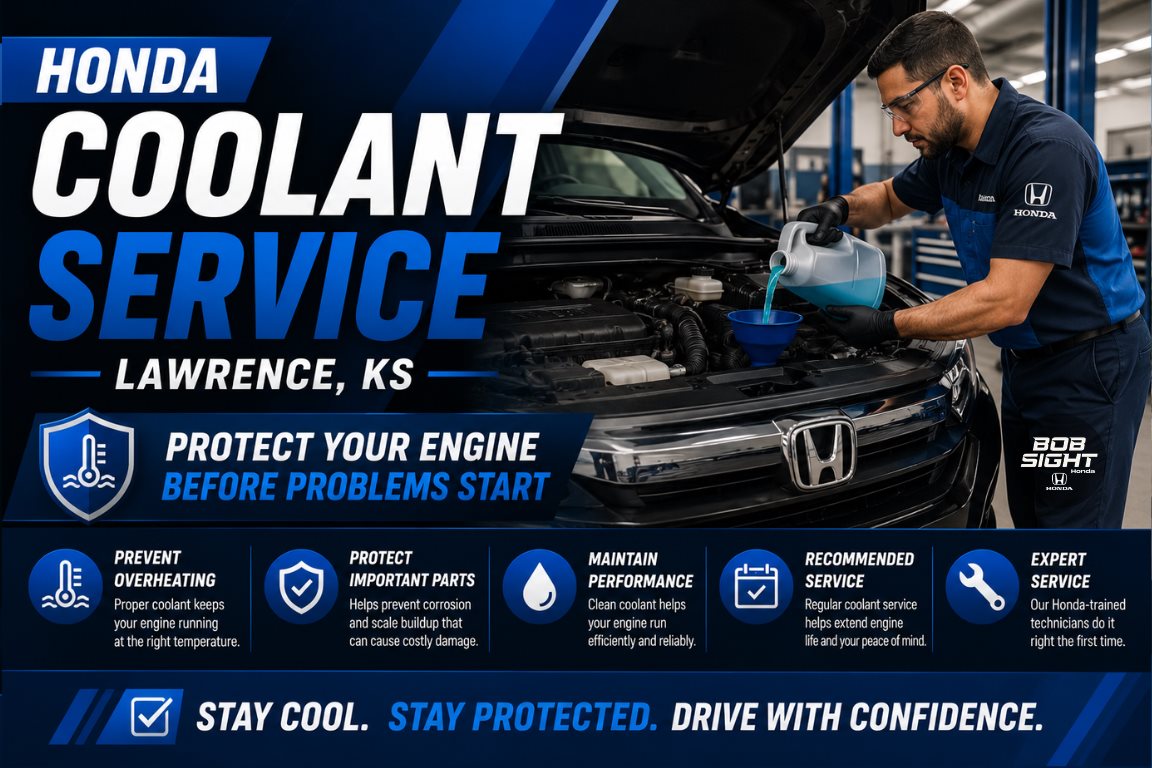
Schedule Honda coolant service in Lawrence, KS
Honda coolant service in Lawrence KS is important because your engine’s cooling system helps regulate temperature, prevent overheating, protect internal components, and support long-term reliability through Kansas heat, winter cold, and daily driving around Douglas County. At Bob Sight Honda in Lawrence, our service team helps drivers from Lawrence, Topeka, Baldwin City, Eudora, and the greater Kansas City Metro understand when coolant service matters, what the coolant system does, and why waiting too long can lead to bigger problems than routine maintenance. Whether you drive a Honda Accord, Civic, CR-V, HR-V, Pilot, Passport, Ridgeline, Odyssey, or a Honda hybrid model, coolant plays a key role in keeping your vehicle dependable.
In This Guide You’ll Learn
This guide explains coolant service in practical terms for Honda owners in Lawrence and Northeast Kansas.
- What coolant does inside your Honda engine and cooling system
- Why Honda coolant service matters in Kansas weather
- Common warning signs that your coolant system needs attention
- How coolant service compares with simply topping off fluid
- What happens during a professional coolant service visit
- How to plan coolant service around commuting, family driving, and long-term ownership
- Why Bob Sight Honda is a trusted local resource for Honda service in Lawrence KS
What Honda Coolant Does for Your Engine
Honda coolant helps absorb, transfer, and manage engine heat so your vehicle can operate within a safe temperature range. It also helps protect cooling system components from corrosion, freezing, boiling, and premature wear when the correct coolant is maintained at the right level and condition.
Coolant is often called antifreeze, but it does more than help during cold weather. In a Honda engine, coolant circulates through the engine block, cylinder head, radiator, heater core, hoses, and other cooling system components. As the engine creates heat, the coolant absorbs that heat and carries it to the radiator, where airflow helps release it. This process keeps the engine from running too hot during everyday driving.
For Lawrence drivers, coolant is working every time you sit in traffic near Iowa Street, commute along K-10, drive toward Topeka on I-70, or run errands near 6th Street and Massachusetts Street. Short trips, long highway drives, summer heat, and winter cold all place different demands on the cooling system. If coolant becomes old, contaminated, diluted, or low, it may not protect the system as well as it should. That can increase the risk of overheating, internal corrosion, poor heater performance, and cooling system leaks.
Honda vehicles are engineered to use coolant that meets the proper specifications for the model. Using the correct coolant matters because modern engines rely on carefully designed chemical protection. The wrong coolant type or an improper mixture can reduce corrosion protection and may not match Honda’s cooling system requirements. That is why Honda coolant service Lawrence KS should be handled with attention to vehicle-specific needs rather than guesswork.
Why Coolant Service Matters in Lawrence KS Weather
Coolant service matters in Lawrence KS because Kansas weather can shift from humid summer heat to freezing winter mornings, and your Honda’s cooling system has to perform through both extremes. Fresh, properly maintained coolant helps protect your engine from overheating in hot conditions and freezing-related stress during cold conditions.
Summer driving in Lawrence can be hard on a cooling system. Hot pavement, slow traffic, air conditioning use, and longer highway trips toward Kansas City or Topeka can all raise engine temperature demands. Your radiator, cooling fans, thermostat, water pump, and coolant must work together to move heat away from the engine. If one part of the system is weak or the coolant has degraded, the engine may be more vulnerable when temperatures climb.
Winter creates a different challenge. Coolant must resist freezing while still flowing properly through the system. Cold mornings in Douglas County can expose weak batteries, aging hoses, brittle seals, and low coolant levels. If the coolant mixture is not correct, the system may be less prepared for freezing conditions. That can lead to pressure changes, poor heater performance, or damage to components that depend on proper fluid protection.
Local driving patterns matter too. A driver commuting between Lawrence and the Kansas City Metro may put steady highway miles on a Honda CR-V or Accord. A family using a Pilot or Odyssey for school pickup, grocery runs, and weekend activities may see more stop-and-go driving. A student or young professional may take shorter trips around campus, downtown, and nearby neighborhoods. Each pattern affects how the cooling system cycles through heat, pressure, and temperature changes.
Coolant Service vs. Coolant Top-Off
A coolant top-off adds fluid when the level is low, while coolant service addresses fluid condition, system protection, and the long-term health of the cooling system. Topping off can help in some situations, but it should not replace proper inspection and service when coolant is old, contaminated, leaking, or no longer protecting the system correctly.
Many drivers notice the coolant reservoir and assume adding fluid is all the system needs. That may be true if the level is only slightly low and the fluid is still clean, but low coolant can also be a warning sign. Coolant does not normally disappear quickly in a healthy sealed system. If the level keeps dropping, there may be a leak, a pressure issue, a failing hose, a radiator concern, a water pump problem, or another cooling system condition that needs diagnosis.
Coolant service is more complete because it looks at the condition of the fluid and the system around it. Over time, coolant can lose protective additives, become contaminated, or become less effective at corrosion protection. Rust particles, scale, old fluid, or improper coolant mixtures can reduce the system’s ability to protect important parts. A coolant exchange or cooling system service helps refresh the fluid and gives technicians a chance to inspect for related issues.
| Service Type | What It Does | When It May Be Needed |
|---|---|---|
| Coolant top-off | Adds coolant to bring the level back into range | When fluid is slightly low and no leak or contamination is present |
| Coolant inspection | Checks level, color, condition, leaks, hoses, radiator, and related components | When warning signs appear or before seasonal temperature changes |
| Coolant service | Replaces old coolant with fresh coolant that meets the correct requirements | When service interval, fluid condition, or inspection results show it is needed |
For Honda owners in Lawrence, this distinction matters because topping off without understanding why coolant is low can delay the right repair. If your Honda coolant level keeps changing, if you smell something sweet near the engine bay, or if the temperature gauge behaves unusually, schedule a service visit instead of relying on repeated top-offs.
Warning Signs Your Honda May Need Coolant Service
Your Honda may need coolant service if you notice overheating, a rising temperature gauge, low coolant levels, coolant leaks, sweet smells, poor heater performance, steam, or dashboard warning lights. These signs should be taken seriously because cooling system problems can worsen quickly.
One of the clearest warning signs is an engine temperature gauge that rises higher than normal. Some newer vehicles use warning lights instead of traditional gauges, but the meaning is similar. If your Honda indicates that the engine is running hot, you should not ignore it. Continuing to drive an overheating engine can create serious mechanical risk, including damage to gaskets, internal engine components, and cooling system parts.
Visible leaks are another important signal. Coolant may appear as a colored fluid under the vehicle, often near the front of the engine bay. It may also leave residue around hoses, clamps, the radiator, the coolant reservoir, or the water pump area. A sweet smell after driving can also point toward coolant escaping somewhere in the system. These signs should be inspected by a trained technician because the source may not be obvious from the outside.
Here is a step-by-step response if you suspect a coolant issue:
- Watch the temperature gauge or warning light and avoid continuing to drive if the engine is overheating.
- Park safely and let the engine cool before checking anything under the hood.
- Do not remove the radiator cap or coolant cap while the engine is hot because the system may be pressurized.
- Look for visible coolant on the ground, around the reservoir, or near hoses if it is safe to inspect visually.
- Schedule Honda service so the cooling system can be checked properly before the problem gets worse.
Lawrence-area drivers should be careful during summer road trips, holiday travel, and long commutes. A small cooling issue that feels minor during a short drive near home can become more serious on I-70, K-10, or rural roads outside Baldwin City and Eudora. If something feels off, it is better to have the system inspected early.
What Happens During Honda Coolant Service
During Honda coolant service, technicians inspect the cooling system, evaluate fluid condition, check for leaks or worn components, and replace old coolant with coolant that meets the vehicle’s needs. The goal is to restore cooling system protection and identify potential issues before they become expensive problems.
A professional coolant service visit usually begins with an inspection. The technician may check the coolant level, coolant appearance, reservoir condition, radiator condition, hose condition, clamps, thermostat behavior, cooling fan operation, and visible leak points. If the vehicle has warning lights or overheating concerns, diagnostic steps may also be needed. This inspection helps determine whether the vehicle simply needs maintenance or whether there is an underlying repair concern.
The coolant replacement process removes old coolant and introduces fresh coolant designed for the vehicle’s cooling system. Honda vehicles commonly require coolant that matches Honda specifications, and using the proper type is important for corrosion protection and material compatibility. The technician also works to reduce trapped air in the system because air pockets can interfere with temperature control. After service, the system may be checked for proper operation and leaks.
Here is a simplified process:
- The service team confirms the Honda model, mileage, service history, and any symptoms the driver has noticed.
- The technician inspects the cooling system for leaks, hose wear, fluid condition, and component concerns.
- Old coolant is removed according to the correct service procedure for the vehicle.
- Fresh coolant that meets the correct specification is added to the system.
- The system is checked for proper level, pressure behavior, heat circulation, and visible leaks.
- The driver receives service recommendations if any related parts need attention.
This matters because cooling systems are connected systems, not single-fluid containers. A worn hose, weak cap, sticking thermostat, or small leak can reduce cooling performance even after fresh coolant is added. That is why Honda coolant service at a Honda service center in Lawrence KS offers more value than a quick fluid guess.
How Coolant Protects Honda Engines, Heaters, and Hybrid Systems
Coolant protects more than the engine because it also supports cabin heat, temperature stability, corrosion protection, and related systems that depend on controlled thermal management. In some Honda hybrid models, coolant and thermal management can also support hybrid system efficiency and component protection.
The engine is the main focus, but the heater core is also part of the cooling system. When you turn on heat during a cold Lawrence morning, warm coolant helps transfer heat into the cabin. If coolant is low, contaminated, or not circulating properly, heater performance may suffer. Drivers may notice weak heat, changing cabin temperatures, or unusual smells. These symptoms may point to cooling system concerns rather than only climate control issues.
Corrosion protection is another major reason coolant condition matters. Cooling systems include metal, rubber, plastic, seals, and gaskets that must work together under pressure and heat. Proper coolant contains additives that help protect internal passages and components. As coolant ages, those additives can degrade. When protection weakens, corrosion, deposits, and scale can affect heat transfer and system reliability.
Hybrid vehicles add another reason to take thermal management seriously. Honda hybrid systems are engineered with specific cooling and efficiency needs, and service should be performed with the correct procedures. If you drive a Honda Accord Hybrid, CR-V Hybrid, or Civic Hybrid, it is important to work with a service team familiar with Honda systems. Bob Sight Honda can help identify the right service path for your specific Honda model.
Quick Facts About Honda Coolant Service Lawrence KS
Honda coolant service Lawrence KS helps protect your engine from overheating, freezing, corrosion, poor heat transfer, and cooling system wear. It is a maintenance step that supports dependable driving through seasonal Kansas weather and everyday local routes.
- Coolant helps regulate engine temperature and prevent overheating.
- Antifreeze protection matters during cold Northeast Kansas mornings.
- Old coolant can lose corrosion protection over time.
- Low coolant may signal a leak, not just a need for topping off.
- Warning signs include overheating, sweet smells, visible leaks, low reservoir levels, weak heater output, and warning lights.
- Honda models need coolant that meets the correct vehicle specifications.
- Routine coolant inspections are helpful before summer heat and winter cold.
These quick facts are helpful because coolant service is easy to overlook until a warning sign appears. Drivers around Lawrence often think about oil changes, tires, and brakes first, but the cooling system is just as important for long-term reliability. If your Honda regularly travels between Lawrence, Topeka, Eudora, Baldwin City, and Kansas City, keeping the cooling system healthy helps protect the vehicle through different speeds, temperatures, and driving conditions.
Ownership Planning for Honda Coolant Maintenance
Ownership planning for Honda coolant maintenance means checking your owner’s manual, watching for warning signs, scheduling inspections around seasonal changes, and keeping service records organized. This helps protect your Honda over time and supports better decisions as mileage increases.
Every Honda owner should understand that maintenance is not only about responding to problems. It is also about preventing avoidable issues through consistent care. Coolant service should be planned based on Honda recommendations, vehicle age, mileage, driving conditions, and inspection results. A driver who mostly travels short distances around Lawrence may have different needs than someone commuting daily to Topeka or Kansas City.
Seasonal planning is useful in Kansas. Before summer, coolant should be ready for heat, air conditioning use, and longer road trips. Before winter, the system should be prepared for freezing temperatures, heater demand, and cold starts. These seasonal checks are useful for families driving a Honda Pilot or Odyssey, commuters in an Accord or Civic, and SUV owners relying on a CR-V, HR-V, Passport, or Ridgeline for daily transportation.
Service records also matter. Keeping track of coolant service, oil changes, brake inspections, tire rotations, battery checks, and other maintenance can help you understand your vehicle’s history. If you plan to trade in your Honda later, organized records can also support a clearer ownership story. You can schedule future maintenance through the Bob Sight Honda online service scheduler when your vehicle is due.
Dealership Coolant Service vs. General Repair Shops
Dealership coolant service gives Honda owners access to vehicle-specific knowledge, proper coolant selection, Honda-focused inspection routines, and service records tied to their vehicle history. General repair shops may handle basic maintenance, but Honda-specific service can be valuable when cooling system precision matters.
Modern Honda vehicles are designed with specific maintenance requirements. The coolant type, service procedure, system layout, and inspection approach can vary by model and powertrain. A Honda Accord may not have the same service considerations as a Honda Pilot, Ridgeline, CR-V Hybrid, or Odyssey. Working with a Honda service department helps ensure your vehicle is evaluated with the correct model context.
A general shop may be convenient for some maintenance, but coolant service is not only about draining and filling fluid. The technician should understand system pressure, air bleeding, leak points, thermostat behavior, cooling fan operation, hose condition, and heater performance. If the wrong coolant is used or trapped air remains in the system, the service may not provide the protection you expected. Honda-focused service helps reduce guesswork.
For Lawrence drivers, location also matters. Bob Sight Honda is positioned to support drivers from Douglas County, Topeka, Baldwin City, Eudora, and the Kansas City Metro with Honda service close to home. If your coolant warning light appears after a commute on K-10 or your heater feels weak on a freezing morning, having a trusted local Honda service center can make the next step easier.
Frequently Asked Questions
How often does a Honda need coolant service in Lawrence KS?
A Honda needs coolant service based on the model, mileage, age, owner’s manual guidance, fluid condition, and inspection results. Some vehicles can go a long time between coolant services, but that does not mean the system should be ignored. Coolant can age, lose protective additives, or become contaminated over time. The best schedule is the one that matches your specific Honda and driving conditions.
Honda owners should check their maintenance information and ask a qualified service advisor if they are unsure. A technician can inspect coolant level, color, condition, freeze protection, and visible cooling system components. If the coolant is old or the system shows signs of leaks, service may be recommended sooner. Waiting until the vehicle overheats is not a good maintenance strategy.
In Lawrence, seasonal driving makes inspections valuable. Summer heat, winter cold, and regional highway driving between Lawrence, Topeka, Eudora, Baldwin City, and Kansas City all put demand on the cooling system. If you use your Honda for commuting, family travel, or frequent highway trips, ask Bob Sight Honda to review coolant condition during routine service visits. This can help prevent surprises during extreme weather.
What are the signs of low coolant in a Honda?
Common signs of low coolant in a Honda include a low reservoir level, engine overheating, a rising temperature gauge, weak cabin heat, warning lights, visible leaks, or a sweet smell near the vehicle. These symptoms should not be ignored because low coolant can lead to overheating or indicate an active leak.
Low coolant can happen for several reasons. A small leak in a hose, radiator, water pump, reservoir, cap, or connection may allow fluid to escape slowly. In other cases, old components may weaken under heat and pressure. A driver may not notice the issue until the coolant level drops enough to affect system performance. That is why a professional inspection matters if the level keeps changing.
For Lawrence drivers, low coolant may show up during stressful driving conditions. You might notice the temperature rising during summer traffic near Iowa Street, on a highway drive toward Kansas City, or while climbing grades outside town with the air conditioning running. If you suspect low coolant, let the vehicle cool before checking anything and schedule service promptly. Never open a hot pressurized coolant system.
Can I just add coolant myself instead of scheduling service?
You can sometimes add coolant if the level is slightly low and you use the correct fluid, but repeated top-offs are not a substitute for Honda coolant service or leak diagnosis. If coolant keeps dropping, there is likely a reason that needs to be found. Adding fluid without addressing the cause may delay needed repairs. It can also create risk if the wrong coolant type or mixture is used.
Honda vehicles should use coolant that matches the proper specification for the model. Mixing incompatible coolant types can reduce protection and may create cooling system problems. A service visit also allows the technician to inspect hoses, clamps, radiator condition, reservoir condition, pressure behavior, and possible leak sources. That level of inspection cannot be replaced by simply adding fluid in the driveway.
If you are near Lawrence, Eudora, Baldwin City, or Topeka and your Honda coolant level is low, pay attention to the pattern. A one-time minor adjustment may not be alarming, but frequent low coolant is a warning sign. Schedule service at Bob Sight Honda if the level keeps dropping, if warning lights appear, or if the vehicle runs hotter than normal. It is better to find a small leak early than deal with overheating later.
Why is my Honda overheating?
A Honda can overheat because of low coolant, a coolant leak, a failing thermostat, a radiator issue, cooling fan problems, a weak water pump, air trapped in the cooling system, or blocked coolant flow. Overheating should be treated as urgent because continued driving can damage the engine.
When the engine overheats, the cooling system is no longer removing heat effectively. The cause may be simple, such as low coolant, or more complex, such as a failing component. A technician may need to pressure test the system, inspect fluid condition, check fan operation, look for leaks, and confirm coolant circulation. Accurate diagnosis matters because replacing fluid alone may not fix the underlying issue.
Kansas driving can expose cooling system weakness quickly. A Honda that seems fine during short neighborhood trips may overheat during a hot afternoon drive on I-70 or while sitting in slow traffic near downtown Lawrence. If your Honda begins to overheat, pull over safely, shut the vehicle off, and let it cool. Then arrange service instead of trying to push through the drive.
Where can I schedule Honda coolant service near me in Lawrence KS?
You can schedule Honda coolant service near Lawrence KS at Bob Sight Honda, where Honda owners can get cooling system inspections, coolant service, and maintenance guidance for their specific model. The service team can help determine whether your vehicle needs coolant replacement, leak diagnosis, or related cooling system repairs.
Scheduling local Honda service is helpful because coolant concerns should be checked with model-specific knowledge. The team can review your Honda Accord, Civic, CR-V, HR-V, Pilot, Passport, Ridgeline, Odyssey, or hybrid model based on its mileage and condition. They can also check for related issues such as hose wear, radiator concerns, thermostat problems, or low coolant levels. This helps give you a clearer answer than guessing from symptoms alone.
Bob Sight Honda serves drivers from Lawrence, Topeka, Baldwin City, Eudora, Douglas County, and the greater Kansas City Metro. If you are searching for Honda coolant service Lawrence KS or Honda service near me, scheduling with a local Honda service center helps keep maintenance convenient. It also keeps your service history connected with a dealership that understands Honda vehicles and local driving conditions.
Schedule Honda Coolant Service in Lawrence KS
Scheduling Honda coolant service in Lawrence KS is a smart way to protect your engine, prepare for seasonal temperature changes, and keep your vehicle reliable for daily driving. Coolant service may not be the most visible maintenance item, but it plays a major role in preventing overheating and protecting important components.
For Lawrence-area drivers, coolant service is about confidence. It helps your Honda handle hot summer commutes, cold winter mornings, school traffic, highway trips, and daily errands without avoidable cooling system stress. Whether you drive across town, travel to Topeka, commute toward Kansas City, or navigate rural roads near Baldwin City and Eudora, your cooling system needs to be ready for changing conditions.
Bob Sight Honda is here to help local drivers understand what their Honda needs and when it needs attention. If your coolant level is low, your vehicle is running warmer than normal, your heater feels weak, or your Honda is due for cooling system maintenance, schedule service with our Lawrence team. A timely inspection can help protect your vehicle, your schedule, and your peace of mind.
Helpful Links
- Schedule Honda Service
- Honda Service Department
- Honda Parts Department
- New Honda Inventory
- Bob Sight Honda
Proud to be part of the Bob Sight Auto Group
Bob Sight Honda is proud to serve Lawrence, Douglas County, Topeka, Baldwin City, Eudora, and drivers throughout the greater Kansas City Metro as part of the Bob Sight Auto Group. Our family of dealerships is built to help local shoppers find the right vehicle, schedule trusted service, compare financing options, and stay connected with automotive resources across multiple brands. Whether you are scheduling Honda coolant service in Lawrence KS, shopping for your next Honda, or exploring another Bob Sight location, our team is here to support your next step with clear information and local experience.