Honda CR-V vs. Toyota RAV4 for Lawrence Drivers
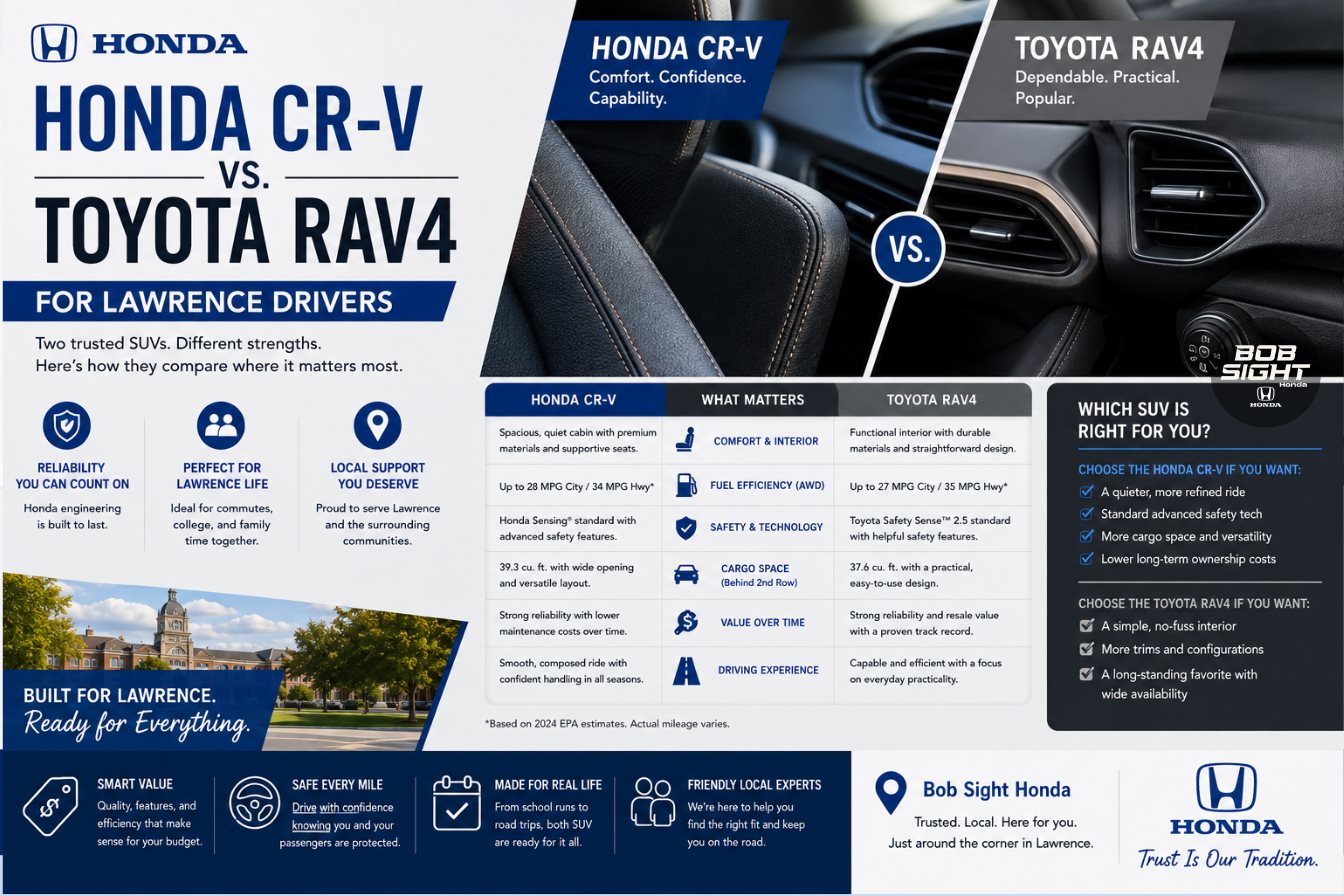
Choosing between the Honda CR-V and Toyota RAV4 is one of the most critical vehicle decisions for drivers navigating daily commutes across Lawrence, Douglas County, and the greater Kansas City metro area. Both of these compact crossover SUVs have earned strong reputations for long-term reliability, resale value, and practical daily versatility. However, when evaluating passenger room, interior refinement, hybrid powertrain smoothness, cargo flexibility, and real-world winter performance along Highway 10 or Iowa Street, the Honda CR-V establishes clear advantages for Midwest drivers. At Bob Sight Honda in Lawrence, KS, our team helps local shoppers compare key specifications, test-drive drive modes, and select the optimal compact SUV for their family budget and commute style.
Explore our current selection of versatile new crossovers by browsing our new Honda CR-V inventory in Lawrence, KS today.
In This Guide You'll Learn
This comprehensive comparison breaks down critical differences between the Honda CR-V and Toyota RAV4 to assist your shopping research:
- How passenger legroom, rear seat comfort, and overall cargo capacity compare in real-world use
- Performance and fuel economy differences between gas and hybrid powertrain options
- All-wheel-drive performance across Kansas winter snow, slush, and icy highway conditions
- Standard safety suites including Honda Sensing versus Toyota Safety Sense technology
- Step-by-step decision framework for selecting between CR-V trim levels
- Long-term ownership value, maintenance costs, and trade-in retention in Douglas County
Comparing the Honda CR-V and Toyota RAV4 for Kansas Drivers
The Honda CR-V provides superior rear-seat passenger legroom, a quieter cabin environment, and smoother power delivery compared to the Toyota RAV4, making it the preferred choice for Kansas commuters. While both vehicles represent heavyweights in the compact crossover class, the CR-V emphasizes elevated cabin ergonomics, refined driving dynamics, and intuitive technological integration. Drivers who frequently travel between Lawrence and Topeka on Interstate 70 will appreciate the CR-V balanced suspension tuning, which absorbs rough pavement patches and highway expansion joints far more effectively than the stiffer ride found in the RAV4.
Under the hood, the Honda CR-V offers a responsive 1.5-liter turbocharged four-cylinder gas engine alongside an advanced two-motor hybrid system, whereas the Toyota RAV4 relies on a naturally aspirated 2.5-liter engine or a traditional hybrid setup. The turbocharged Honda engine delivers peak torque at lower RPM levels, providing effortless acceleration when merging onto busy expressways like K-10 during peak morning rush hours. In comparison, the non-turbocharged RAV4 engine often produces excessive mechanical engine noise under heavy acceleration without providing a noticeable improvement in passing power.
Interior design philosophies also create a distinct separation between these two popular Japanese crossovers. The Honda CR-V features a clean, horizontal dashboard layout with honeycomb mesh trim hiding air vents, premium soft-touch materials across touchpoints, and clear sightlines that reduce blind spots. The Toyota RAV4 incorporates a bulkier, utility-focused dashboard with rubberized knobs that, while functional, feels dated and less sophisticated. For Douglas County families seeking a high-quality interior environment for daily school drop-offs and weekend road trips, the CR-V delivers a noticeably higher class of refinement.
Regional climate and driving habits further highlight the practical benefits of the CR-V design. Kansas winters bring unpredictable ice storms, freezing slush, and harsh winds across open farmland between Eudora and Baldwin City. The CR-V lower cowl height and wider front windshield supply exceptional forward visibility, helping drivers navigate hazardous road conditions with confidence. When combined with intelligent all-wheel-drive capability, the CR-V emerges as a well-rounded daily vehicle tailored to Midwest driving requirements.
Interior Comfort, Passenger Space, and Cargo Capacity Comparison
The Honda CR-V delivers class-leading rear legroom of 41.0 inches and up to 76.5 cubic feet of total cargo space, outclassing the Toyota RAV4 in both passenger comfort and utility. Interior dimension numbers directly translate into daily usability, especially when transporting adult passengers, installing child safety seats, or packing gear for weekend camping trips at Clinton State Park. The extra 3.2 inches of rear legroom in the CR-V allows taller passengers to stretch out comfortably during long journeys across Eastern Kansas without feeling cramped against the front seatbacks.
Rear door functionality is another area where the Honda CR-V demonstrates thoughtful engineering for busy parents and commuters. The rear doors on the CR-V open to a full 90-degree angle, creating a wide entryway that simplifies loading bulky car seats, groceries, or sports equipment. By contrast, the Toyota RAV4 rear doors open to a narrower angle, requiring extra maneuvering when placing infant carriers or securing young children into harness restraints in tight parking spaces along W 23rd Street.
Cargo management inside the Honda CR-V is enhanced by a low lift-over height and a dual-level cargo floor on non-hybrid models, allowing owners to maximize vertical storage space or create a flat loading surface when the 60/40 split rear seatbacks are folded down. The Toyota RAV4 offers 37.5 cubic feet of cargo space behind the second row and 69.8 cubic feet overall, which falls short of the CR-V expanded volume. Whether carrying luggage for a flight out of Kansas City International Airport or transporting home improvement supplies from local stores in Lawrence, the CR-V accommodates larger loads with greater ease.
The following table outlines key interior dimensions and capacity specifications comparing the Honda CR-V to the Toyota RAV4:
| Dimension / Feature | Honda CR-V | Toyota RAV4 |
|---|---|---|
| Front Legroom | 41.3 in. | 41.0 in. |
| Rear Legroom | 41.0 in. | 37.8 in. |
| Cargo Volume (Seats Up) | 39.3 cu. ft. (Gas) / 36.3 cu. ft. (Hybrid) | 37.5 cu. ft. |
| Maximum Cargo Volume (Seats Down) | 76.5 cu. ft. | 69.8 cu. ft. |
| Rear Door Opening Angle | Approximately 90 Degrees | Approximately 70 Degrees |
In addition to raw dimensional advantages, seat design in the Honda CR-V incorporates body-stabilizing front seats designed to reduce fatigue during extended highway driving. The supportive seat structure cradles the spine and pelvis, reducing lower back stress during long trips to Wichita or Kansas City. Combined with acoustic windshield glass and acoustic insulation, the CR-V creates a quiet, relaxing sanctuary that isolates occupants from road rumble and wind noise.
Performance, Powertrain Options, and All-Wheel-Drive Capability
The Honda CR-V utilizes a responsive 1.5-liter turbocharged engine generating 190 horsepower and 179 lb-ft of torque across a broad RPM range for effortless daily acceleration. Engine responsiveness is critical when merging onto fast-moving traffic along I-70 or passing agricultural vehicles on rural two-lane roads near Baldwin City. Because the turbocharger provides peak torque starting at low engine speeds, the CR-V accelerates smoothly without needing to downshift abruptly, resulting in a predictable and controlled driving experience.
The Toyota RAV4 features a standard 2.5-liter four-cylinder engine producing 203 horsepower and 184 lb-ft of torque paired with an 8-speed automatic transmission. Although the RAV4 boasts slightly higher peak horsepower on paper, its non-turbocharged engine requires high revs to deliver its power, creating loud engine buzz inside the passenger cabin under hard acceleration. The 8-speed transmission in the RAV4 can also feel indecisive when searching for gears during low-speed suburban driving around Lawrence neighborhoods.
All-wheel-drive capability is a vital consideration for Midwest drivers who encounter seasonal ice, deep snow, and heavy rain showers. The Honda Real Time AWD with Intelligent Control System continuously monitors traction demands, automatically transferring up to 50 percent of engine torque to the rear wheels when front-wheel slippage is detected. This system operates proactively during cornering and acceleration, preventing wheel slip before it happens rather than reacting after traction is lost on slick surfaces along Mass Street.
To further explain drivetrain terminology for shoppers, Real Time AWD refers to an automated system that engages rear-wheel traction electronically without requiring manual driver intervention. This system balances fuel efficiency during dry highway cruising with instant four-wheel traction when sensors detect rain, ice, or loose gravel. Combined with snow drive modes that adjust throttle sensitivity and traction control interventions, the CR-V provides reliable stability across all four Kansas seasons.
Hybrid Efficiency: CR-V Hybrid vs. RAV4 Hybrid on Kansas Highways
The Honda CR-V Hybrid utilizes an innovative two-motor hybrid system producing 204 horsepower and 247 lb-ft of instant electric torque, delivering seamless power and exceptional fuel efficiency. Unlike traditional hybrid setups that rely heavily on mechanical planetary gearsets, the Honda two-motor system uses one motor to drive the wheels and a second generator motor to charge the lithium-ion battery pack. This configuration enables direct electric-motor drive at low-to-medium speeds, providing rapid throttle response that feels similar to a fully electric vehicle when commuting around town.
Fuel economy performance for both hybrid models is highly competitive, making them ideal vehicles for drivers commuting daily between Lawrence and Olathe along K-10. The CR-V Hybrid achieves impressive EPA fuel economy ratings while providing direct, linear braking feel through its regenerative braking deceleration selectors. Paddle shifters mounted on the steering wheel allow drivers to adjust the level of regenerative braking resistance easily, allowing for smooth speed control down steep hills without overheating traditional friction brakes.
The Toyota RAV4 Hybrid utilizes a three-motor hybrid setup paired with a electronic continuously variable transmission. While the RAV4 Hybrid delivers solid fuel economy figures, its gasoline engine engages frequently with a noticeable mechanical thud, and the electronic control module can produce an unnatural rubber-band acceleration feel under heavy loads. In contrast, the Honda system simulates gear shifts during hard acceleration using linear shift control technology, creating a natural mechanical sound that mimics a conventional transmission.
Comparing these two hybrid paths highlights clear lifestyle advantages depending on daily commute demands:
- Urban and Suburban Commuting: The CR-V Hybrid operates in EV mode more frequently during stop-and-go driving, maximizing fuel savings on short trips through downtown Lawrence or university campus routes.
- Highway Travel and Merging: The massive 247 lb-ft of instant torque in the CR-V Hybrid allows drivers to join fast-flowing freeway traffic effortlessly without engine hesitation.
- Refinement and Cabin Quietness: Honda active noise cancellation technology actively counters unwanted powertrain frequencies, maintaining a serene interior environment during battery charging cycles.
- Brake Feel and Control: Steering-wheel regenerative paddle selectors give CR-V drivers fine control over vehicle deceleration, enhancing confidence on slippery winter roads.
Advanced Safety Technologies and Driver-Assist Features
Every Honda CR-V comes standard with the comprehensive Honda Sensing suite of safety and driver-assistive technologies designed to protect occupants on regional roadways. Using a wide-angle camera with a 90-degree field of view and millimeter-wave radar with a 120-degree field of view, the system accurately detects pedestrians, cyclists, road boundaries, and other vehicles. This broad detection angle improves system responsiveness when navigating busy intersections near Iowa Street or detecting sudden slowdowns on the highway.
Standard features within Honda Sensing include Collision Mitigation Braking System, Road Departure Mitigation, Adaptive Cruise Control with Low-Speed Follow, Lane Keeping Assist System, Forward Collision Warning, and Traffic Sign Recognition. Traffic Jam Assist is another crucial inclusion, combining gentle steering inputs with automatic speed adjustments during heavy stop-and-go traffic jams along I-70 near the Kansas City metro area, significantly reducing driver stress during afternoon commutes.
Toyota equips the RAV4 with Toyota Safety Sense, which includes a similar list of active safety technologies such as pre-collision warnings, dynamic radar cruise control, and lane tracing features. However, real-world testing demonstrates that Honda Sensing systems execute steering adjustments and braking interventions with greater smoothness. The lane-keeping assistance in the CR-V gently guides the vehicle toward the center of the lane without the abrupt, jerky steering inputs sometimes experienced in the RAV4.
Structural safety design in the Honda CR-V relies on Advanced Compatibility Engineering body structure. This proprietary body architecture distributes frontal crash energy more evenly across the vehicle frame, protecting the passenger cabin from intrusive forces during impacts with vehicles of varying sizes. Combined with standard side curtain airbags, front knee airbags, and rear side-impact airbags, the CR-V achieves top safety evaluation scores from independent testing agencies.
Cost of Ownership, Maintenance Schedules, and Long-Term Value
Predictable routine service schedules, exceptional build quality, and strong resale values make the Honda CR-V one of the most cost-effective long-term vehicle investments for Kansas families. Operating a crossover SUV in Douglas County requires consideration of ongoing oil changes, tire rotations, brake pad replacements, and fluid maintenance. The Honda Maintenance Minder system dynamically calculates service needs based on actual engine operating conditions, preventing premature fluid changes while ensuring critical components are serviced on schedule.
Routine oil changes for the CR-V require full synthetic 0W-20 engine oil meeting API SP and ILSAC GF-6A specifications, protecting internal turbocharger bearings and engine clearances during sub-zero winter starts. Scheduled service intervals occur roughly every 7,500 to 10,000 miles, aligning conveniently with tire rotations to ensure uniform tread wear across all four wheels. Maintaining proper tire tread depth is essential for preserving all-wheel-drive traction on slushy roadways during Kansas winters.
Resale value retention is a major strength for both the Honda CR-V and Toyota RAV4, as both vehicles retain high percentages of their original value over three-year to five-year ownership cycles. Strong pre-owned demand across the greater Kansas City market means that CR-V owners enjoy high trade-in equity when upgrading to newer models. Choosing a vehicle with proven residual value lowers your total cost of ownership significantly over time.
When evaluating dealership service support, local access makes a substantial difference in long-term ownership satisfaction. Servicing your vehicle at Bob Sight Honda in Lawrence ensures that factory-trained technicians install genuine OEM parts, update onboard computer software, and maintain complete service records that validate factory warranty coverage. Local service convenience eliminates the need to travel long distances for routine oil changes or maintenance checkups.
Step-by-Step Buying Guide: Choosing the Right Compact SUV in Lawrence
Selecting the ideal compact crossover requires matching your daily driving requirements, family size, and winter commuting needs to the correct trim level and powertrain configuration. Navigating the vehicle purchase process structured around clear research steps ensures that you secure a vehicle that meets your long-term lifestyle needs without exceeding your desired monthly budget.
Follow these practical steps when shopping for a compact SUV in Douglas County:
- Identify Your Commute Profile and Mileage Expectations: Calculate your average weekly driving mileage across Lawrence, Topeka, or Kansas City. If your routine involves heavy stop-and-go city driving, prioritize the CR-V Hybrid for maximum fuel savings; if you drive mostly long highway distances on I-70, the gas 1.5L turbocharged engine offers excellent value.
- Evaluate Drivetrain Requirements for Winter Weather: Determine whether front-wheel drive satisfies your daily driving habits or if Real Time AWD is necessary for navigating snow-covered side streets and steep driveways during winter storms.
- Compare Interior Trim Features and Convenience Options: Review key interior features across trim levels, such as leather-trimmed seating, power tailgate functionality, wireless Apple CarPlay and Android Auto integration, and heated front seats.
- Schedule a Comprehensive Test Drive in Lawrence: Visit our showroom to test-drive the CR-V along local routes including K-10 and urban streets, testing forward visibility, turning radius, cabin quietness, and seat comfort.
- Evaluate Trade-In Value and Financing Terms: Utilize online trade-in estimation tools to determine your current vehicle equity, and review current finance specials or lease offers available through our finance department.
Taking a structured approach to your vehicle purchase removes guesswork and allows you to compare models with complete clarity. Our knowledgeable sales representatives at Bob Sight Honda assist you at every step, providing transparent specifications and flexible scheduling for test drives.
Once you select your preferred CR-V trim level, our team assists with customizing genuine accessories, such as all-season rubber floor mats, roof rack crossbars, and cargo trays designed to protect your vehicle interior from Kansas mud and snow. Tailoring your vehicle from day one enhances daily practicality throughout your ownership journey.
Real-World Driving Scenarios Across Douglas County and Kansas City
Real-world driving conditions in Eastern Kansas highlight the practical engineering differences between the Honda CR-V and Toyota RAV4 across varied road environments. From stop-and-go traffic near the University of Kansas campus to high-speed travel across open rural highways in Douglas County, a vehicle must adapt quickly to changing road surfaces, wind conditions, and traffic flow.
Consider these common local driving scenarios and how the Honda CR-V performs:
- Navigating Iowa Street Retail Traffic: Frequent traffic lights and short turn lanes demand responsive low-speed acceleration and excellent sightlines. The low cowl height, slim A-pillars, and instant electric torque of the CR-V Hybrid allow drivers to maneuver through busy shopping corridors smoothly.
- Cruising K-10 Highway to Johnson County: Sustained 70 MPH highway speeds test cabin noise isolation and stability against crosswinds. The CR-V acoustic windshield and body-stabilizing seats reduce fatigue, while adaptive cruise control maintains safe follow distances automatically.
- Winter Commuting After a Snowstorm in Eudora: Unplowed residential roads and slippery highway ramps require intelligent traction management. The Real Time AWD system distributes power instantly to wheels with grip, keeping the crossover stable when accelerating through slushy intersections.
- Weekend Trips to Clinton Lake or Camping Sites: Transporting outdoor gear, coolers, and sports equipment requires flexible cargo capacity. The wide rear hatch opening and low cargo floor height of the CR-V make loading heavy gear effortless compared to narrower cargo holds.
These real-world scenarios demonstrate why thoughtful design choices matter far more than catalog specifications alone. By prioritizing driver visibility, ergonomic comfort, and smooth power delivery, the Honda CR-V excels across every environment Midwest drivers encounter daily.
Quick Facts: Honda CR-V vs. Toyota RAV4 Comparison
A quick comparison of core features highlights key areas where the Honda CR-V establishes clear leadership over the Toyota RAV4:
- Rear Seat Space: Honda CR-V offers 41.0 inches of rear legroom versus 37.8 inches in the Toyota RAV4.
- Total Cargo Capacity: Honda CR-V provides up to 76.5 cubic feet of maximum cargo space compared to 69.8 cubic feet in the RAV4.
- Gas Engine Design: CR-V features a smooth 1.5L turbocharged engine with early torque delivery; RAV4 uses a non-turbocharged 2.5L engine.
- Hybrid Performance: CR-V Hybrid generates 247 lb-ft of instant torque from its two-motor electric drive system.
- Safety Technology: Honda Sensing suite comes standard across all CR-V trim levels, featuring Traffic Jam Assist and wide-angle radar.
These factual advantages reinforce why the Honda CR-V consistently earns top ratings from automotive journalists and daily drivers alike. Selecting a crossover that excels in interior space and powertrain smoothness ensures long-term satisfaction for years to come.
Ownership Planning and Winter Driving Strategy for Kansas Families
Developing a long-term maintenance and winter preparation strategy ensures your compact SUV remains safe, efficient, and reliable through years of Midwest driving. Severe temperature drops, freezing rain, and corrosive road salt applied to Kansas highways demand proactive vehicle care to preserve mechanical integrity and body finish.
Winter vehicle preparation should begin in autumn before freezing weather arrives in Douglas County. Key winter care steps include inspecting tire tread depth to maintain traction on icy roads, testing battery cold cranking amps to prevent cold-morning starting failures, and filling washer fluid reservoirs with freeze-resistant cleaning solution. Equipping your CR-V with genuine Honda all-season high-wall floor mats protects interior carpet from melted snow, mud, and salt stains tracked in from parking lots.
Long-term mechanical protection relies on following recommended service intervals for engine oil, fluid flushes, and filter replacements. The Honda Maintenance Minder system alerts you when service is due, allowing you to schedule convenient appointments at our Lawrence service department. Regular multi-point inspections performed by factory-certified technicians identify minor wear on brake pads, serpentine belts, and suspension bushings before they turn into costly repairs.
Adopting proper winter driving habits further protects your vehicle investment. Allowing the engine to idle briefly on cold mornings ensures synthetic oil circulates fully to upper valvetrain components before driving under load. Rinsing the vehicle undercarriage periodically during winter months removes accumulated road salt, protecting brake lines, suspension arms, and exhaust components from premature corrosion.
Frequently Asked Questions About the Honda CR-V vs. Toyota RAV4 in Lawrence
Is the Honda CR-V or Toyota RAV4 better for families in Lawrence, KS?
The Honda CR-V is generally better suited for Kansas families due to its superior 41.0 inches of rear legroom, wider rear door opening angles, and larger total cargo capacity of 76.5 cubic feet. The extra rear legroom makes installing bulky rear-facing infant car seats much easier without forcing the front passenger to slide their seat forward uncomfortably. Additionally, the 90-degree rear door openings provide a wide entry space that simplifies loading young children and sports gear during daily school drop-offs in Lawrence.
Interior cabin refinement is another key area where the CR-V excels for family use. The CR-V incorporates high-quality interior materials, body-stabilizing front seats, and acoustic sound insulation that creates a quiet, low-stress environment on long road trips across Eastern Kansas. The lower cargo lift-over height also allows parents and older children to load heavy groceries or backpacks into the rear cargo area without straining.
While the Toyota RAV4 offers competitive safety features, its narrower rear door openings, smaller rear legroom, and noisier cabin under acceleration make it less accommodating for growing families. Bringing your family to Bob Sight Honda in Lawrence allows you to test rear seat space firsthand and experience how the CR-V caters to daily family transportation needs.
How does all-wheel-drive performance compare between the CR-V and RAV4 on snow and ice?
Both vehicles offer capable all-wheel-drive systems, but the Honda Real Time AWD with Intelligent Control System delivers smoother, more proactive traction engagement on icy Kansas roads. The Honda system continuously monitors steering angle, wheel speed sensors, and throttle inputs to transfer up to 50 percent of engine torque to the rear wheels before front-wheel slippage occurs. This proactive power distribution helps maintain directional stability when accelerating onto slick highway ramps along K-10 or I-70 during winter snowstorms.
The Toyota RAV4 offers dynamic torque vectoring on select gas trims and an electronic AWD system on hybrid models. While effective, the RAV4 electronic rear motor on hybrid trims can feel delayed when engaging on sudden ice patches, leading to brief front-wheel spin before four-wheel traction kicks in. The mechanical link and electronic control in the Honda Real Time AWD system provide a more consistent, confidence-inspiring driving feel on slippery surfaces.
In addition to all-wheel-drive hardware, the Honda CR-V includes a dedicated Snow drive mode that recalibrates throttle mapping and transmission shift points to reduce wheel spin on loose snow. Paired with adequate tire tread depth, the CR-V provides reliable winter mobility across Douglas County during harsh Midwest weather events.
Should I buy a Honda CR-V Gas model or CR-V Hybrid for daily commuting in Kansas?
Choosing between the gas and hybrid CR-V depends on your commute style, but the CR-V Hybrid is ideal for city drivers seeking maximum fuel efficiency and instant electric torque. The CR-V Hybrid delivers 204 horsepower and 247 lb-ft of torque from its two-motor electric system, making stop-and-go driving through downtown Lawrence or urban Kansas City traffic exceptionally smooth and quiet. Regenerative braking paddle selectors also allow hybrid drivers to control speed without wearing down traditional brake pads during city driving.
If your daily routine consists mostly of high-speed highway travel between Lawrence and Topeka on I-70, the gas 1.5-liter turbocharged CR-V engine offers outstanding value and fuel economy. The 190-horsepower turbocharged engine provides strong passing power and low-RPM torque while carrying a lower initial purchase price, making it an economical choice for long-distance highway commuters.
Both powertrain options deliver excellent long-term reliability and high trade-in retention. Visiting Bob Sight Honda allows you to test-drive both the gas turbocharged engine and the two-motor hybrid powertrain back-to-back along local highways to determine which driving experience matches your personal preferences.
Does the Honda CR-V hold its resale value well in the Kansas City market?
Yes, the Honda CR-V consistently ranks among the top compact crossover SUVs for resale value retention and trade-in equity in the greater Kansas City area. Thanks to its proven mechanical durability, strong safety record, and high consumer demand, the CR-V retains a high percentage of its original value over three-year to five-year ownership cycles. High residual values translate directly into lower monthly lease payments and greater trade-in equity when you decide to upgrade vehicles.
Pre-owned buyers across Douglas County actively seek out used Honda CR-V models due to their reputation for trouble-free operation well past 100,000 miles. Maintaining complete service records at an authorized dealership like Bob Sight Honda further enhances your vehicle trade-in valuation, proving that all factory-recommended fluid changes and inspections were performed on schedule.
While the Toyota RAV4 also enjoys strong resale values, the CR-V higher interior build quality and timeless styling help pre-owned models maintain a premium market appeal. Investing in a CR-V protects your financial capital while providing safe, comfortable daily transportation.
Where can I service my Honda CR-V near Lawrence, KS?
You can service your Honda CR-V at Bob Sight Honda located conveniently in Lawrence, KS, where factory-trained technicians provide comprehensive maintenance using genuine OEM parts. Our modern service department is equipped with specialized diagnostic equipment engineered specifically for advanced Honda powertrains, Sensing radar calibration, and hybrid electric systems. From routine oil changes to complete brake system overhauls, our service team handles all maintenance needs efficiently.
Servicing your vehicle at our dealership guarantees that your maintenance records are automatically logged in the official central database, protecting your factory warranty coverage. We also offer convenient online scheduling, a comfortable customer lounge with complimentary Wi-Fi, and Express Service lanes for quick routine maintenance visits without long wait times.
Whether you reside in Lawrence, Eudora, Baldwin City, or Topeka, Bob Sight Honda serves as your trusted local destination for expert care. Schedule your next service appointment online or visit our service center to keep your CR-V performing in peak condition.
Why Choosing a Local Lawrence Dealership Makes the Difference
Purchasing and servicing your vehicle at Bob Sight Honda ensures you receive personalized, community-focused support backed by automotive sales and service expertise. As a locally grounded dealership serving Lawrence, Douglas County, and surrounding Kansas communities, we pride ourselves on building long-term relationships with our customers. Our sales approach focuses on clear information, transparent communication, and helping you find the exact vehicle that fits your daily life.
Supporting local business keeps your tax dollars working directly within Douglas County, funding community schools, public infrastructure, and local parks. Beyond community investment, buying locally provides unmatched convenience when scheduling routine service visits, pick-up arrangements, or acquiring genuine accessories. Our friendly staff is always available to answer technical questions, explain feature operations, or assist with vehicle technology settings long after your purchase is complete.
Whether you are researching your first compact crossover or upgrading your current family vehicle, Bob Sight Honda is committed to delivering an exceptional dealership experience. Visit our modern showroom on Iowa Street in Lawrence, KS, to test-drive the Honda CR-V and experience the difference our team brings to automotive retail.
Helpful Links
Explore these key dealership links to research inventory, schedule service, or evaluate trade-in options online:
- New Honda CR-V Inventory in Lawrence, KS
- Value Your Trade-In Online
- Pre-Owned Vehicle Inventory in Lawrence
- Schedule Service at Bob Sight Honda
- Why Buy From Bob Sight Honda
Proud to Be Part of the Bob Sight Auto Group
Bob Sight Honda is proud to serve drivers across Lawrence and Eastern Kansas as a member of the family-owned Bob Sight Auto Group. For generations, our automotive group has provided exceptional customer care, transparent automotive sales, and expert service across the Kansas City region. Explore our group dealership locations below to find sales, service, or collision repair near you: