Honda Maintenance Minder Codes in Lawrence, KS: What A, B, and Service Subcodes Mean
Schedule Honda service in Lawrence, Kansas
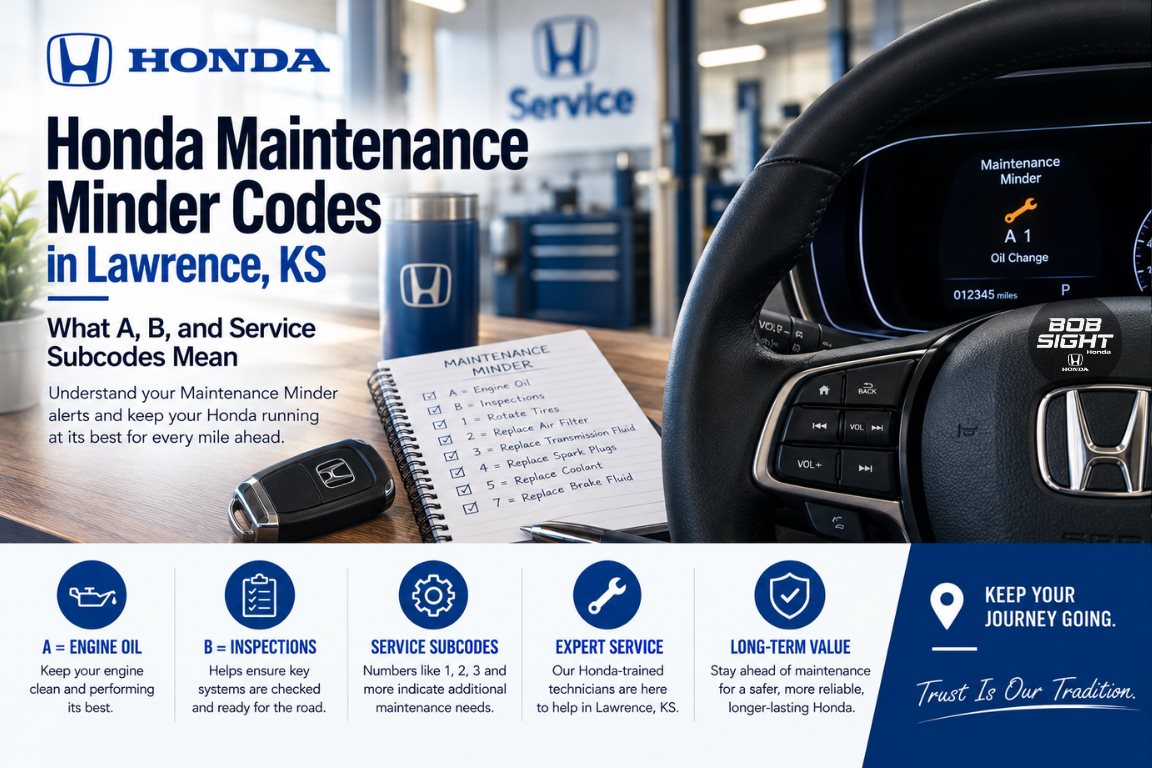
Honda Maintenance Minder codes tell Lawrence drivers which maintenance services their vehicles currently need, with letters identifying main services and numbers identifying additional service items. An A code generally calls for engine oil replacement, while a B code includes engine oil and oil-filter replacement plus a broader group of inspections. Numbered subcodes can identify services such as tire rotation, air-filter replacement, transmission-fluid replacement, spark-plug service, coolant replacement, rear differential-fluid replacement, or brake-fluid replacement. The exact codes and procedures depend on the Honda model, model year, engine, drivetrain, and market.
Understanding these codes helps Honda owners respond to vehicle needs without relying on a one-size-fits-all mileage schedule. The Maintenance Minder monitors operating conditions and calculates oil life based on how the vehicle is driven. Short trips around Lawrence, highway commuting on K-10, seasonal temperature changes, towing, and extended travel can affect how quickly service becomes due. The displayed code gives the owner a more specific starting point for planning a maintenance visit.
At Bob Sight Honda, drivers from Lawrence, Topeka, Eudora, Baldwin City, Olathe, Overland Park, Douglas County, and the Kansas City Metro can receive vehicle-specific maintenance guidance. A service advisor can review the code, mileage, model information, service history, and current condition before recommending work. This guide explains the common Honda Maintenance Minder codes, what the oil-life percentages mean, and how to prepare for your next appointment. Always confirm the requirements for your exact vehicle in its owner's manual because code definitions and maintenance procedures can vary.
In This Guide You’ll Learn
This guide explains how to read Honda Maintenance Minder messages and connect each displayed code with the correct maintenance conversation. It covers the A and B main items, common numbered subcodes, oil-life percentages, warning timing, and model-specific differences. It also explains why a code should be interpreted together with your Honda's service history and operating conditions. The goal is to help Lawrence-area owners make informed maintenance decisions without guessing.
- How the Honda Maintenance Minder system works
- What the A and B main service codes generally mean
- What Honda subcodes 1 through 7 can identify
- How to interpret 15 percent, 5 percent, and 0 percent oil-life displays
- Why codes can vary by model, powertrain, and drivetrain
- What to do when multiple codes appear together
- How to prepare for Honda service in Lawrence, Kansas
The Maintenance Minder is intended to support timely maintenance, but it is not a substitute for owner awareness. Fluid leaks, abnormal noises, warning lights, tire damage, changes in braking, overheating, or other concerns should be addressed when they occur. Owners should not wait for a Maintenance Minder code when the vehicle shows a separate problem. A code is a planned-maintenance signal, not a complete mechanical diagnosis.
How Does the Honda Maintenance Minder System Work?
Honda Maintenance Minder estimates when maintenance is due by monitoring engine operating conditions and displaying calculated engine-oil life as a percentage. The system does not simply count a fixed number of miles between oil changes. It considers vehicle operation to estimate how quickly the engine oil is being used. When service approaches, the driver information display presents an oil-life percentage along with applicable maintenance codes.
The displayed percentage represents estimated remaining engine-oil life, not the physical amount of oil inside the engine. A display of 30 percent does not mean the oil pan contains only 30 percent of its required oil. It means the system estimates that approximately 30 percent of the oil's calculated service life remains. Owners must still check the engine-oil level according to the instructions in the owner's manual because Maintenance Minder does not replace level checks.
Operating conditions influence the calculation. Repeated short trips may prevent the engine from remaining at full operating temperature for long periods. Stop-and-go traffic near the University of Kansas or along 23rd Street can create a different operating pattern than steady travel on I-70. Summer heat, winter cold, idling, towing, hills, and accumulated highway mileage can also shape maintenance timing.
The system combines a main maintenance item with one or more sub-items. A letter such as A or B identifies the primary service category. A number such as 1, 2, or 3 identifies another maintenance item due at the same time. A display such as A1 therefore communicates more information than an oil-life percentage alone.
Honda advises owners to follow the Maintenance Minder information shown by their vehicles and the requirements in the applicable owner's manual. Some time-based services may still be required if a Maintenance Minder message does not appear within a specified period. Maintenance needs can also differ among gasoline, hybrid, electric, front-wheel-drive, and all-wheel-drive models. The exact manual for the vehicle identification number and model year remains the controlling source.
What Do Honda Oil-Life Percentages Mean?
The Honda oil-life percentage estimates how much useful engine-oil life remains and becomes more urgent as the display approaches zero. A higher percentage indicates that routine oil service is not yet near its calculated due point. At 15 percent, maintenance is approaching and the owner should begin planning an appointment. At 5 percent, service is due soon, while 0 percent indicates that calculated oil life has been exhausted.
| Oil-Life Display | General Meaning | Recommended Owner Response |
|---|---|---|
| 100 percent | The system was recently reset after qualifying service | Continue normal driving and monitor the display |
| 30 percent | Calculated oil life remains, but service is getting closer | Review future travel and maintenance plans |
| 15 percent | Maintenance is due soon | Review the displayed code and arrange service |
| 5 percent | Maintenance is due now | Schedule service promptly |
| 0 percent | Calculated oil life has reached its service limit | Complete the indicated maintenance without unnecessary delay |
| Negative mileage | The vehicle has traveled beyond the calculated maintenance point | Arrange the required service as soon as practical |
At 15 percent, many Honda vehicles display a maintenance message whenever the vehicle is started or the relevant information screen is selected. This is the useful planning stage. A Lawrence driver with an upcoming trip to Topeka, Kansas City, or another destination can schedule maintenance before adding substantial mileage. Waiting until a long trip begins can make routine service more difficult to fit into the schedule.
At 5 percent, the vehicle is communicating that the calculated service point has arrived. The owner should confirm all displayed letters and numbers rather than requesting only an oil change. A code such as B16 may indicate that several maintenance items are due together. Completing only one item can leave other indicated services unfinished.
When the display reaches 0 percent and begins showing negative mileage, the system is tracking how far the vehicle has traveled beyond the calculated service point. Negative mileage is not a separate diagnostic trouble code. It is an overdue-maintenance counter connected to the Maintenance Minder calculation. Owners should not reset the display simply to remove the reminder.
The oil-life display also does not identify the cause of a low oil level, oil-pressure warning, leak, or engine concern. An oil-pressure warning light requires a different and more urgent response than a routine Maintenance Minder notification. If the red oil-pressure warning appears, follow the owner's manual instructions and avoid assuming that a routine oil change is the only issue. Planned maintenance indicators and critical warning lights serve different purposes.
What Does Honda Maintenance Minder Code A Mean?
Honda Maintenance Minder code A generally means that the engine oil should be replaced. The A code may appear by itself or with one or more numbered subcodes. An A1 message, for example, generally combines engine-oil replacement with tire rotation. Owners should read every character because the number adds another required maintenance item.
Engine oil lubricates internal parts, carries heat, helps manage contaminants, and supports the operation of systems that depend on proper oil pressure. Over time, heat, combustion byproducts, moisture, and normal use reduce its ability to perform those jobs. Honda's Maintenance Minder estimates when replacement is appropriate based on vehicle operation. The correct oil type and viscosity depend on the exact engine and model year.
Many recent Honda gasoline and hybrid models specify a low-viscosity oil such as SAE 0W-20, but owners should never assume that specification without checking the oil-fill cap and owner's manual. Honda generally directs owners to use oil meeting current API certification requirements stated for the vehicle. Viscosity describes how oil flows at lower and higher temperatures, while an API certification identifies performance standards. Using the specified oil supports lubrication, efficiency, and emissions-system requirements.
An A code does not mean other vehicle systems should be ignored. A service visit may still include a general review of visible conditions, warning indicators, tire pressure, fluid levels, or customer-reported concerns. The code identifies the scheduled main item, while technicians and owners remain responsible for noticing other safety or condition issues. If the vehicle has a leak, abnormal sound, or warning light, mention it when arranging the appointment.
Consider a Honda Civic used for daily trips from west Lawrence to the university area. Frequent starts, short trips, traffic, and seasonal temperature changes may produce a different oil-life pattern than a Civic driven mainly on steady highway routes. The Maintenance Minder adapts its estimate to operation rather than forcing both vehicles into the same mileage assumption. That is why the dashboard percentage is often more useful than relying on an oil-change interval remembered from a different vehicle.
What Does Honda Maintenance Minder Code B Mean?
Honda Maintenance Minder code B generally calls for engine-oil and oil-filter replacement plus a defined group of inspections. The inspection list can include the front and rear brakes, steering components, suspension components, driveshaft boots, brake lines and hoses, fluid levels and condition, exhaust-system components, and fuel lines and connections. Exact B-service requirements vary by Honda model and model year. The owner's manual should be used to confirm the complete list.
The oil filter captures contaminants circulating through the lubrication system. Replacing it during a B service helps the fresh engine oil circulate through a clean filter designed for the application. The broader inspection portion gives a technician an opportunity to identify visible wear, damage, leakage, or deterioration. An inspection does not mean that every inspected part will require replacement.
Brake inspection is particularly relevant for vehicles used in repeated city traffic. Stop-and-go driving near downtown Lawrence, school zones, campus streets, and busy shopping areas creates frequent braking events. A technician may review pad thickness, rotor condition, caliper operation, brake hoses, lines, and other specified items. Brake pads and rotors are wear components, so their remaining life depends on driving habits and conditions rather than the B code alone.
Steering, suspension, and driveshaft-boot inspections also matter in Kansas. Potholes, broken pavement, winter road treatments, gravel, and freeze-thaw cycles can affect components beneath the vehicle. A damaged boot can allow lubricant to escape or contaminants to reach a joint. Identifying a condition during a planned inspection may allow the owner to address it before it becomes more disruptive.
A B service should be interpreted together with any numbered subcodes displayed. B1 generally adds tire rotation, while B12 commonly adds tire rotation and air-cleaner or cabin-filter service. A more complex display can include transmission, coolant, differential, or brake-fluid items when applicable. Ask the service advisor to list each code and recommended procedure separately so the complete visit is easy to understand.
What Do Honda Maintenance Minder Subcodes 1 Through 7 Mean?
Honda Maintenance Minder subcodes identify additional services due with the main A or B item, and their exact meaning must be confirmed for the individual vehicle. Common Honda subcodes cover tire rotation, filters, transmission fluid, spark plugs, valve-clearance inspection, engine coolant, rear differential fluid, and brake fluid. Not every Honda uses every numbered code. Electric and hybrid vehicles may also display maintenance needs that differ from conventional gasoline models.
| Common Subcode | Typical Maintenance Item | Important Qualification |
|---|---|---|
| 1 | Rotate tires | Tires should also be inspected for pressure, wear, damage, and uneven tread |
| 2 | Replace the engine air-cleaner element and dust-and-pollen filter; inspect the drive belt where applicable | Requirements and severe-condition guidance vary by model |
| 3 | Replace transmission fluid | Use the Honda-specified fluid and procedure for the exact transmission |
| 4 | Replace spark plugs and inspect valve clearance; additional timing-related service may apply to certain engines | Requirements differ by engine design and model year |
| 5 | Replace engine coolant | Use the specified coolant and follow air-bleeding and disposal procedures |
| 6 | Replace rear differential fluid on applicable all-wheel-drive models | Not applicable to vehicles without the relevant rear differential |
| 7 | Replace brake fluid | Time-based replacement guidance may apply even if the code does not appear |
Subcode 1 addresses tire rotation, which helps manage tread wear among tire positions. Rotation does not repair alignment problems, damaged tires, or incorrect pressure. A technician should review tread depth, visible damage, inflation, and wear patterns while the tires are being moved. Uneven wear may indicate an alignment, suspension, inflation, or driving-condition concern that requires separate evaluation.
Subcode 2 commonly covers the engine air-cleaner element, dust-and-pollen filter, and drive-belt inspection where applicable. The engine filter helps limit airborne contaminants entering the engine, while the cabin filter supports airflow through the heating and air-conditioning system. Dusty roads near rural Douglas County, construction, pollen, and airborne debris can influence filter condition. Honda may provide accelerated replacement guidance for certain severe operating conditions.
Subcode 3 generally identifies transmission-fluid replacement. Honda transmissions require the correct fluid and service procedure for their design. A continuously variable transmission, conventional automatic transmission, hybrid drive unit, and other applications should not be treated as interchangeable. Using the specified fluid is important for lubrication, hydraulic operation, cooling, friction characteristics, and shift quality.
Subcode 4 commonly includes spark-plug replacement and valve-clearance inspection on applicable engines. Certain Honda engines may also have timing-belt-related service associated with this maintenance point, while chain-driven engines follow different requirements. Spark plugs help ignite the air-fuel mixture in gasoline engines, and valve clearance refers to the measured space within the valvetrain. Because engine designs vary, the code must be matched to the exact vehicle rather than interpreted from a generic chart alone.
Subcode 5 generally means engine-coolant replacement. Coolant transfers heat, supports freeze protection, raises the boiling point, and contains additives that help protect the cooling system. Kansas temperatures can range from winter freezes to demanding summer heat, making correct coolant condition important. Owners should use the Honda-specified coolant and avoid mixing products without confirming compatibility.
Subcode 6 generally applies to rear differential-fluid replacement on applicable all-wheel-drive models. The rear differential helps distribute torque within the rear drive system. Its fluid lubricates gears, bearings, and clutch-related components where used. A front-wheel-drive Honda without the applicable rear differential would not require this service.
Subcode 7 generally identifies brake-fluid replacement. Brake fluid transfers hydraulic pressure when the driver presses the brake pedal and can absorb moisture over time. Honda owner information may specify a time-based interval when the Maintenance Minder message does not appear within the stated period. Owners should follow their exact manual and avoid assuming that a normal brake-pedal feel proves the fluid never needs service.
What Do Combined Honda Service Codes Mean?
A combined Honda Maintenance Minder code means that the main letter service and every displayed numbered subcode are due during the same maintenance period. A1 generally combines engine-oil replacement with tire rotation. B12 generally combines the B service with tire rotation and filter-related maintenance. A code such as B16 can combine oil and filter service, inspections, tire rotation, and applicable rear differential-fluid replacement.
Combined codes help owners group maintenance efficiently. Rather than scheduling separate visits for services approaching at similar times, the system displays the items together. This can reduce unnecessary repeat appointments and helps create a complete service record. The owner should still ask for a clear explanation of every item before work begins.
| Example Code | General Interpretation |
|---|---|
| A1 | Replace engine oil and rotate tires |
| B1 | Replace engine oil and filter, complete B inspections, and rotate tires |
| B12 | Complete B service, rotate tires, and perform applicable filter and drive-belt items |
| A13 | Replace engine oil, rotate tires, and replace applicable transmission fluid |
| B16 | Complete B service, rotate tires, and replace applicable rear differential fluid |
| B17 | Complete B service, rotate tires, and replace brake fluid |
These examples are general interpretations and may not apply identically to every Honda. The same numbered code can require vehicle-specific procedures, parts, and fluids. A Pilot with all-wheel drive has different drivetrain-maintenance considerations from a front-wheel-drive Accord. A hybrid CR-V also differs from a gasoline-only model even when the display contains familiar letters and numbers.
Use the following process when a combined code appears:
- Photograph or write down the full display. Include the oil-life percentage, letter, numbers, and any accompanying message.
- Record the current mileage. Mileage helps the advisor review maintenance history and model-specific needs.
- Check the owner's manual. Locate the Maintenance Minder table for the exact model and model year.
- Review previous service records. Confirm whether any displayed item was recently completed but not properly documented or reset.
- Schedule the complete service. Provide the entire code rather than requesting only an oil change.
- Discuss other symptoms separately. Mention warning lights, sounds, leaks, vibration, braking changes, or drivability concerns.
- Save the completed repair order. Keep the date, mileage, code, services, fluids, and parts in your records.
A Lawrence driver who sees B16 before a trip to Kansas City should not interpret it as a generic oil-change reminder. The 1 can indicate tire rotation, and the 6 can identify rear differential service on an applicable all-wheel-drive model. Completing only the oil and filter could leave two displayed maintenance needs unresolved. Sharing the complete code helps the service team prepare accurately.
Why Honda Maintenance Codes Vary by Model and Powertrain
Honda Maintenance Minder codes vary because different models use different engines, transmissions, drivetrains, fuel systems, batteries, cooling systems, and maintenance components. A gasoline Civic, CR-V Hybrid, all-wheel-drive Pilot, Ridgeline, Odyssey, and Prologue do not have identical mechanical layouts. A universal code chart can provide a starting point but cannot replace the owner's manual. Vehicle-specific interpretation protects against ordering the wrong service or fluid.
Drivetrain creates one clear difference. An all-wheel-drive Honda may use a rear differential that requires fluid service, while a front-wheel-drive model does not have the same rear-drive system. Transmission designs also differ among Honda vehicles. A conventional automatic, continuously variable transmission, and electrified drive unit require different fluids, capacities, and procedures.
Engine design changes the meaning of certain maintenance items. Gasoline engines use spark plugs, engine oil, filters, and a cooling system, but timing-system requirements vary. Some engines use a timing belt, while others use a timing chain. Hybrid models add high-voltage components and power electronics, though routine owner maintenance still includes familiar items such as tires, brake fluid, cabin filtration, and cooling-system care.
Electric vehicles introduce a different maintenance profile because they do not use gasoline-engine oil or spark plugs. They still require tire care, brake inspections, brake fluid, cabin filtration, cooling-system checks, and other vehicle-specific maintenance. Regenerative braking can change how friction brakes are used, but it does not eliminate brake inspection. Owners should follow the electric vehicle's specific Maintenance Minder information rather than a chart written for gasoline models.
Model-year changes also matter. Honda can revise powertrains, fluids, service codes, software, filters, and recommended procedures between generations. Advice that was correct for an older Accord may not apply to a current Accord Hybrid. Always identify the model year, model, trim, engine or powertrain, drivetrain, and VIN when discussing maintenance.
How Kansas Driving Conditions Affect Honda Maintenance
Kansas heat, winter cold, wind, dust, road construction, potholes, and mixed city-highway driving can influence how quickly Honda maintenance needs develop. The Maintenance Minder adapts its engine-oil calculation to operating conditions, but owners should remain alert to conditions outside the oil-life display. Tires, batteries, brakes, filters, wipers, fluids, and suspension components can be affected by seasonal use. Local maintenance planning should address the complete vehicle.
Summer heat places additional demand on the cooling system, air conditioning, battery, and tires. Tire pressure changes with temperature, and sustained highway speeds create additional heat within the tire structure. Drivers traveling from Lawrence to Topeka or Kansas City should inspect pressure and visible condition before longer trips. Cooling-system concerns should be addressed promptly rather than waiting for code 5.
Winter temperatures can reduce 12-volt battery performance and lower tire pressure. Snow, ice, freezing rain, and road treatments affect traction and visibility. Wiper blades, washer fluid, defrosters, exterior lighting, brakes, and tires deserve seasonal attention. An upcoming Maintenance Minder service can be a useful time to request a winter-readiness inspection.
Dust and debris can affect engine and cabin filters. Gravel roads near Baldwin City, rural Eudora, construction zones, and dry summer conditions may expose the vehicle to more airborne material than steady paved-road driving. Honda owner information may provide additional guidance for dusty conditions. Filter condition should be evaluated rather than assumed from appearance outside the housing.
Potholes and damaged pavement can influence tire wear, wheels, alignment, steering, and suspension. A tire rotation under subcode 1 creates an opportunity to inspect tread patterns and damage. Rotation can help promote even wear, but it cannot correct an alignment problem. If the steering wheel becomes off-center or the vehicle pulls, vibrates, or develops irregular tire wear, request an evaluation without waiting for the next code.
What Should You Do When a Maintenance Minder Code Appears?
When a Honda Maintenance Minder code appears, record the complete code, review the owner's manual, check service history, and schedule the indicated maintenance before it becomes overdue. Do not focus only on the oil-life percentage. The letter and numbers explain which services need attention. Acting at the 15-percent stage provides time to plan around work, school, travel, and family schedules.
Begin by viewing the complete maintenance screen. Display controls vary by model, so consult the owner's manual if the message disappears from the main screen. Record every character exactly as shown. A missing subcode can change the requested service.
Next, compare the message with your records. If a service was completed recently but the code remains, the system may not have been reset correctly. Do not assume the vehicle needs the same work again, and do not reset it without confirming what was completed. Accurate resets are important because the system uses the new starting point for future reminders.
- Capture the code and oil-life percentage. Take a clear photo of the driver information display.
- Note the mileage and model information. Include model year, model, trim, powertrain, and drivetrain when known.
- Review the correct manual. Confirm the listed services and time-based requirements.
- Check maintenance records. Identify the last oil, tire, transmission, coolant, differential, filter, and brake-fluid services.
- Schedule with the complete information. Share the code and any separate vehicle concerns.
- Approve services after reviewing them. Ask what each item does and why it applies to your Honda.
- Confirm the reset after service. The reset should occur only after the required maintenance has been completed.
- Keep the repair order. Store documentation for future maintenance, warranty questions, and ownership history.
Drivers can use the Bob Sight Honda service scheduler to request an appointment in Lawrence. Include the displayed Maintenance Minder code in the appointment notes when possible. If the vehicle has a separate safety or drivability concern, state it clearly rather than listing only routine maintenance. This helps the service team distinguish planned service from diagnostic needs.
If a critical warning light appears, respond according to the owner's manual instead of waiting for a routine appointment. Oil pressure, overheating, brake-system, charging-system, and other warnings can signal conditions requiring immediate attention. The Maintenance Minder is designed for scheduled maintenance. It does not replace the vehicle's warning and diagnostic systems.
Honda Maintenance Minder Quick Facts
Honda Maintenance Minder codes combine an oil-life estimate with letters and numbers that identify maintenance due on the vehicle. The A and B codes describe main service items. Numbered subcodes add tire, filter, fluid, ignition, cooling, differential, or brake-fluid services. The exact interpretation should always be confirmed for the specific Honda.
- The oil-life percentage estimates remaining oil service life, not the amount of oil in the engine.
- Code A generally calls for engine-oil replacement.
- Code B generally calls for engine-oil and filter replacement plus specified inspections.
- Subcode 1 generally means tire rotation.
- Subcode 2 commonly covers air filters and a drive-belt inspection where applicable.
- Subcode 3 generally calls for transmission-fluid replacement.
- Subcode 4 commonly includes spark plugs and valve-clearance inspection, with additional model-specific requirements possible.
- Subcode 5 generally calls for engine-coolant replacement.
- Subcode 6 generally applies to rear differential-fluid replacement on qualifying all-wheel-drive vehicles.
- Subcode 7 generally calls for brake-fluid replacement.
- At 15-percent oil life, owners should begin arranging the indicated maintenance.
- Negative mileage means the calculated maintenance point has passed.
- The system should be reset only after the displayed maintenance is completed.
- Warning lights and mechanical symptoms require separate attention.
The Maintenance Minder helps organize service, but it works best when paired with accurate records. Save each repair order and note the code, date, mileage, services, parts, and fluids. Documentation helps future advisors understand what has been completed. It also supports long-term ownership and future trade-in evaluation.
Owners should also remember that codes can differ between Honda models and generations. A chart found online may omit a service, include a code not used by your vehicle, or describe an older procedure. Use the current owner's manual for your VIN and model year. A Honda service advisor can help translate that information into a vehicle-specific appointment.
Planning Long-Term Honda Maintenance in Lawrence
Long-term Honda maintenance works best when owners use Maintenance Minder codes, time-based requirements, seasonal inspections, and accurate service records together. No single dashboard message represents every ownership need. Tires, brakes, wipers, batteries, fluids, filters, and safety concerns should be monitored between scheduled visits. A consistent plan helps the vehicle remain ready for daily transportation and regional travel.
Start by creating a simple maintenance file. Keep the owner's manual, warranty information, repair orders, recall documents, tire records, and receipts together. Digital copies can make the information easier to access when traveling or changing service locations. Record services completed outside the dealership with the same attention to dates, mileage, parts, and fluids.
Review the file whenever a new code appears. A service advisor can compare current codes with previous work to avoid duplication and identify overdue items. This is useful when purchasing a used Honda with an incomplete maintenance history. Establishing a documented baseline can make future Maintenance Minder messages easier to interpret.
Plan seasonal checks around Kansas weather. Before winter, review battery condition, tire tread and pressure, brakes, exterior lights, wipers, washer fluid, heating, and defrosting. Before summer road trips, check the cooling system, air conditioning, tires, fluids, and visible leaks. These checks complement the Maintenance Minder rather than replacing it.
Owners who tow, drive on dusty roads, make repeated short trips, or accumulate substantial highway mileage should discuss those conditions during service visits. Certain operating patterns may call for additional inspections or different maintenance timing under Honda guidance. A Ridgeline used for towing has a different duty cycle from an Accord used for a short urban commute. Vehicle use provides context that the displayed code alone cannot communicate.
The Bob Sight Honda Service Department provides maintenance support for Honda owners throughout Lawrence and nearby Kansas communities. Drivers can also review current Honda service and parts specials before scheduling. Specials can change and may have eligibility requirements, so review the current details. Consistent service should be based on vehicle needs rather than delayed while waiting for a particular offer.
Frequently Asked Questions About Honda Maintenance Minder Codes
What does Honda Maintenance Minder code A1 mean?
Honda Maintenance Minder code A1 generally means the engine oil should be replaced and the tires should be rotated. The letter A identifies the engine-oil service. The number 1 adds tire rotation to the visit. The exact procedure should be confirmed in the owner's manual for the vehicle.
Tire rotation helps distribute wear among tire positions. During rotation, the tires should also be reviewed for tread depth, damage, pressure, and uneven wear. Rotation does not correct alignment problems or repair tire damage. Any irregular wear pattern may require additional diagnosis.
An A1 code can appear during routine commuting in Lawrence, whether the vehicle is driven mainly around town or on K-10. Operating conditions influence the oil-life calculation, while the tire subcode helps organize rotation timing. Record the mileage after the service and keep the repair order. Confirm that the Maintenance Minder is reset only after both indicated items are completed.
What does Honda Maintenance Minder code B1 mean?
Honda Maintenance Minder code B1 generally means the vehicle needs engine-oil and oil-filter replacement, specified B-service inspections, and tire rotation. The B identifies the broader oil, filter, and inspection service. The 1 adds tire rotation. Exact inspection items vary by model and model year.
A B-service inspection may include brakes, steering, suspension, driveshaft boots, brake lines and hoses, fluid levels, exhaust components, and fuel lines. Inspection does not mean each component needs replacement. It provides a structured opportunity to identify wear, leakage, damage, or deterioration. Any recommended work should be explained separately.
For a Honda driven through Lawrence construction, winter potholes, and regular highway travel, the inspection can provide useful condition information. Tire wear, suspension components, and protective boots can be affected by road conditions. Brake condition also depends on traffic and driving habits. Ask the advisor to document findings and keep them with your maintenance history.
Can I keep driving after Honda oil life reaches 15 percent?
A Honda can generally still be driven at 15-percent oil life, but the display means maintenance is approaching and should be scheduled soon. The 15-percent point is designed to give owners time to plan. It should not be treated as permission to ignore the code indefinitely. Review the full letter-and-number combination when making the appointment.
How quickly the percentage continues to decline depends on vehicle operation. A driver adding substantial highway mileage between Lawrence and Kansas City may reach the next warning stage sooner than someone making fewer trips. Upcoming travel should be considered when choosing an appointment date. Completing maintenance before a long trip can be more convenient than becoming overdue while away from home.
The 15-percent display applies to calculated oil life and planned maintenance. It does not override separate warning lights or symptoms. If the oil-pressure warning appears, the engine overheats, or the vehicle develops a leak or abnormal sound, respond according to the owner's manual. Those conditions may require immediate attention regardless of the Maintenance Minder percentage.
What happens if the Honda Maintenance Minder is reset too early?
Resetting Honda Maintenance Minder before completing the indicated service can make future reminders inaccurate and disrupt maintenance records. The system assumes the required work was completed when it is reset. It begins a new calculation from that point. An early reset can make it harder to know when the unfinished service is actually due.
If the system was reset accidentally, write down the mileage and contact a Honda service professional for guidance. Previous records may help reconstruct the maintenance timeline. Do not wait for the next calculated reminder if an identified service remains incomplete. The solution depends on which code was cleared and when the previous service occurred.
Accurate resets matter for Lawrence drivers who accumulate mileage quickly on I-70 or K-10. A missing reminder can allow an oil, tire, fluid, or filter service to be forgotten. Saving repair orders creates a backup record if the dashboard history becomes unclear. The technician or service advisor should reset only the items that were actually completed.
Why did my Honda show multiple Maintenance Minder numbers at once?
Multiple Maintenance Minder numbers appear when several maintenance sub-items are due during the same service period. Honda groups these items with the main A or B service to help owners address them together. A code such as B123 can identify a B service plus tire rotation, filter-related maintenance, and transmission-fluid replacement. The exact meaning must be checked for the specific vehicle.
Grouped service codes do not mean the vehicle suddenly developed several failures. They identify planned maintenance items that have reached the same calculated service point. Each service supports a different system, so ask for an itemized explanation. This makes it easier to understand the purpose of each procedure and the fluid or part involved.
A driver from Eudora, Baldwin City, or Topeka may find a combined appointment more convenient than several separate visits to Lawrence. Provide the full code when scheduling so the service department can plan appropriate time and materials. Bring previous maintenance records if the vehicle was serviced elsewhere. Those records help confirm whether every displayed item is still needed.
Schedule Honda Maintenance in Lawrence, Kansas
Bob Sight Honda can help Lawrence-area owners translate Maintenance Minder codes into vehicle-specific service based on the exact model, year, powertrain, drivetrain, mileage, and history. Understanding the code before your appointment makes the process clearer. Record the complete display and note any separate warning lights or symptoms. A service advisor can then distinguish scheduled maintenance from diagnostic concerns.
Local service can also make long-term recordkeeping more consistent. Drivers throughout Douglas County can establish a history of oil changes, inspections, fluid services, tire care, and other maintenance. Those records support future planning and help technicians understand what has already been completed. Consistent documentation is useful whether you plan to keep the Honda for many years or eventually use the dealership's Value Your Trade tool.
Bob Sight Honda serves Honda owners from Lawrence, Topeka, Eudora, Baldwin City, Olathe, Overland Park, and the Kansas City Metro. Whether your display shows A1, B12, B16, B17, or another combination, bring the complete code to the appointment. The correct service should follow the owner's information for your exact vehicle. Avoid relying on a code interpretation copied from a different model or model year.
When your Maintenance Minder reaches 15 percent or displays a service-due message, use the online scheduler for Bob Sight Honda. Include the code, mileage, and any vehicle concerns in the appointment request. Bring service records when available. A clear maintenance history and timely response help support dependable Honda ownership across changing Kansas roads and seasons.
Helpful Links
- Schedule Honda Service
- Honda Service Department
- Honda Express Service
- Service and Parts Specials
- Honda Parts Department
Proud to be part of the Bob Sight Auto Group
Bob Sight Honda is proud to serve Lawrence and surrounding Kansas communities as part of the Bob Sight Auto Group. Our family of dealerships supports drivers shopping for Honda, Chrysler, Dodge, Jeep, Ram, Ford, and Kia vehicles across the region. Customers can also turn to the Bob Sight Collision Center for professional collision-repair support. Across every location, our goal is to build lasting relationships through helpful guidance, dependable service, and a customer-first approach.
Bob Sight Honda serves drivers from Lawrence, Topeka, Eudora, Baldwin City, Douglas County, Olathe, Overland Park, and the Greater Kansas City area. Whether you need help interpreting a Maintenance Minder code, planning seasonal service, ordering parts, or maintaining a recently purchased Honda, our team is ready to help. We believe dealership relationships should continue throughout ownership rather than end after a purchase. Trust Is Our Tradition.
Maintenance Minder code definitions and procedures can vary by Honda model, model year, engine, drivetrain, powertrain, and market. Always consult the owner's manual for the exact vehicle and confirm service requirements with a qualified professional. Dashboard maintenance reminders do not replace attention to warning lights, fluid levels, tire condition, unusual sounds, leaks, or changes in vehicle operation.