Honda Maintenance Schedule: A Guide for Kansas Owners
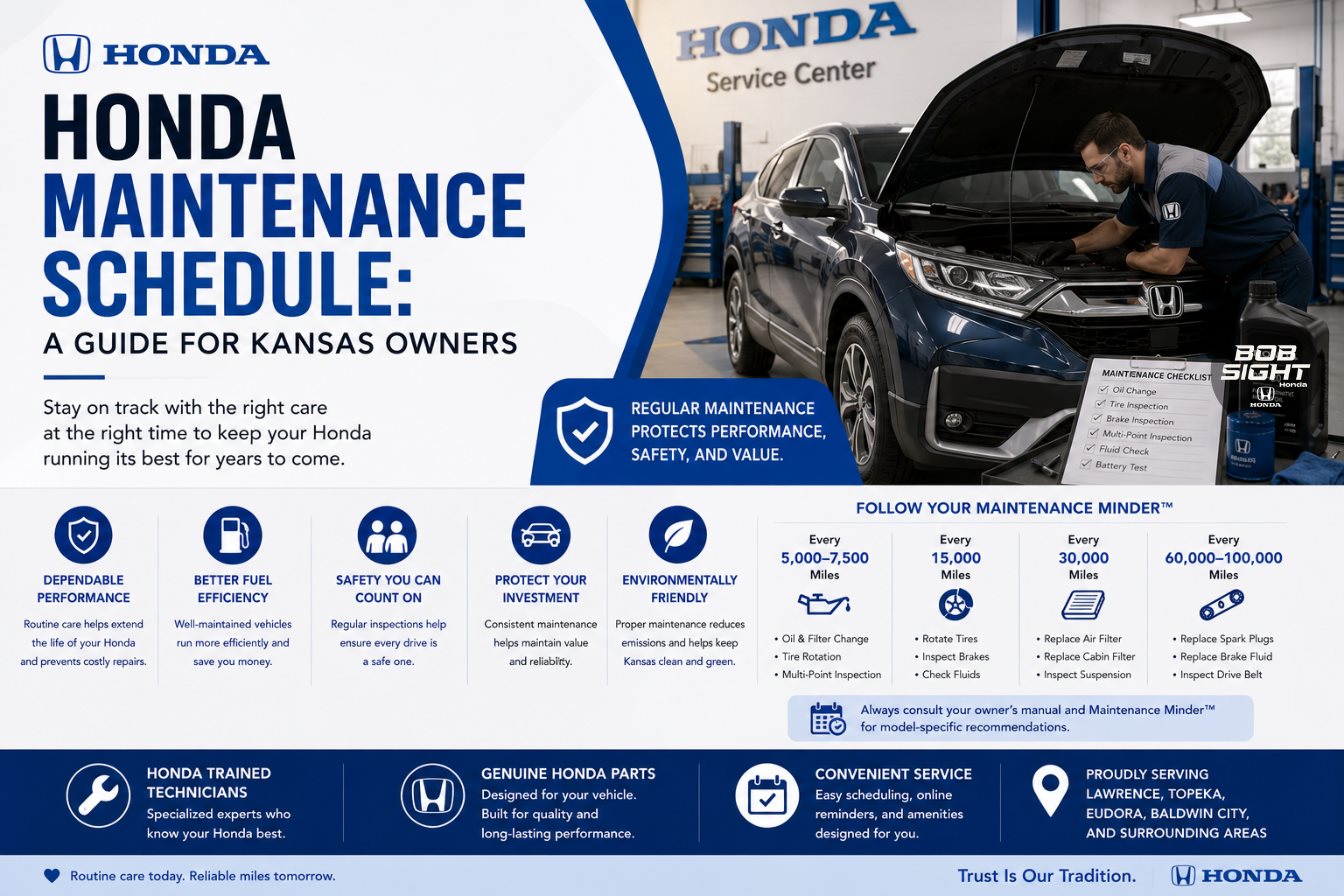
Maintaining your vehicle according to the official factory schedule is the most effective way to ensure long-term reliability, safety, and fuel efficiency while driving across Douglas County and the greater Kansas City metro area. At Bob Sight Honda in Lawrence, KS, our certified technicians provide comprehensive maintenance services designed to keep your Honda Accord, Civic, CR-V, Pilot, Passport, Odyssey, HR-V, or Ridgeline running smoothly through cold Midwest winters and humid summer road trips. Whether you are daily commuting along K-10 toward Olathe or navigating stop-and-go traffic on Iowa Street, staying on top of scheduled service intervals prevents premature wear on critical components and preserves your vehicle trade-in value. This comprehensive guide outlines everything Kansas drivers need to know about factory maintenance codes, mileage milestones, fluid requirements, and local driving factors.
Keep your vehicle running at peak performance on Midwest roads by scheduling expert service at Bob Sight Honda in Lawrence, KS today.
In This Guide You'll Learn
This ownership guide breaks down essential factory service recommendations to help you make informed decisions about your vehicle care:
- How the Honda Maintenance Minder system calculates service needs based on operating conditions
- Key mileage intervals for oil changes, tire rotations, brake service, and fluid flushes
- Specific synthetic oil viscosities and API standards required for modern Honda engines
- How severe Kansas winter weather and hot summer conditions impact maintenance frequency
- Step-by-step procedures for scheduling service appointments and preparing your vehicle
- Long-term ownership strategies to maximize vehicle longevity and resale value
Understanding the Honda Maintenance Minder System and Warning Codes
The Honda Maintenance Minder system uses an onboard computer algorithm to monitor engine operating conditions, engine speed, ambient temperature, and total mileage to calculate remaining engine oil life continuously. Rather than relying strictly on fixed calendar dates, this intelligent monitoring system alerts drivers on the multi-information display when service is due, counting down from 100 percent oil life down to 15 percent, 5 percent, and 0 percent. When the oil life indicator reaches 15 percent, a main maintenance code accompanied by sub-item numbers will illuminate on your dashboard, giving you ample time to arrange a service appointment at a qualified service center in Lawrence, KS.
Main maintenance items are categorized into two primary system codes that define the foundational service required during your visit. Code A indicates that an engine oil change is required, while Code B signifies a complete engine oil and filter change along with a comprehensive multi-point inspection, brake inspection, parking brake adjustment, and visual check of tie-rod ends, steering gear, suspension, driveshaft boots, and brake lines. Ignoring these warnings can lead to reduced engine efficiency and component failure, so addressing them promptly ensures your vehicle remains in peak operating condition.
Sub-item numerical codes provide additional specific service requirements that align with current mileage milestones and driving history. Sub-code 1 calls for a tire rotation and tire pressure check, while Sub-code 2 indicates it is time to replace the engine air cleaner element and cabin dust filter while inspecting the drive belt. Sub-code 3 alerts you to replace the transmission fluid, Sub-code 4 indicates spark plug replacement and timing belt inspection, Sub-code 5 requires engine coolant replacement, Sub-code 6 requires rear differential fluid replacement on all-wheel-drive models, and Sub-code 7 signifies brake fluid replacement. Understanding these codes empowers Kansas owners to maintain complete service compliance without paying for unnecessary premature maintenance.
Driving conditions in Eastern Kansas often accelerate maintenance needs due to extreme seasonal temperature shifts and regional road conditions. Frequent short trips under five miles in freezing weather, extended idling during school pickup on W 23rd Street, and driving in dusty rural areas surrounding Baldwin City or Eudora cause the Maintenance Minder system to adjust interval timing automatically. By responding promptly when your dashboard display indicates service is due, you protect your engine from harmful thermal breakdown and mechanical friction under severe operating demands.
Essential Mileage Intervals for Honda Maintenance in Kansas
Following a structured mileage-based maintenance timeline guarantees that vital engine, drivetrain, and safety systems receive timely inspection and component replacement throughout your vehicle's lifespan. While the Maintenance Minder dynamically calculates exact dates, establishing benchmark expectations around 7,500-mile, 15,000-mile, 30,000-mile, and 60,000-mile intervals helps owners budget and plan routine maintenance visits. Staying proactive with routine checks prevents minor component wear from cascading into costly mechanical repairs on busy thoroughfares like I-70 or Highway 59.
Every 7,500 to 10,000 miles, or when notified by Maintenance Minder Code A or B, your vehicle requires an engine oil change, oil filter replacement, tire rotation, and brake wear inspection. At the 15,000-mile mark, technicians conduct a deeper evaluation of steering linkage, suspension components, exhaust systems, fuel lines, and fluid levels, alongside replacing the interior cabin air filter to keep pollen and agricultural dust out of the passenger cabin during Kansas spring and summer months.
Reaching 30,000 miles represents a significant ownership milestone requiring comprehensive air intake filter replacement, brake fluid testing, transmission fluid inspection, and thorough battery health diagnostics. Vehicles equipped with Real Time AWD systems may also require rear differential fluid replacement around this mark to prevent fluid shearing and thermal degradation. Maintaining clean fluids is particularly critical for local commuters navigating steep grades and heavy winter snow slush along Clinton Parkway and 6th Street in Lawrence.
The table below summarizes standard recommended service intervals for modern Honda models driven under typical Kansas operating conditions:
| Interval Milestone | Primary Service Requirements | Key Inspection Focus Areas |
|---|---|---|
| 7,500 / 15,000 Miles | Synthetic Oil Change, Oil Filter, Tire Rotation | Brake Pads, Tire Tread Depth, Fluid Levels |
| 30,000 Miles | Cabin Filter, Engine Air Filter, AWD Differential Fluid | Suspension, Drive Boots, Exhaust System |
| 45,000 / 60,000 Miles | CVT / Automatic Transmission Fluid, Brake Fluid Flush | Brake Rotors, Drive Belts, Battery Health |
| 90,000 / 100,000 Miles | Spark Plugs, Engine Coolant, Timing Belt (if applicable) | Water Pump, Valve Clearance, Fuel System |
Adhering to these structured mileage intervals keeps your factory warranty active and fully compliant. Whether operating a gas-powered Civic or a CR-V Hybrid, bringing your vehicle to an authorized dealership ensures that original equipment manufacturer parts and factory-trained technicians execute every inspection step precisely to specification.
Honda Oil Change Intervals and Synthetic Oil Requirements
Modern Honda engines require advanced full synthetic engine oil certified under ILSAC GF-6A standards and API SP service classifications to protect internal components from extreme friction and thermal stress. Turbocharged Earth Dreams engines found in recent Accord, Civic, and CR-V models, as well as naturally aspirated V6 engines in the Pilot and Passport, operate under high compression ratios and elevated thermal loads. Utilizing low-viscosity formulations such as 0W-20 or 0W-16 full synthetic oil ensures rapid lubrication flow to critical engine components during cold morning starts in freezing Kansas winters.
Full synthetic engine oil offers superior oxidation stability, volatility resistance, and deposit control compared to traditional conventional or synthetic blend oils. In turbocharged direct-injection engines, using improper oil formulations can contribute to low-speed pre-ignition and harmful carbon buildup on intake valves. Genuine Honda Ultimate Full Synthetic Oil contains specialized friction modifiers and detergent additives tailored specifically to preserve variable valve timing components and turbocharger bearings under demanding highway driving conditions between Lawrence and Topeka.
Delaying oil changes beyond the Maintenance Minder recommendation allows oil to breakdown, accumulate soot, and form engine sludge, which restricts vital oil passages and increases internal friction. Over time, contaminated oil degrades engine seal performance, increases fuel consumption, and risks costly internal mechanical damage. Replacing the OEM oil filter during every oil change is equally vital, as clean filter media traps microscopic metal particles and debris before they can recirculate through delicate engine galleries.
Local commuters traveling the K-10 highway corridor every day subject their vehicle engines to sustained ambient temperatures in summer and rapid thermal cycling in winter. By strictly adhering to full synthetic replacement intervals and using genuine OEM filters, Douglas County drivers protect engine longevity, maintain maximum fuel economy, and ensure their vehicle delivers smooth, reliable performance throughout every season.
Brake System Inspection and Maintenance for Midwest Driving Conditions
Brake system safety relies on periodic inspection of friction materials, hydraulic lines, caliper hardware, and brake fluid boiling point degradation to ensure consistent stopping performance. Regional driving patterns in Eastern Kansas involve a mix of high-speed highway merging on I-70 and sudden stop-and-go deceleration along congested retail corridors like Iowa Street or Massachusetts Street. These variable driving demands generate substantial friction heat, accelerating friction material wear on front brake pads and rotors.
Routine brake inspections conducted during every oil change and tire rotation evaluate remaining brake pad friction material measured in millimeters. Brake pads starting at 10mm to 12mm of thickness when new should be scheduled for replacement once friction material wears down to 3mm or 4mm, preventing metal-to-metal contact with the brake rotor. Allowing pads to wear down completely results in rotor scoring, reduced braking efficiency, increased stopping distances, and higher overall repair costs.
Brake fluid replacement represents another vital maintenance requirement that is frequently overlooked by vehicle owners. Honda specifies replacing hydraulic brake fluid every three years regardless of vehicle mileage because brake fluid is hygroscopic, meaning it actively absorbs atmospheric moisture over time. Accumulated moisture lowers the boiling point of the fluid and leads to internal corrosion of anti-lock brake calipers, master cylinders, and proportioning valves, resulting in a soft or spongy brake pedal feel during hard braking stops.
Winter road treatments in Douglas County and neighboring Johnson County utilize corrosive chemical deicers and rock salt that accelerate surface oxidation on exposed brake rotors and calipers. Routine professional brake cleaning, hardware lubrication, and fluid flushes remove road salt residue, prevent caliper slide pin binding, and ensure your braking system operates with immediate pedal response when driving on slippery winter road surfaces.
Seasonal Kansas Winter Preparation and Battery Health
Freezing winter temperatures severely reduce a vehicle battery's chemical efficiency while simultaneously increasing the cranking power required to start a cold engine. During severe Midwest cold snaps, automotive batteries can lose up to 50 percent of their cranking capacity, turning a weak or aging battery into an immediate reliability liability. Preparing your vehicle prior to the arrival of freezing weather in Lawrence ensures dependable winter engine starts and uninterrupted operation of vital safety systems.
A comprehensive pre-winter vehicle inspection focuses on several key cold-weather reliability systems:
- Battery Cold Cranking Amps (CCA) Test: Technicians conduct a digital conductance test to evaluate cold cranking capacity, internal resistance, and terminal connections to identify failing battery cells before winter arrives.
- Coolant and Antifreeze Concentration Check: Testing the engine coolant with a refractometer confirms the proper 50/50 mix of genuine Honda Long Life Type 2 Coolant and distilled water, providing freeze protection down to minus 34 degrees Fahrenheit.
- Tire Tread Depth and Pressure Audit: Measuring tire tread depth ensures adequate traction in snow and slush, while adjusting inflation pressure accounts for the natural drop of approximately one pound per square inch for every 10-degree drop in outside temperature.
- Wiper Blade and Washer System Maintenance: Replacing worn rubber wiper blades and filling the washer reservoir with freeze-resistant cleaning fluid guarantees clear windshield visibility during winter storms and heavy highway road spray.
Automobile electrical systems face heavy accessory loads during Kansas winter months from heated seats, rear window defrosters, cabin blowers, and headlight usage during shorter daylight hours. A compromised battery or failing alternator struggles to maintain proper voltage under these heavy electrical loads, leading to flickering interior displays or unexpected battery discharge while parked outdoors overnight.
Scheduling a seasonal winter prep visit at our Lawrence service center provides peace of mind before winter weather impacts local roads. Replacing an old battery proactively avoids the hassle of being stranded in freezing weather, ensuring your heater, defrosting systems, and engine start reliably every morning.
Transmission Fluid, Coolant, and Major Component Service Schedules
Drivetrain components including Continuously Variable Transmissions (CVT), multi-speed automatic transmissions, transfer cases, and cooling systems require specialized fluid services at high-mileage intervals to maintain structural durability. Honda advanced transmissions utilize precise internal tolerances and specialized friction materials that demand exact fluid formulations. Substituting aftermarket universal transmission fluids can cause clutch slippage, harsh shifting, chatter, and accelerated internal mechanical wear.
Continuously Variable Transmissions used in the Civic, Accord, HR-V, and CR-V require Honda HCF-2 CVT Fluid designed specifically to support the extreme clamping pressure between the metal belt and drive pulleys. Traditional automatic transmissions and 9-speed or 10-speed units found in the Honda Pilot, Passport, Odyssey, and Ridgeline utilize specialized automatic transmission fluids engineered for precise hydraulic valve body actuation and thermal stability under heavy towing loads.
Engine cooling systems rely on genuine Honda Long Life Type 2 Coolant, an ethylene glycol-based formula containing non-silicate organic acid technology (OAT) that prevents internal aluminum corrosion and water pump seal damage. The initial coolant flush is scheduled at 120,000 miles or 10 years under normal operating conditions, with subsequent flushes recommended every 60,000 miles thereafter to remove spent anti-corrosion additives and thermal contaminants.
High-mileage maintenance around 100,000 miles also encompasses spark plug replacement using laser-iridium spark plugs to maintain complete fuel combustion, as well as valve clearance inspections on select engine families. Models equipped with V6 engines incorporating a timing belt require timing belt replacement, water pump replacement, and drive belt tensioner service at 105,000 miles to prevent catastrophic engine failure caused by a broken timing belt.
Step-by-Step Process for Preparing Your Honda for Routine Maintenance
Properly preparing your vehicle before bringing it in for routine maintenance streamline the check-in process and ensures our service team addresses all your vehicle concerns thoroughly. Following a systematic preparation routine allows technicians to focus directly on scheduled maintenance while giving you an opportunity to communicate any subtle changes in vehicle driveability, unusual noises, or dashboard warnings observed during daily commutes across Lawrence.
Follow these practical steps to prepare your vehicle for an efficient service experience:
- Note Active Maintenance Minder Codes: Review your instrument cluster multi-information display and document all illuminated main codes (A or B) and sub-item numbers (1 through 7) to share with your service advisor upon arrival.
- Document Specific Driveability Symptoms: Write down descriptions of any unusual vibrations, squeaks, fluid spots under the vehicle, or hesitations, noting when they occur, such as during cold starts or highway braking on K-10.
- Clear Personal Belongings from Cargo Areas: Remove heavy cargo, personal items, and child safety seats if service requires access to the spare tire well, cabin air filter housing, or rear suspension components.
- Locate Wheel Lock Keys and Service Records: Place your anti-theft wheel lock key on the passenger seat if equipped, and bring any previous service documentation if you are visiting our service center for the first time.
- Confirm Rental or Shuttle Transportation Needs: Determine whether you will utilize our comfortable customer lounge with complimentary Wi-Fi, schedule a local shuttle ride in Lawrence, or arrange a loaner vehicle for extended maintenance repairs.
Taking a few minutes to organize this information accelerates service intake and ensures clear communication between you and your service team. Clear communication prevents misunderstandings and allows factory-certified technicians to complete all required work quickly and accurately during your scheduled appointment time.
Our dedicated service advisors review your vehicle's factory warranty status, open recall databases, and recorded service history during check-in to confirm that all recommended maintenance steps align precisely with manufacturer guidelines. This meticulous approach guarantees that no critical service milestone is missed during your appointment.
How to Schedule and Track Your Honda Service Appointments Online
Utilizing online service scheduling tools offers vehicle owners maximum convenience, allowing you to select preferred appointment dates, choose specific services, and arrange transportation options from your smartphone or computer. Digital scheduling eliminates phone hold times and provides 24/7 access to our service calendar so you can fit routine maintenance easily into your personal schedule whether you live in Lawrence, Topeka, or Eudora.
Follow this simple step-by-step procedure to book your service appointment online:
- Access the Online Scheduling Portal: Navigate to our official website and select the schedule service portal to open the secure appointment booking interface.
- Enter Vehicle Identification Information: Provide your vehicle year, model, trim, and approximate current mileage so the system can display relevant factory-recommended maintenance packages automatically.
- Select Required Maintenance Services: Choose specific services based on active Maintenance Minder codes, or select individual routine services such as an oil change, tire rotation, or brake inspection.
- Choose Your Preferred Date and Time Slot: Browse available calendar dates and select an open time slot that fits your personal schedule, designating whether you plan to drop off or wait at the dealership.
- Confirm Contact Information and Submit: Enter your name, phone number, and email address to receive immediate digital appointment confirmation and calendar reminders.
Digital appointment tracking keeps you informed throughout the entire maintenance process via text message or email updates. Once your vehicle enters our service bay, technicians perform a comprehensive multi-point inspection and send a digital inspection report directly to your phone, complete with photos and clear health ratings for key components.
This transparent digital inspection process allows you to review recommended maintenance items, approve or decline suggested services, and communicate directly with your service advisor from anywhere. Online tracking provides total control and transparency, ensuring you are fully informed about your vehicle's maintenance status before picking up your keys.
Quick Facts: Honda Maintenance Schedule at a Glance
Keeping core maintenance facts readily accessible helps vehicle owners maintain proactive care routines and make confident decisions regarding vehicle upkeep. Key service facts to keep in mind include:
- Maintenance Minder Trigger: Service warnings illuminate at 15% remaining oil life, giving you time to schedule an appointment before reaching 0%.
- Synthetic Oil Formulation: Modern engines require full synthetic 0W-20 or 0W-16 oil meeting API SP and ILSAC GF-6A specifications.
- Brake Fluid Interval: Hydraulic brake fluid must be flushed and replaced every 3 years regardless of total vehicle mileage.
- Tire Rotation Frequency: Tires should be rotated every 7,500 miles or during every oil change to promote even tread wear.
- Timing Belt Replacement: Honda V6 engines with timing belts require belt and water pump replacement at 105,000 miles.
Staying mindful of these baseline service parameters prevents unexpected breakdowns and extends the total operational lifespan of your automobile. Routine maintenance performed at recommended intervals is the single most cost-effective strategy for protecting your vehicle investment.
Long-Term Ownership Planning and Vehicle Reliability Strategy
A proactive long-term maintenance strategy transforms routine service visits into an investment that protects resale value, enhances safety, and extends total operational longevity. Honda vehicles are globally recognized for exceptional mechanical durability, with many models easily exceeding 200,000 miles when maintained according to factory specifications. Achieving maximum mileage potential requires moving beyond reactive repairs and adopting a disciplined ownership approach grounded in preventive maintenance care.
Maintaining complete, documented service records plays a crucial role in preserving high trade-in and private resale value when you decide to upgrade vehicles in the future. Prospective pre-owned buyers and dealership appraisers in the Kansas City regional market place a high premium on vehicles accompanied by verified dealership maintenance logs showing consistent oil changes, fluid flushes, and timely component replacements. Digital service records stored within our dealership database provide indisputable proof that your vehicle received proper care using genuine OEM parts throughout its life.
Adapting your maintenance habits to local Midwest environmental realities further safeguards critical mechanical systems. Severe temperature fluctuations between hot, humid summer highway driving on Highway 59 and freezing winter cold snaps accelerate fluid oxidation and rubber degradation. Proactively replacing aging coolant hoses, serpentine belts, suspension bushings, and wiper blades before extreme weather seasons arrive prevents minor wear from escalating into unexpected roadside breakdowns during family trips.
Partnering with a trusted local dealership service center ensures your vehicle receives ongoing software updates, factory recall compliance checks, and specialized diagnostic evaluations during every routine maintenance visit. Factory-trained technicians utilize specialized diagnostic tools engineered specifically for advanced hybrid powertrains, Sensing safety suites, and electronic drive systems. This expert oversight ensures your automobile delivers reliable, safe, and comfortable transportation for years and miles to come.
Frequently Asked Questions About Honda Maintenance in Lawrence, KS
How often should I get an oil change for my Honda in Lawrence, KS?
You should schedule an engine oil change whenever your vehicle's Maintenance Minder system displays 15 percent oil life remaining, which typically occurs every 7,500 to 10,000 miles under normal driving conditions. Operating under severe conditions, such as short winter commutes in Lawrence, extended idling, or frequent driving on unpaved county roads, accelerates oil breakdown and reduces the interval between required changes.
Modern engines utilize advanced full synthetic oil formulated to resist thermal degradation and shear stress over extended miles. Utilizing full synthetic engine oil certified under ILSAC GF-6A standards ensures rapid oil circulation to overhead camshafts and turbocharger bearings during cold starts, protecting delicate internal engine clearances from metal-to-metal wear.
Regular oil changes conducted at our Lawrence service center include a genuine OEM oil filter replacement and a comprehensive visual inspection of underbody components. Adhering strictly to oil life warnings protects your factory warranty coverage and preserves long-term fuel efficiency during daily highway driving along K-10 and I-70.
What does Honda Maintenance Minder Code B12 mean?
Maintenance Minder Code B12 indicates that your vehicle requires an engine oil and filter change (Code B), tire rotation (Sub-code 1), and engine air cleaner plus cabin dust filter replacements (Sub-code 2). In addition to replacing these components, Code B mandates a thorough multi-point inspection of brake pads, tie-rod ends, steering components, drive boots, and fluid levels.
Sub-code 2 filter replacements are particularly important for Midwest drivers because cabin dust filters capture atmospheric pollen, agricultural dust, and road debris before it enters the interior heating and air conditioning system. Clean intake air filters ensure maximum airflow to the engine combustion chambers, optimizing horsepower output and fuel economy during hot summer months.
When Code B12 appears on your instrument panel, bringing your vehicle to an authorized service department guarantees that genuine OEM air filters are installed and that factory-trained technicians execute the required multi-point mechanical inspections precisely. Completing this service package keeps your HVAC system fresh and protects internal engine components from airborne particle contamination.
Is dealership service better than an independent repair shop for Honda warranty maintenance?
Servicing your vehicle at an authorized dealership guarantees that maintenance is performed by factory-trained technicians using specialized diagnostic tools and genuine OEM parts designed specifically for your model. While independent repair shops can perform general fluid changes, dealership service centers maintain direct access to factory technical service bulletins, software updates, and official recall databases that independent facilities cannot access.
Furthermore, maintaining your vehicle at an authorized dealership ensures that all service history is automatically logged into the central manufacturer database. This seamless record-keeping provides indisputable proof of warranty compliance if a major mechanical component requires warranty coverage, eliminating disputes regarding maintenance documentation or non-compliant aftermarket parts.
Our Lawrence dealership service center uses specialized calibration equipment required for modern safety systems, including Sensing radar and camera suites, as well as high-voltage hybrid battery diagnostic tools. Choosing expert dealership service protects your factory warranty, preserves long-term resale value, and ensures your vehicle receives expert care from certified technicians.
How do Kansas winter conditions affect my Honda maintenance schedule?
Freezing winter temperatures, road salt, and frequent short-distance driving during Kansas winters subject engine oil, batteries, rubber belts, and braking systems to severe operating stress. Cold weather causes engine oil to flow more slowly during initial startup, while freezing temperatures drop battery output capacity dramatically, making pre-winter maintenance inspections essential for cold-weather reliability.
Corrosive road deicers and liquid brine treatments applied to highways around Douglas County accelerate surface oxidation on exposed brake rotors, caliper slide pins, and underbody exhaust components. Rinsing the undercarriage regularly and having technicians inspect and lubricate brake hardware during winter tire rotations prevents binding and premature corrosion damage.
Additionally, ambient temperature drops cause tire pressure to decrease by approximately one PSI for every 10-degree drop in outside temperature. Inspecting tire inflation pressure frequently during winter months ensures proper tread contact with icy road surfaces, maintaining optimal vehicle traction and handling performance throughout snow season.
Why does my Honda require a brake fluid change every three years?
Brake fluid must be replaced every three years because glycol-based hydraulic brake fluid naturally absorbs atmospheric moisture over time, lowering its boiling point and causing internal system corrosion. As water content accumulates within the hydraulic lines, heavy braking on steep hills or during emergency stops can cause the trapped moisture to boil, resulting in gas bubbles that lead to a sudden soft brake pedal and reduced stopping power.
Absorbed moisture inside the braking system also accelerates internal rusting and pitting of sensitive anti-lock braking system (ABS) hydraulic modulators, brake calipers, and wheel cylinders. Replacing hydraulic brake fluid at the mandatory three-year interval removes contaminated moisture-laden fluid before internal corrosion can damage expensive electronic brake components.
Our factory-trained technicians perform complete hydraulic brake flushes using genuine brake fluid, purging old fluid and air bubbles entirely from the braking system. This routine maintenance service restores firm pedal feel, protects vital ABS components, and ensures immediate, reliable braking response during emergency stopping situations on Midwest roads.
Why Local Expertise Matters for Your Honda Maintenance Schedule
Choosing a local, factory-authorized service center ensures your vehicle receives dedicated care tailored specifically to regional driving conditions and Midwest weather challenges. At Bob Sight Honda, our service department is staffed by certified technicians who understand the specific demands placed on vehicles driving through Douglas County, Topeka, Eudora, and Baldwin City. From winter salt protection to high-speed commuter travel on K-10, our team delivers accurate diagnostics and precise maintenance tailored to your driving habits.
We utilize specialized diagnostic software, state-of-the-art service bays, and genuine OEM parts to maintain the exact engineering standards set by the factory. Beyond technical expertise, our commitment to transparent customer service ensures that you receive detailed digital inspection reports, clear maintenance recommendations, and competitive pricing on all routine services. Entrusting your vehicle to our team guarantees reliable performance, enhanced safety, and long-term peace of mind on every journey.
Whether your vehicle is due for a basic oil change, comprehensive brake service, or high-mileage fluid flush, our team is prepared to deliver efficient, high-quality care. Visit us in Lawrence, KS, or utilize our online appointment scheduler to keep your vehicle running smoothly year-round.
Helpful Links
Explore these key dealership resources to schedule maintenance, browse service specials, or order genuine OEM parts online:
- Schedule Service Online in Lawrence, KS
- Current Honda Service and Parts Specials
- Honda Express Service Lane Information
- Order Genuine OEM Honda Parts
- Learn More About Our Honda Service Center
Proud to Be Part of the Bob Sight Auto Group
Bob Sight Honda is proud to serve drivers across Lawrence and Eastern Kansas as a member of the family-owned Bob Sight Auto Group. For generations, our automotive group has provided exceptional customer care, transparent automotive sales, and expert service across the Kansas City region. Explore our group dealership locations below to find sales, service, or collision repair near you: