Honda Ownership Costs vs Toyota: Which Brand Saves More?
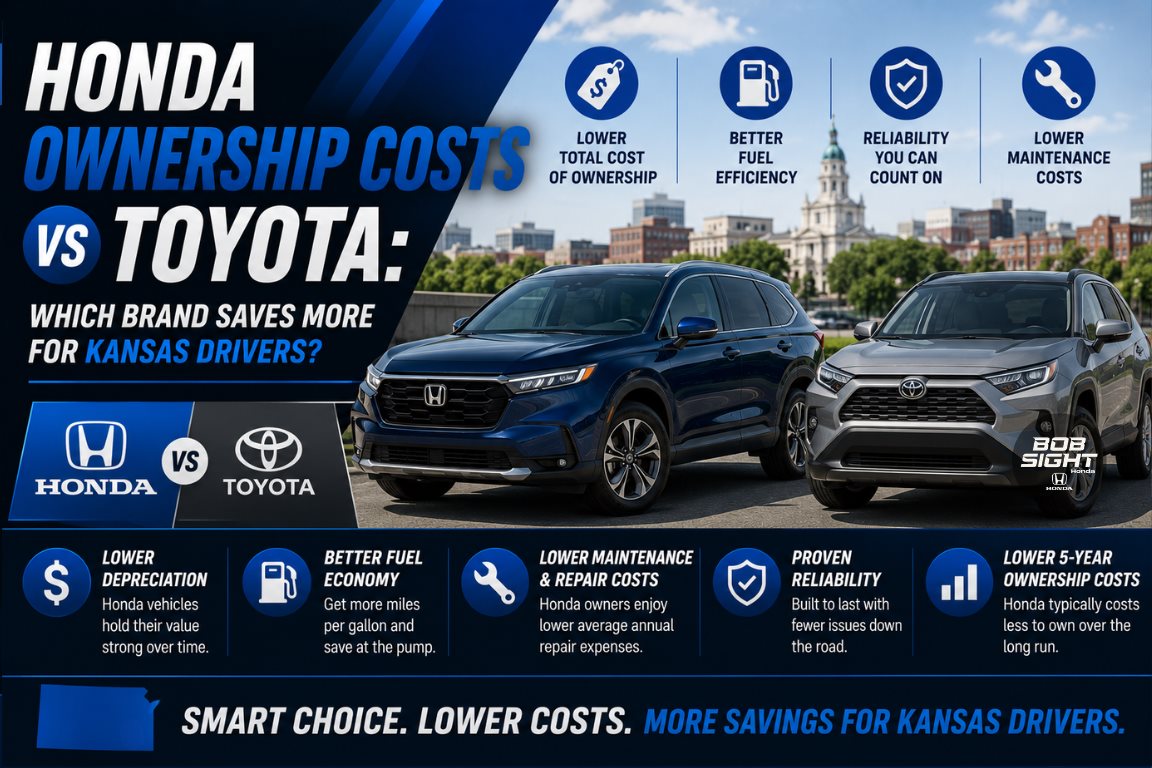
Compare new Honda vehicles at Bob Sight Honda in Lawrence, KS
When comparing Honda ownership costs vs Toyota, Lawrence shoppers should look beyond the purchase price and consider maintenance, fuel economy, resale value, insurance, reliability, service habits, and how each vehicle fits real Kansas driving. At Bob Sight Honda in Lawrence, Kansas, we help drivers from Lawrence, Topeka, Baldwin City, Eudora, Douglas County, and the greater Kansas City Metro compare long-term ownership value in a practical way. Honda and Toyota both have strong reputations for dependability, but the brand that saves more depends on the specific model, how long you plan to keep it, how many miles you drive, and how consistently you maintain it.
In This Guide You’ll Learn
This guide breaks down Honda ownership costs vs Toyota in a way that helps Kansas shoppers compare total value, not just brand reputation.
- What total ownership cost really includes beyond the purchase decision
- How Honda and Toyota compare for maintenance, fuel economy, and resale value
- Why Kansas driving habits can change long-term ownership expenses
- How Honda models like Civic, Accord, CR-V, HR-V, Pilot, Odyssey, Passport, and Ridgeline fit different budgets
- How hybrid models can affect fuel savings and ownership planning
- What steps help lower long-term ownership costs
- Why shopping and servicing locally with Bob Sight Honda supports long-term value
What Total Ownership Cost Really Means
Total ownership cost is the full amount a driver spends to buy, drive, maintain, insure, fuel, repair, and eventually trade or sell a vehicle. When comparing Honda ownership costs vs Toyota, the smartest shoppers look at the complete ownership picture instead of focusing on one single number.
The purchase decision is only the first part of vehicle ownership. Over time, maintenance, tires, brakes, fuel, insurance, registration, repairs, depreciation, and resale value all influence what a vehicle truly costs. A vehicle that costs less upfront may not always save more if it uses more fuel, loses value faster, or requires more frequent repairs. Likewise, a vehicle with a strong resale reputation may reduce long-term costs because it holds more value when traded later.
For Lawrence drivers, total ownership cost should also reflect how the vehicle will be used. A commuter traveling from Lawrence to Kansas City on K-10 has different expenses than a driver who mostly stays close to downtown, campus, or neighborhood errands. A family driving to Topeka, Baldwin City, Eudora, youth sports events, and weekend activities may put more demand on tires, brakes, fluids, and cargo space. These daily patterns matter because cost is shaped by real usage, not just manufacturer reputation.
| Ownership Cost Factor | Why It Matters | What Shoppers Should Compare |
|---|---|---|
| Fuel economy | Affects weekly and monthly driving costs | Gasoline and hybrid options by model |
| Maintenance | Protects reliability and reduces repair risk | Service intervals, parts, fluids, tires, brakes |
| Depreciation | Impacts trade-in or resale value | Model demand and long-term value retention |
| Insurance | Varies by vehicle, driver, and coverage | Quotes for specific Honda and Toyota models |
| Repairs | Can affect long-term affordability | Reliability, service history, warranty coverage |
Honda vs Toyota Reliability: What It Means for Ownership Costs
Honda and Toyota are both known for strong reliability, so ownership cost differences often come down to the specific model, maintenance history, driving habits, and long-term care. A well-maintained Honda can be an excellent long-term value for Kansas drivers who want dependability and practical daily ownership.
Reliability matters because fewer unexpected repairs generally mean lower ownership stress. Honda models are engineered for long-term use when maintained according to factory recommendations. Vehicles like the Honda Civic, Accord, CR-V, HR-V, Pilot, Passport, Odyssey, and Ridgeline are popular because they combine everyday comfort with strong durability. Toyota offers similar dependability, which is why shoppers often compare Civic vs Corolla, Accord vs Camry, CR-V vs RAV4, and Pilot vs Highlander.
The important point is that reliability is not only a brand trait. It is also an ownership habit. A Honda that receives timely oil changes, tire rotations, brake inspections, coolant service, transmission service, battery checks, and air filter replacements is more likely to stay dependable. A Toyota that is neglected can become expensive, just as any vehicle can. Maintenance discipline often matters as much as the badge on the grille.
In Lawrence, reliability becomes valuable because many drivers rely on one vehicle for several different roles. A Honda CR-V may serve as a commuter vehicle during the week, a family SUV on weekends, and a road-trip vehicle during holidays. A Honda Accord may handle daily drives to work, school, and regional travel along I-70. Dependability helps protect your schedule, reduces inconvenience, and supports stronger long-term ownership value.
Maintenance Costs: Honda vs Toyota
Honda and Toyota maintenance costs are usually competitive, but the least expensive vehicle to own is often the one that receives consistent preventive service. Routine maintenance helps avoid larger repairs and keeps long-term ownership costs more predictable.
Honda maintenance commonly includes oil changes, tire rotations, brake inspections, coolant service, transmission fluid service, battery testing, engine air filter replacement, cabin air filter replacement, wiper blade replacement, and multi-point inspections. Toyota vehicles require similar routine care. Because both brands are mainstream, dependable, and widely serviced, neither one is automatically expensive to maintain when compared with many luxury or specialty brands.
Honda’s Maintenance Minder system can help owners plan service based on vehicle operating conditions. Instead of relying only on a fixed mileage number, many Honda models notify drivers when specific maintenance is due. This can be useful for Lawrence drivers whose routines vary between short city trips, longer highway commutes, and seasonal travel. Maintenance Minder helps make service planning easier and can support better long-term cost control.
Here is a practical way to compare maintenance before choosing between Honda and Toyota:
- Compare the specific models you are considering, such as Honda CR-V vs Toyota RAV4 or Honda Accord vs Toyota Camry.
- Review recommended maintenance schedules for each model.
- Ask about tire sizes, brake wear patterns, hybrid system needs, and fluid service requirements.
- Consider your local driving conditions, including city traffic, highway mileage, winter weather, and summer heat.
- Choose the vehicle that fits your driving style and commit to routine service from the beginning.
Bob Sight Honda helps Honda owners stay ahead of service through the online Honda service scheduler. Keeping service organized is one of the simplest ways to protect long-term ownership value. Whether you drive a new Honda, used Honda, or certified pre-owned Honda, routine maintenance is the foundation of lower ownership costs.
Fuel Economy and Hybrid Savings for Kansas Drivers
Fuel economy can strongly affect Honda ownership costs vs Toyota because fuel is one of the most frequent expenses drivers pay throughout vehicle ownership. For Lawrence shoppers who commute regularly or drive across Northeast Kansas, efficient Honda gasoline and hybrid models can make a meaningful difference over time.
Fuel cost adds up because it is ongoing. A driver commuting between Lawrence and Kansas City may cover many miles every week. A family traveling between Lawrence, Topeka, Eudora, and Baldwin City may see fuel usage rise quickly during school seasons, sports schedules, and weekend events. Even a small fuel economy advantage can matter when multiplied across years of ownership.
Honda offers efficient models across several categories. The Honda Civic is a strong fit for commuters who want compact efficiency. The Honda Accord is a smart sedan for drivers who want more space without moving into an SUV. The Honda CR-V and CR-V Hybrid are practical for shoppers who want cargo room, available hybrid efficiency, and everyday versatility. Honda hybrid models can be useful for drivers who want lower fuel use without giving up familiar driving habits.
| Driver Type | Honda Models to Consider | Ownership Cost Advantage |
|---|---|---|
| Daily commuter | Civic, Accord, Civic Hybrid, Accord Hybrid | Strong fuel efficiency and lower daily operating costs |
| Small family | CR-V, CR-V Hybrid, HR-V | Flexible space with efficient driving options |
| Larger family | Pilot, Odyssey | Passenger space and practical long-term usability |
| Weekend traveler | Passport, Ridgeline, CR-V | Versatility for regional travel and active routines |
Toyota also offers fuel-efficient vehicles and hybrids, so the best comparison should be model-specific. The right answer depends on whether you are comparing Civic vs Corolla, Accord Hybrid vs Camry Hybrid, CR-V Hybrid vs RAV4 Hybrid, or Pilot vs Highlander. Bob Sight Honda can help shoppers compare Honda options based on actual driving needs instead of generic brand claims.
Resale Value and Depreciation
Resale value can reduce total ownership costs because a vehicle that holds its value well may be worth more when it is traded or sold. Honda and Toyota both perform strongly in this area, so condition, mileage, maintenance records, and model demand become key factors.
Depreciation is the loss of vehicle value over time. It is easy to overlook because it does not arrive as a bill, but it is one of the largest ownership costs for many drivers. A vehicle that retains more value can help reduce the total cost of ownership when you decide to trade into another model. This is one reason many shoppers prioritize Honda and Toyota in the first place.
Honda models often remain desirable in the used market because shoppers recognize the brand’s reputation for dependability. Used Honda Civic, Accord, CR-V, Pilot, Odyssey, and Ridgeline models often attract strong interest from drivers who want practical value. A well-maintained Honda with documented service history can stand out when it comes time to trade or resell. Maintenance records tell a stronger ownership story and can help support buyer confidence.
Lawrence shoppers should also think about local demand. Compact SUVs, efficient sedans, and family vehicles tend to remain popular in Kansas because they fit daily life well. A Honda CR-V may appeal to commuters, small families, and weekend travelers. A Honda Odyssey may appeal to families needing practical seating and cargo flexibility. A Honda Civic may appeal to students, young professionals, and fuel-conscious drivers. Choosing a vehicle with broad appeal can help protect resale strength.
Insurance, Tires, Brakes, and Other Everyday Expenses
Insurance, tires, brakes, batteries, fluids, and wear items all affect total ownership cost, and they can vary more by model and driving style than by brand alone. Honda and Toyota shoppers should compare the exact vehicle they plan to buy rather than assuming every model has the same ownership expense.
Insurance depends on many factors, including driver history, location, vehicle type, safety features, repair costs, theft data, and selected coverage. A Honda Civic may insure differently than a Honda Pilot because they serve different purposes and fall into different categories. The same is true for Toyota models. Shoppers should request insurance quotes before buying if they want a more accurate ownership estimate.
Tires and brakes are also major ownership items. A compact sedan may use different tires than a midsize SUV, and tire size can affect replacement cost. Brake wear depends on driving habits. Stop-and-go traffic near downtown Lawrence or school pickup lines can wear brakes differently than steady highway driving toward Topeka or Kansas City. Drivers who coast smoothly and maintain proper tire pressure often reduce wear over time.
Kansas conditions add specific ownership considerations. Summer heat can shorten battery life and stress cooling systems. Winter cold can reduce tire pressure and expose weak batteries. Potholes, road construction, gravel shoulders, and seasonal storms can affect suspension and alignment. These issues affect both Honda and Toyota owners, which is why preventive inspections are an important part of smart ownership planning.
Best Honda Models for Lower Ownership Costs
The best Honda models for lower ownership costs are usually the ones that match the driver’s needs without adding unnecessary size, fuel use, or features they will not use. A shopper who chooses the right Honda for their lifestyle is more likely to save over time than someone who buys more vehicle than they need.
The Honda Civic is a strong option for commuters, students, and young professionals who want efficiency and easy daily ownership. The Honda Accord adds more passenger room and highway comfort, making it a practical sedan for drivers traveling between Lawrence, Topeka, and Kansas City. The Honda HR-V gives shoppers SUV flexibility in a smaller footprint. The Honda CR-V remains one of the most versatile choices for drivers who want cargo space, comfort, and efficient SUV ownership.
For families, the Honda Pilot and Honda Odyssey offer different value stories. The Pilot is a three-row SUV that works well for families who want space and SUV confidence. The Odyssey is a minivan built around passenger comfort, sliding door convenience, and family practicality. For shoppers with active lifestyles, the Passport and Ridgeline provide more adventurous capability while still keeping Honda usability at the center.
| Honda Model | Best Fit | Ownership Cost Strength |
|---|---|---|
| Honda Civic | Commuters and first-time buyers | Efficiency and simple daily usability |
| Honda Accord | Drivers wanting sedan comfort | Space, efficiency, and strong long-term appeal |
| Honda CR-V | Small families and SUV shoppers | Versatility, resale strength, and available hybrid efficiency |
| Honda HR-V | Young professionals and city drivers | Compact SUV practicality |
| Honda Pilot | Families needing three rows | Long-term family utility |
| Honda Odyssey | Parents and larger households | Purpose-built family convenience |
Shoppers can compare available Honda models in the new Honda inventory at Bob Sight Honda. Comparing models side by side helps drivers choose the right balance of fuel economy, passenger room, cargo space, and long-term cost.
Quick Facts About Honda Ownership Costs vs Toyota
Honda ownership costs vs Toyota are often close, so the best choice depends on model selection, maintenance habits, fuel economy, resale value, insurance, and local driving needs. Both brands are strong, but Honda offers many efficient, practical, and long-lasting models for Kansas shoppers.
- Honda and Toyota are both known for long-term reliability.
- Total ownership cost includes fuel, maintenance, insurance, repairs, depreciation, tires, and resale value.
- Honda Civic, Accord, CR-V, and HR-V are strong options for cost-conscious drivers.
- Honda hybrid models can help reduce fuel spending for commuters.
- Routine maintenance is one of the best ways to lower long-term ownership costs.
- Kansas weather can affect batteries, tires, brakes, fluids, and cooling systems.
- Shopping locally helps drivers compare vehicles based on real Lawrence-area driving needs.
These quick facts show why the Honda vs Toyota cost comparison should be practical instead of emotional. Both brands have loyal owners, but the right vehicle should fit your commute, family size, maintenance habits, and long-term plans. A Honda that matches your lifestyle can deliver strong value for many years.
Ownership Planning for Kansas Drivers
Ownership planning helps Honda drivers lower long-term costs by matching the right model to their lifestyle, maintaining it consistently, and preparing for seasonal Kansas driving conditions. A smart ownership plan can reduce repair risk and protect resale value.
Start by choosing the right size vehicle. A driver who mostly commutes alone may save more with a Civic, Accord, or HR-V than a larger SUV. A small family may find the CR-V offers the best balance of space and efficiency. A larger household may need the Pilot or Odyssey because buying a vehicle that is too small can lead to a faster trade cycle. The right fit reduces the chance of changing vehicles sooner than planned.
Next, build a maintenance routine. Schedule oil changes, tire rotations, brake inspections, coolant service, transmission service, and battery checks before problems appear. Use genuine Honda parts when appropriate and keep service records organized. These records help you understand your vehicle’s history and can support value when it is time to trade. The Bob Sight Honda service department can help local owners stay on track.
Finally, think seasonally. Before summer, check cooling system health, air conditioning performance, tires, and battery condition. Before winter, check tire pressure, wiper blades, washer fluid, battery strength, and heating performance. Lawrence, Topeka, Baldwin City, Eudora, and Kansas City drivers experience enough weather variety that seasonal care matters. A vehicle maintained for local conditions usually costs less to own than one maintained only when something breaks.
How to Lower Your Honda Ownership Costs
The best way to lower Honda ownership costs is to choose the right model, drive smoothly, maintain it on schedule, protect resale value, and address small issues before they become larger repairs. Cost savings come from consistent decisions over the full life of the vehicle.
Lower ownership costs start before you buy. Compare fuel economy, seating needs, cargo space, tire size, insurance quotes, and expected maintenance. Avoid buying more vehicle than you need, but do not buy too little vehicle if your family will outgrow it quickly. A well-matched Honda tends to be more cost-effective because it fits your life longer.
Here are practical steps to help reduce ownership expenses:
- Follow Honda Maintenance Minder recommendations and factory service guidance.
- Rotate tires regularly to promote even wear and longer tire life.
- Check tire pressure monthly, particularly during Kansas temperature swings.
- Address warning lights promptly instead of waiting for symptoms to worsen.
- Keep service records organized for future resale or trade-in value.
- Use the correct fluids and parts for your specific Honda model.
- Drive smoothly to reduce brake, tire, and fuel wear.
- Schedule seasonal inspections before extreme heat or freezing weather.
- Compare insurance costs before choosing a trim or model.
- Use the value your trade tool when planning your next vehicle move.
These steps are simple, but they are powerful over time. A Honda owner who maintains the vehicle carefully, drives with awareness, and keeps records often creates a stronger ownership experience. Whether comparing Honda ownership costs vs Toyota or planning your next Honda, consistency is what turns a reliable vehicle into a lower-cost long-term investment.
Frequently Asked Questions
Does Honda cost less to own than Toyota?
Honda can cost less to own than Toyota in some cases, but the difference depends on the specific models, maintenance history, fuel economy, insurance, resale value, and driving habits. Both brands are known for strong dependability and long-term value. The most accurate comparison is model-to-model, such as Honda CR-V vs Toyota RAV4 or Honda Accord vs Toyota Camry. A well-maintained Honda can be a very cost-effective long-term choice.
Shoppers should compare total ownership cost instead of focusing only on purchase price. Fuel economy, tire replacement, brake wear, service intervals, depreciation, and repair history all matter. A vehicle that saves fuel and retains value may cost less over time even if another vehicle looks similar upfront. Maintenance discipline also plays a major role in long-term savings.
For Lawrence drivers, the answer often depends on how the vehicle is used. A Honda Civic or Accord may be a smart choice for commuting to Kansas City or Topeka. A Honda CR-V or HR-V may fit small families and daily errands well. Bob Sight Honda can help shoppers compare Honda models based on real Kansas driving rather than generic brand assumptions.
Which Honda models have the lowest ownership costs?
Honda Civic, Honda Accord, Honda HR-V, and Honda CR-V are often strong choices for lower ownership costs because they balance efficiency, dependability, practicality, and resale appeal. Hybrid versions of models like the Accord, Civic, and CR-V may also help reduce fuel costs for frequent drivers. The lowest-cost option depends on your size needs and driving routine. Choosing the right model matters more than choosing the smallest model automatically.
A Civic may work well for students, commuters, and young professionals who want excellent efficiency. An Accord may fit drivers who want more space and highway comfort. An HR-V gives shoppers compact SUV flexibility, while a CR-V adds more family-ready space. Families needing three rows may spend more overall with a Pilot or Odyssey, but those models can still be cost-effective if they prevent the need for a larger or less practical vehicle.
In Lawrence, the best Honda model depends on whether you drive mostly in town, commute long distances, carry passengers, or need cargo space. A commuter near K-10 may value fuel economy most. A family in Baldwin City or Eudora may prioritize space and long-term usability. Bob Sight Honda can help match the vehicle to the driver instead of treating ownership cost as one-size-fits-all.
Is Honda maintenance expensive compared to Toyota?
Honda maintenance is generally competitive with Toyota maintenance, and both brands are known for reasonable long-term service needs when maintained properly. The exact cost depends on the model, mileage, driving conditions, and service history. Routine maintenance is expected for both brands. Preventive care is usually less expensive than waiting for repairs.
Honda maintenance includes oil changes, tire rotations, brake inspections, coolant service, transmission service, air filters, batteries, and multi-point inspections. Toyota vehicles require similar maintenance categories. Differences may appear based on tire size, hybrid system design, part availability, and model-specific requirements. That is why shoppers should compare the specific vehicle instead of relying only on brand reputation.
Kansas driving can influence maintenance needs for both Honda and Toyota. Hot summers, cold winters, potholes, construction zones, and highway commuting can affect tires, brakes, batteries, and fluids. Honda owners in Lawrence can use Bob Sight Honda service resources to stay ahead of maintenance. Consistent service is the best way to keep ownership costs under control.
Do Honda vehicles hold their value well?
Honda vehicles often hold their value well because of strong consumer demand, practical model lineups, and the brand’s reputation for reliability. Resale value depends on condition, mileage, service history, model popularity, and market demand. A well-maintained Honda with clean records is usually more appealing to future shoppers. This can help reduce total ownership cost when it is time to trade or sell.
Models like the Honda Civic, Accord, CR-V, Pilot, Odyssey, and Ridgeline often remain popular in the used market. Their broad appeal helps support resale strength. Buyers looking for used vehicles often prioritize reliability, comfort, fuel economy, and maintenance history. Honda models tend to perform well because they check many of those boxes.
For Lawrence-area drivers, keeping a Honda in strong condition can make a difference later. Regular service, clean interior care, tire maintenance, and prompt repairs all support long-term value. If you plan to trade your vehicle at Bob Sight Honda, keeping records can help tell a stronger ownership story. Resale value is not only about the vehicle brand, but also how well the vehicle was cared for.
Should I choose Honda or Toyota for long-term savings?
You should choose the brand and model that best fits your long-term driving habits, maintenance expectations, fuel needs, space requirements, and resale goals. Honda and Toyota both offer strong long-term value, so the best choice often comes down to the exact vehicle and your lifestyle. Honda is a strong option for drivers who want practical engineering, efficient models, versatile SUVs, and dependable ownership. The right Honda can deliver excellent long-term savings when maintained properly.
Start by comparing the models that fit your needs. If you want a compact car, compare Civic and Corolla. If you want a midsize sedan, compare Accord and Camry. If you want a compact SUV, compare CR-V and RAV4. If you need family space, compare Pilot, Odyssey, Highlander, and Sienna based on how your household actually travels.
For Kansas shoppers, local context matters. A driver commuting from Lawrence to Kansas City may prioritize fuel economy and comfort. A family traveling between Lawrence, Topeka, Baldwin City, and Eudora may prioritize space, reliability, and service access. Bob Sight Honda can help compare Honda options with those local needs in mind. That makes the decision more useful than simply asking which brand is cheaper in general.
Compare Honda Ownership Value at Bob Sight Honda
Honda ownership costs vs Toyota should be evaluated through real-world driving needs, not brand loyalty alone. For many Lawrence shoppers, Honda offers an excellent mix of reliability, efficiency, resale strength, practical features, and long-term value.
Bob Sight Honda helps drivers compare ownership costs in a way that reflects daily life in Northeast Kansas. Whether you drive mostly around Lawrence, commute to Kansas City, visit family in Topeka, or travel throughout Douglas County, your vehicle should match your real routine. Honda offers options for commuters, families, students, young professionals, weekend travelers, and long-term owners.
When you are ready to compare Honda models, start with the team at Bob Sight Honda in Lawrence. You can browse new Honda inventory, explore finance options, value your trade, and schedule service with a dealership that understands local driving. A smart ownership decision starts with the right vehicle and continues with the right maintenance plan.
Helpful Links
Proud to be part of the Bob Sight Auto Group
Bob Sight Honda is proud to serve Lawrence, Douglas County, Topeka, Baldwin City, Eudora, and drivers throughout the greater Kansas City Metro as part of the Bob Sight Auto Group. Our family of dealerships is built to help local shoppers find the right vehicle, schedule trusted service, compare financing options, and stay connected with automotive resources across multiple brands. Whether you are comparing Honda ownership costs vs Toyota, shopping for your next Honda, servicing your current vehicle, or exploring another Bob Sight location, our team is here to support your next step with clear information and local experience.