Honda Ownership Tips for Drivers in Lawrence, Topeka, Eudora, and Baldwin City
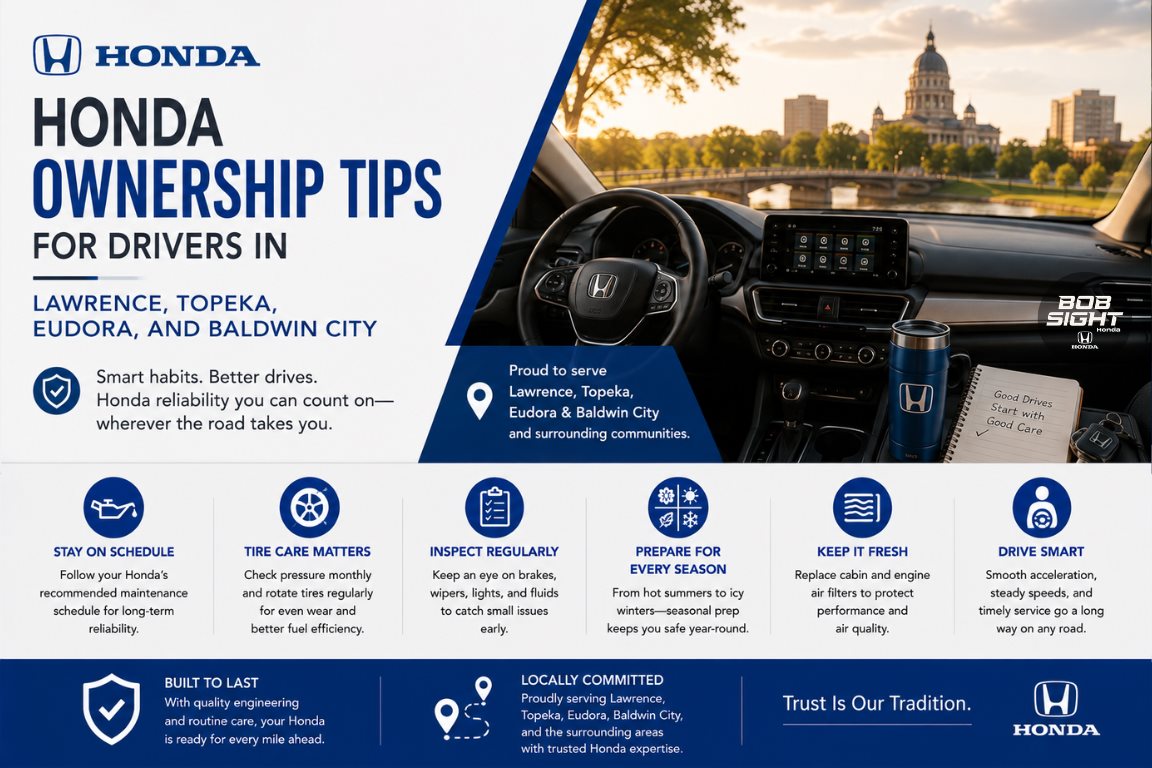
Schedule Certified Honda Maintenance at Bob Sight Honda in Lawrence, KS
Maximizing the long-term reliability, fuel economy, and trade-in value of your Honda requires an ownership strategy tailored to the regional climate and driving routes of Douglas and Shawnee Counties. At Bob Sight Honda in Lawrence, Kansas, we know that commuting daily along Highway 10 into the Kansas City metro, navigating Interstate 70 toward Topeka, or making rural runs between Eudora and Baldwin City places unique demands on your automobile. Whether you operate a fuel-efficient Honda Civic, a versatile Honda CR-V Hybrid, or a family-ready Honda Pilot SUV, taking proactive care of your vehicle ensures dependable performance through hot Midwest summers and icy winter storms. By adhering to factory maintenance schedules, utilizing genuine Honda parts, and relying on our certified service team, you can keep your vehicle running like new while protecting your long-term financial equity.
In this guide, you'll learn:
- Essential maintenance routines tailored to highway commuting and rural driving across northeast Kansas.
- How regional climate shifts in Lawrence and Topeka impact battery performance, tires, and engine fluids.
- Strategies for protecting your vehicle's exterior and cabin against seasonal weather and gravel road debris.
- Step-by-step procedures for tracking Honda Maintenance Minder codes and scheduling local service.
- How to manage drivetrain systems, all-wheel-drive components, and transmission care for long-term vehicle health.
- Best practices for preserving hybrid powertrain battery efficiency and fuel economy across local routes.
- Why trusting Bob Sight Honda preserves factory warranties and maximizes future trade-in valuation.
Adapting Honda Maintenance to Northeast Kansas Driving Conditions
Customizing your vehicle care routine to account for high-speed highway miles, rural unpaved roads, and extreme seasonal temperatures prevents unexpected mechanical breakdowns. Commuting between Topeka, Lawrence, Eudora, and Baldwin City involves a mix of heavy stop-and-go city traffic, open-road cruising along K-10, and dusty county roads. Each driving environment creates distinct wear patterns on friction brake pads, suspension bushings, and air filtration systems. Understanding how local geography impacts your powertrain ensures you can take preventive action before minor friction leads to major component failure.
High-speed highway travel generates elevated under-hood operating temperatures, accelerating the thermal breakdown of engine oil and transmission fluids. Conversely, short trips around college campuses or suburban neighborhoods prevent the engine from reaching full operating temperature, allowing condensation and unburnt fuel to accumulate inside the crankcase. Following factory fluid intervals using Genuine Honda full synthetic oil protects internal engine bearings, pistons, and camshafts against friction and internal corrosion under all regional driving conditions.
Rural driving across Douglas and Shawnee Counties introduces fine agricultural dust and gravel impacts that test your vehicle's protective barriers. Fine dirt road dust bypasses worn seals easily if filters are left unchecked. Regularly replacing engine and cabin air filters prevents airborne particles from entering the combustion chamber or circulating through dashboard vents, ensuring optimal fuel combustion, peak horsepower, and clean interior air for your family.
To keep your Honda performing at its peak across varied regional terrain, consider establishing a consistent monthly vehicle check routine. Inspecting tire tread depth, checking under-hood fluid clarity, and clearing leaf debris from the windshield cowl prevents small environmental issues from turning into expensive service visits. Proactive attention to detail is the cornerstone of long-term automotive reliability.
Managing Seasonal Weather Extremes: Summer Heat to Winter Ice
Preparing your Honda for severe climate shifts across northeast Kansas safeguards electrical systems, maintains tire traction, and preserves cooling system efficiency. Summer heat indexes in Lawrence and Topeka frequently top 100°F, placing immense pressure on your engine cooling system and air conditioning compressor. Ensuring coolant reservoirs maintain a proper 50/50 water-to-antifreeze concentration prevents high-temperature engine boil-overs during extended highway traffic delays near the I-70 turnpike interchange.
Winter weather brings freezing slush, aggressive rock salt applications, and sub-zero cold snaps along US-59 and K-10. Freezing air contracts the compressed air inside your tires, dropping inflation pressure by approximately 1 PSI for every 10-degree temperature decline. Checking tire pressure monthly with a reliable digital gauge and maintaining adequate tread depth prevents dangerous hydroplaning, skidding, and extended stopping distances on icy or wet road surfaces.
| Season | Primary Maintenance Focus | Regional Climate Impact | Recommended Action |
|---|---|---|---|
| Spring | Undercarriage wash & wheel alignment | Clears winter salt & corrects pothole wear | Inspect suspension & alignment annually |
| Summer | Cooling system check & battery load test | High heat degrades battery fluid & coolant | Test battery reserve capacity before heatwaves |
| Autumn | Wiper replacement & lighting inspection | Decreasing daylight & early morning frost | Install fresh wiper blades & winter washer fluid |
| Winter | Cold Cranking Amp check & tire tread depth | Sub-zero starts & slick, snowy road surfaces | Verify tread depth is above 4/32 inches |
Sub-zero winter mornings also place heavy electrical demands on 12-volt starter batteries. Cold weather reduces battery chemical reaction speeds and power output by up to 50 percent while requiring significantly extra cranking energy to turn over cold, dense engine oil. Having a digital battery load test performed at Bob Sight Honda before winter arrives prevents frustrating morning start failures in your driveway.
Seasonal transitions are also the ideal time to evaluate windshield wiper health and washer fluid chemistry. Summer UV rays bake natural wiper rubber, causing tearing, chatter, and severe streaking when sudden autumn cloudbursts hit. Replacing wiper blades bi-annually and filling washer reservoirs with low-temperature de-icing fluid guarantees an unobstructed view during freezing rain and heavy highway road spray.
Protecting Exterior Paint and Interior Upholstery
Utilizing genuine Honda protective accessories and establishing a routine cleaning schedule guards your vehicle against winter road salt, road tar, and daily interior spills. De-icing chemicals used along Kansas highways can cause corrosive rust damage to exposed metal undercarriage components, lower door edges, brake lines, and exhaust hangers if left untreated. Washing your vehicle's underbody thoroughly after winter storms removes trapped salt crusts and prevents long-term structural corrosion.
Interior preservation is equally important for maintaining daily driving comfort and future resale value. Active families in Baldwin City and Eudora bring mud, sand, wet towels, and sports gear directly into the cabin. Equipping your vehicle with custom-fit Honda Genuine All-Weather Floor Mats traps liquid spills, snow slush, and ground-in dirt within raised perimeter barriers, keeping factory floor carpets clean and dry.
To systematically preserve your vehicle's condition throughout the year, follow this protective care routine:
- Apply a high-grade synthetic paint sealant or carnauba wax twice per year to shield exterior paint from UV fading and acidic bug splatter.
- Wash wheel wells and chassis undersides thoroughly after highway salt applications along K-10 and Interstate 70.
- Install custom rubber all-weather floor trays and rear cargo liners to contain mud, food crumbs, and sports equipment debris.
- Wipe down leather or cloth seating surfaces regularly with approved pH-neutral cleaners to prevent staining and denim dye transfer.
- Park in shaded areas or place a custom windshield sunshade across the glass during summer months to protect dashboard plastics from cracking.
Taking proactive steps to shield both the exterior sheet metal and interior cabin preserves that new-car showroom feel. Consistent protection ensures your Honda commands top dollar at trade-in time while providing a healthier, cleaner environment for your daily family travel.
Understanding Honda Maintenance Minder Codes and Service Intervals
The Honda Maintenance Minder system calculates remaining oil life dynamically based on engine revolutions, trip duration, and operating temperatures, alerting you when service is required. Rather than relying solely on fixed calendar months or static mileage numbers, modern Honda vehicles utilize intelligent onboard monitoring software to determine precise maintenance timing for your exact driving habits.
When oil life reaches 15 percent, a main service code (A or B) and numerical sub-codes (1 through 6) display on your dashboard instrument cluster. Main Code A calls for a simple engine oil change, while Main Code B indicates a full oil and filter change, mechanical brake inspection, parking brake adjustment, and multi-point check. Numerical sub-codes indicate specific maintenance items like tire rotations, cabin filter replacements, spark plug renewals, or fluid flushes.
Understanding these automated maintenance codes allows drivers in Topeka, Eudora, and Baldwin City to plan service appointments conveniently before oil degradation occurs. Bringing your vehicle to Bob Sight Honda guarantees that these system codes are reset accurately using official diagnostic tools after factory-approved maintenance is completed.
Ignoring Maintenance Minder alerts for extended periods risks severe engine wear and may jeopardize active factory warranty coverage. When your dashboard displays a service prompt, contacting our service advisors promptly ensures your vehicle receives the exact care it requires without unnecessary add-on expenses.
Maintaining Drivetrain Systems, All-Wheel Drive, and Transmissions
Regular transmission fluid replacement and rear differential service protect your drivetrain against mechanical friction and thermal breakdown during highway towing or snow driving. Your Honda's transmission and all-wheel-drive (AWD) systems work continuously to transfer engine power to the pavement smoothly. Continuous Variable Transmissions (CVT) and multi-speed automatic gearboxes rely on specialized hydraulic fluids to cool internal clutches, lubricate steel belts, and actuate smooth gear shifts.
Driving through hilly terrain near the Kansas River valley or towing light utility trailers places elevated thermal loads on transmission fluid. Over thousands of miles, fluid shearing reduces viscosity and heat tolerance. Replacing transmission fluid with Genuine Honda HCF-2 or ATF-TYPE 3.1 fluid at factory intervals eliminates harsh shifting, prevents clutch slippage, and extends gearbox longevity.
For AWD models like the Honda CR-V, Passport, or Pilot equipped with Intelligent Variable Torque Management (i-VTM4), rear differential fluid requires periodic replacement. Fresh fluid prevents internal gear friction, reduces thermal degradation during wheel-slip conditions in snow, and maintains smooth power distribution between front and rear axles.
Adhering to strict drivetrain fluid schedules is one of the most effective ways to avoid major mechanical repairs. Fresh lubricants protect precision-machined gears, bearings, and hydraulic control valves, ensuring your automobile handles slippery Midwest roads with complete confidence.
Optimizing Hybrid Powertrains and High-Voltage Battery Health
Maintaining clean cooling intakes, utilizing regenerative braking, and keeping 12-volt auxiliary batteries healthy maximizes hybrid fuel economy and battery lifespan. Hybrid models like the Honda Accord Hybrid and CR-V Hybrid combine gasoline engines with electric traction motors to deliver outstanding fuel efficiency across Lawrence and Topeka commuter routes. Caring for a hybrid vehicle involves specific maintenance best practices.
High-voltage lithium-ion hybrid batteries generate heat during rapid charging and discharging cycles. Clean air cooling vents located near rear passenger seats pull cabin air across battery cells to maintain optimal operating temperatures. Keeping these cooling vents unobstructed by blankets, pet hair, or luggage prevents high-voltage battery overheating and maintains peak electrical efficiency.
Regenerative braking systems convert kinetic energy into electrical power during deceleration, storing energy back inside the hybrid battery. Smooth, gradual braking along K-10 maximizes energy recovery while reducing wear on traditional mechanical brake pads. This dual-braking setup allows hybrid brake pads to last significantly longer than those on conventional gasoline models.
Ensuring your hybrid vehicle receives regular multi-point checks at Bob Sight Honda keeps electronic control modules updated and cooling fans operating quietly. Proper hybrid care guarantees you continue enjoying exceptional MPG ratings through years of commuting.
Defining Essential Honda Ownership Terms
Learning standard automotive service terms empowers you to make informed decisions regarding your vehicle's long-term care and maintenance. Vehicle ownership involves specific technical terms. Below are fundamental service terms defined in clear, accessible language:
Multi-Point Vehicle Inspection: A thorough visual and mechanical check conducted by factory-certified technicians. Technicians evaluate vital components including brakes, tires, fluids, steering, suspension, and battery health, presenting findings on an easy-to-read color-coded health report.
Full Synthetic Motor Oil: A high-performance lubricant engineered artificially from petroleum compounds. Synthetic oil provides superior viscosity stability, resists thermal breakdown under extreme summer heat, and flows rapidly during sub-zero winter starts.
OEM (Original Equipment Manufacturer) Parts: Replacement components designed and manufactured directly by Honda to exact factory specifications. OEM parts guarantee precise fitment, original engineering performance, and full factory warranty protection.
i-VTM4 All-Wheel Drive: Honda's advanced electronic all-wheel-drive system that actively distributes torque between front and rear axles, as well as dynamically side-to-side between rear wheels, optimizing traction on icy or unpaved roads.
Comparing Authorized Dealership Service vs. Independent Repair Shops
Bob Sight Honda offers factory-trained technicians, specialized diagnostic software, and authentic OEM parts that generic independent repair shops cannot match. Selecting where to service your vehicle is a critical ownership decision. While independent garages may offer convenient locations, they often rely on generic aftermarket parts and universal diagnostic equipment that may not align with Honda engineering specs.
At Bob Sight Honda, our service department is equipped with specialized Honda diagnostic tools capable of reading precise computer trouble codes and updating onboard control software. Our technicians receive continuous factory training directly from Honda, specializing in advanced hybrid systems, powertrain calibrations, and Honda Sensing safety technology.
Furthermore, all maintenance and repair work completed at Bob Sight Honda utilizes Genuine Honda OEM replacement parts. These factory components carry comprehensive warranty coverage and maintain original safety and fuel efficiency standards, preserving your vehicle's factory warranty and long-term resale equity.
Choosing authorized dealership service also ensures complete transparency. Detailed digital inspection reports, clear multi-point documentation, and direct access to factory service bulletins guarantee your vehicle is cared for with uncompromising professionalism.
Quick Facts: Regional Honda Ownership Summary
- Highway Commuter Efficiency: Routine synthetic oil changes and proper tire inflation maximize MPG along K-10 and I-70.
- All-Season Dependability: Pre-season battery testing and cooling system flushes eliminate unexpected climate breakdowns.
- Corrosion Prevention: Frequent undercarriage washes protect lower body panels and brake lines from winter road salt.
- Drivetrain Protection: Scheduled transmission and differential fluid services prevent expensive gearbox wear.
- Hybrid Battery Efficiency: Clear cooling vents and smooth regenerative braking extend hybrid battery performance.
- Factory Precision: Genuine Honda OEM accessories and parts fit perfectly while maintaining original safety standards.
- Resale Equity Retention: Verified dealership service records command top dollar during vehicle trade-in appraisals.
Following a structured ownership plan gives you total confidence behind the wheel, ensuring your Honda remains safe, reliable, and valuable for years to come.
Long-Term Ownership Planning and Equity Protection
Adhering to a documented maintenance schedule lowers long-term repair costs, extends vehicle lifespan, and maximizes trade-in valuation when upgrading. Consistent preventive care prevents minor wear items from escalating into major mechanical failures. Following factory service guidelines protects critical systems like the engine, transmission, hybrid components, and all-wheel-drive assemblies throughout your ownership cycle.
Maintaining complete service records with Bob Sight Honda creates a verified history of professional care. When you decide to trade in your automobile for a new model, a fully documented dealership service history proves the vehicle was meticulously cared for, allowing our appraisal team to offer top trade-in value.
Partnering with Bob Sight Honda makes vehicle ownership effortless. We offer online scheduling, express service lanes, transparent pricing, and comfortable customer lounges designed around your busy schedule. Investing in quality local service pays major dividends in vehicle dependability and retained resale equity.
Frequently Asked Questions
How often should I have my Honda serviced if I commute daily between Topeka and Lawrence?
Daily highway commuters should follow the Honda Maintenance Minder system, which typically prompts oil changes and inspections every 5,000 to 7,500 miles. High-speed highway driving along I-70 or K-10 subjects engine oil and transmission fluids to continuous thermal stress, making regular fluid replacements vital for long-term engine protection.
During routine oil service visits, technicians will also rotate your tires, inspect friction brake pads, and check under-hood fluid levels. Keeping up with these regular intervals prevents uneven tire wear and ensures your vehicle remains reliable for your daily commute.
Contact the service team at Bob Sight Honda in Lawrence to schedule a routine maintenance visit or to learn more about our Express Service options.
What are the benefits of using Genuine Honda OEM parts over aftermarket alternatives?
Genuine Honda OEM parts offer exact factory fitment, verified material durability, and full warranty coverage designed specifically for your model. Generic aftermarket parts bought online or at independent shops are built to fit multiple vehicle makes, often leading to poor fitment, unusual noises, or premature component failure.
OEM components are engineered to match Honda's exact performance, safety, and fuel efficiency standards. Crucially, using genuine parts ensures full compatibility with advanced safety features like Honda Sensing, maintaining original emergency braking performance.
All Genuine Honda parts installed at Bob Sight Honda are backed by a comprehensive factory parts warranty, giving you complete peace of mind.
How can I protect my Honda's paint from gravel damage on rural Eudora and Baldwin City roads?
Protect your vehicle's paint from gravel chips by installing genuine Honda splash guards, applying clear paint protection film, and maintaining a regular wax routine. Flying gravel and road debris along unpaved rural roads can easily chip exterior paint, exposing bare sheet metal to rust.
Molded Honda splash guards deflect rocks, mud, and road tar away from lower body panels and side sills. Applying a clear protective film across high-impact areas like the front bumper and hood edge absorbs rock impacts without damaging underlying paintwork.
Visit the parts center at Bob Sight Honda to view splash guards and exterior protective accessories designed specifically for your vehicle.
Why is my tire pressure light coming on when the weather turns cold in Douglas County?
Your tire pressure light triggers during cold weather because dropping outdoor temperatures cause the air inside your tires to contract, reducing inflation pressure below safety thresholds. Tire pressure decreases by approximately 1 PSI for every 10-degree drop in outside air temperature.
When the TPMS warning light turns on during a chilly autumn or winter morning, check cold tire pressure using a reliable gauge. Inflate tires to the recommended cold PSI listed on the driver's door jamb plaque rather than the maximum pressure molded on the tire sidewall.
If your tire pressure light remains illuminated after inflating tires to the correct pressure, schedule a tire check at Bob Sight Honda to inspect for slow punctures or valve stem leaks.
When should I replace my transmission fluid and differential fluid in my Honda SUV?
Transmission and rear differential fluids should generally be replaced every 30,000 to 60,000 miles or when prompted by specific Maintenance Minder sub-codes. Severe driving conditions such as daily highway commuting, towing, or driving in snow accelerate fluid breakdown and require more frequent changes.
Fresh transmission and differential fluids ensure smooth gear shifting, prevent internal clutch slippage, and protect internal metal components against friction wear. Using Genuine Honda fluids guarantees exact viscosity and thermal stability.
Consult with our certified service advisors at Bob Sight Honda to check your current fluid condition and establish the ideal maintenance schedule for your vehicle.
Why Servicing and Buying Local at Bob Sight Honda Matters
Servicing your vehicle at Bob Sight Honda in Lawrence, KS, provides access to factory-certified expertise, authentic OEM parts, and personalized service tailored to local drivers. As a family-owned dealership serving Lawrence, Topeka, Eudora, and Baldwin City, we take pride in building lasting customer relationships based on honesty, transparent pricing, and technical excellence.
Choosing local dealership service guarantees your automobile receives engineering-exact care from technicians who specialize exclusively in Honda vehicles. We utilize factory diagnostic tools, genuine OEM components, and official service procedures that independent repair shops cannot match. From quick Express Service visits to comprehensive mechanical maintenance, we deliver exceptional quality every time.
When you partner with Bob Sight Honda, you enjoy convenient scheduling, clear communication, and a welcoming customer environment. Visit our dealership on 23rd Street in Lawrence to keep your Honda operating at peak performance. Discover why drivers across Douglas and Shawnee Counties trust Bob Sight Honda for all their automotive needs.
Helpful Links
- Schedule Service Online at Bob Sight Honda
- Learn More About Honda Express Service
- Explore Service & Parts Specials
- Order Genuine Honda Parts & Accessories
- Explore New Honda Inventory in Lawrence, KS
PROUD TO BE PART OF THE BOB SIGHT AUTO GROUP
At Bob Sight Honda, we are proud to stand as a key pillar of the Bob Sight Auto Group, serving drivers across Lawrence, Lee's Summit, Independence, and the surrounding Kansas City metropolitan area. For generations, our group has built a reputation grounded in integrity, exceptional customer care, and active community involvement. Whether you are shopping for a new family SUV, seeking certified pre-owned options, or bringing your vehicle in for expert maintenance, our connected network of dealerships guarantees that you receive consistent quality and transparent service at every touchpoint.