Honda Pilot vs Toyota Highlander: Three-Row Family SUV Comparison
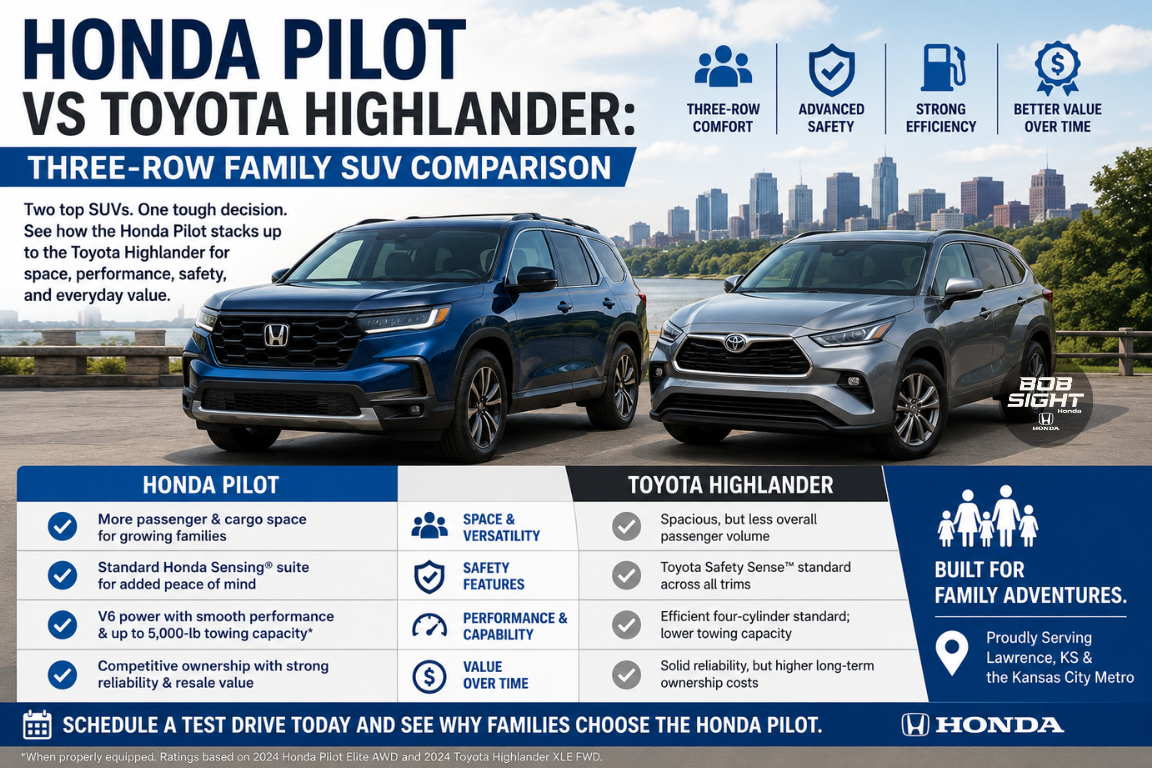
Choosing between the Honda Pilot and the Toyota Highlander requires a detailed look at cabin layout configurations, third-row legroom dimensions, and how distinct powertrain options perform across northeast Kansas highways. At Bob Sight Honda in Lawrence, Kansas, we know that finding the perfect three-row SUV is the foundational key to managing busy family schedules across Douglas County, Topeka, and the western Kansas City metro area. Whether you are carpooling students to activities along Wakarusa Drive or packing heavy tailgating gear for a Saturday trip to the university stadium, interior space and ride composition are essential parameters. Evaluating these highly popular midsize cross-overs side-by-side allows your household to bypass generic advertising claims and pick the exact layout that simplifies your daily driving routine.
Shop New Honda Pilot Inventory at Bob Sight Honda
In This Guide You'll Learn
This comprehensive side-by-side family SUV comparison provides the strategic engineering specs and regional ownership context you need to choose your next vehicle with total clarity:
- The exact interior dimensions separating the Honda Pilot passenger cabin from the Toyota Highlander.
- How a naturally aspirated 3.5-liter V6 engine compares directly to a downsized turbocharged four-cylinder configuration.
- Technical breakdowns of proprietary all-wheel-drive systems operating in severe midwestern winter weather.
- The hidden daily convenience differences between Honda's stowable middle seat and Toyota's fixed captain's chairs.
- Real-world road trip cargo capacity comparisons with all three rows of seating actively occupied.
- How factory-backed driver-assist technology suites perform during busy Kansas City metro highway commutes.
Sizing Up the Cabin: Interior Passenger Space and Third-Row Usability
Sizing up the interior cabin space reveals that the Honda Pilot delivers a significantly more spacious and flexible passenger layout than the Toyota Highlander, particularly when analyzing third-row legroom and rear hip room metrics. While both vehicles are classified as midsize three-row family crossovers, the Pilot makes full use of its boxier, more athletic exterior footprint to maximize real-world shoulder clearance and headroom across all three rows. This structural variance ensures that older children, teenagers, and adult passengers can sit comfortably in the rear without feeling confined during long trips across northeast Kansas.
When you sit in the third row of the Toyota Highlander, you are faced with a relatively tight 28.0 inches of legroom, which often forces rear passengers to ride with their knees elevated, making it best suited for smaller toddlers. The Honda Pilot completely reimagines rear-seat comfort by providing an expansive 32.5 inches of dedicated third-row legroom paired with larger rear quarter window glass. If your daily schedule involves navigating heavy carpool traffic near local Lawrence school districts, having a third row that comfortably accommodates growing teenagers turns a hectic morning routine into a relaxed, stress-free drive.
Furthermore, entry and exit mechanics represent another critical area of daily operational differentiation for local families. The Pilot features a user-friendly, one-touch electronic button system that instantly slides and tilts the second-row seats forward, creating a wide path for kids loading into the back with heavy backpacks. The Highlander relies on more traditional mechanical levers that can be difficult for small children to actuate independently. Choosing a cabin built around intuitive ergonomics eliminates the constant need for parents to step out of the vehicle to assist passengers during quick drop-off stops along busy regional routes.
Powertrain Performance: Naturally Aspirated V6 vs. Turbocharged Four-Cylinder
Comparing the standard powertrains demonstrates a distinct difference in engineering philosophy, matching Honda’s smooth, robust 3.5-liter naturally aspirated V6 engine against Toyota’s downsized 2.4-liter turbocharged inline four-cylinder engine. The Honda Pilot utilizes its advanced V6 engine to produce a commanding 285 horsepower paired with a highly responsive 10-speed automatic transmission. This mechanical pairing delivers linear, predictable acceleration from a standstill, ensuring the vehicle never feels strained or overly noisy when fully loaded with a complete payload of passengers and cargo.
Conversely, the gas-powered Toyota Highlander utilizes a 2.4-liter turbocharged engine generating 265 horsepower mated to an 8-speed automatic gearbox. While the turbocharger provides a healthy 310 pound-feet of low-end torque, the power delivery can occasionally feel abrupt when trying to execute quick passing maneuvers in stop-and-go traffic near Iowa Street intersections. Additionally, four-cylinder turbocharged engines inherently generate more vibration and high-pitched acoustic buzz under heavy acceleration compared to the refined, deep exhaust note of a traditional, naturally aspirated Honda V6 engine layout.
For drivers who regularly commute along high-speed corridors linking Lawrence to Overland Park or Kansas City via the K-10 highway, highway merging confidence is an absolute necessity. The Pilot's 10-speed automatic transmission optimizes gear selections seamlessly, allowing the vehicle to drop multiple gears instantly when you press the gas pedal to merge ahead of fast-moving semi-trucks. At Bob Sight Honda, we invite local shoppers to experience this smooth V6 refinement firsthand, noting how effortlessly the powertrain maintains highway cruising speeds without hunting for gears across rolling Douglas County hills.
AWD Capability and Severe Winter Weather Management
Managing severe midwestern winter weather demands an advanced all-wheel-drive system, and the Honda Pilot’s available i-VTM4® variable torque management system provides superior lateral traction control compared to the Highlander's traditional setup. Most standard all-wheel-drive systems are reactive, waiting for a wheel to physically slip on ice or snow before routing power to the opposing axle. Honda's intelligent torque-vectoring rear differential operates proactively, continuously monitoring steering inputs, throttle percentages, and wheel speeds to distribute power across the chassis before slippage even occurs.
Imagine navigating a snow-covered, unplowed curve along a rural secondary road near Baldwin City or Eudora on a freezing January morning. The i-VTM4® system can automatically send up to 70 percent of the engine’s total torque directly to the rear axle, and dynamically allocate 100 percent of that torque to either the left or right rear wheel. This precise mechanical distribution creates a distinct yaw effect that actively helps rotate the heavy SUV through the turn, significantly reducing dangerous front-wheel understeer and keeping your family securely centered within your lane.
The Toyota Highlander utilizes a standard automatic all-wheel-drive configuration that effectively manages straightforward straight-line traction but lacks the same advanced side-to-side torque-vectoring precision found across the Pilot lineup. When the roads change from freezing winter slush to slick, muddy gravel during intense spring rainstorms, the Pilot’s specialized drive modes—including dedicated Snow, Trail, and Sand settings—recalibrate the throttle mapping and traction control parameters instantly. Investing in an advanced mechanical drivetrain guarantees your family stays moving safely through the most volatile regional weather shifts.
Cargo Capacity and Three-Row Configuration Flexibility
Evaluating cargo configurations reveals that the Honda Pilot offers vastly superior utility over the Toyota Highlander, delivering an impressive 18.6 cubic feet of space behind the third row that dwarfs the Highlander's tighter 16.0 cubic feet baseline. When you are operating a busy household, those extra cubic feet represent the critical difference between easily sliding a full-size stroller or large sports gear bags into the back versus being forced to partially fold down passenger seats and sacrifice seating capacity.
The layout flexibility of the Pilot becomes even more apparent when exploring its unique, segment-exclusive stowable middle seat feature available on premium trims like the Touring and Elite. This brilliant engineering solution allows owners to convert the second row from a traditional three-passenger bench seat into a pair of wide captain's chairs with a center walk-through corridor. If you unexpectedly need to carry an eighth passenger, you simply retrieve the fully functional middle seat module from its dedicated under-floor storage compartment in the rear cargo area and lock it back into place within minutes.
The Toyota Highlander requires buyers to make a permanent choice at the time of purchase between a seven-passenger captain's chair configuration or an eight-passenger bench layout. If your lifestyle needs shift over time, the Highlander's interior cannot adapt to accommodate those changes. With the Pilot, folding both the second and third rows completely flat opens up a cavernous 87.0 cubic feet of highly usable, flat loading space perfect for moving large furniture items, packing camping gear for Clinton Lake weekend trips, or hauling major home improvement supplies across town.
| SUV Technical Metric | Honda Pilot Specifications | Toyota Highlander Specifications | Real-World Family Benefit |
|---|---|---|---|
| Third-Row Legroom | 32.5 Inches | 28.0 Inches | Comfortably accommodates growing teenagers and adults |
| Cargo Volume (All Seats Up) | 18.6 Cubic Feet | 16.0 Cubic Feet | Fits large strollers and full grocery hauls without folding seats |
| Standard Engine Design | 3.5L Naturally Aspirated V6 | 2.4L Turbocharged 4-Cylinder | Delivers linear acceleration and ultra-smooth highway power |
| Transmission Speeds | 10-Speed Automatic | 8-Speed Automatic | Optimizes fuel economy and prevents constant gear hunting |
| AWD Mechanical Architecture | i-VTM4® Torque Vectoring | Standard Dynamic AWD | Proactively routes side-to-side power for maximum winter safety |
In addition to raw volume advantages, the Pilot features a deeply recessed, washable storage bin integrated directly into the rear cargo floor. This hidden compartment is ideal for stowing muddy sports cleats, wet swimsuits after a lake day, or valuable electronic items you want to keep hidden from external view while parked at local shopping centers. The Highlander offers a much shallower under-floor storage tray that fills up quickly with basic emergency supplies. Prioritizing clever, high-volume spatial utility makes the Pilot one of the most practical family management tools available on the market today.
Driver-Assist Technology: Honda Sensing® vs. Toyota Safety Sense
Comparing driver-assist technology suites demonstrates that both vehicles prioritize family safety by including highly comprehensive standard safety packages, but Honda Sensing® delivers more intuitive alerts and smoother lane-keeping interventions during highway commutes. A modern family crossover should act as an active safety shield, utilizing advanced radar arrays and optical camera systems to continuously monitor blind spots, track pedestrian movements, and mitigate potential forward collision risks before they evolve into accidents.
Every new Honda Pilot comes standard with the sophisticated Honda Sensing® suite, integrating critical technologies like Adaptive Cruise Control with Low-Speed Follow, Lane Keeping Assist, and Traffic Sign Recognition. When you are commuting home after a long workday along the crowded, stop-and-go stretches of Interstate 70, the adaptive cruise system manages your throttle and braking inputs smoothly, maintaining a safe, pre-set gap behind the vehicle ahead. The steering interventions applied by the lane-keeping system feel progressive and natural, avoiding the annoying, ping-ponging corrections across the lane markers that drivers sometimes experience in competing models.
The Toyota Highlander counters with its proprietary Toyota Safety Sense suite, which offers a highly comparable list of protective capabilities. However, many drivers note that Toyota's forward collision warning alarms can be overly sensitive, triggering loud audio alerts during routine turning maneuvers near busy suburban parking lots. Honda’s engineering team has meticulously calibrated their warning thresholds to reduce driver alarm fatigue while providing immediate, decisive automated braking force when a true forward obstruction is detected. Testing these safety systems in person helps your family choose the exact interface that feels most supportive.
Step-by-Step: How to Evaluate a Three-Row SUV on a Family Test Drive
Evaluating a three-row midsize crossover on a family test drive requires a systematic, multi-step review process that mimics your actual weekly household routines rather than a brief, quiet loop around the local dealership lot. Bringing your real passenger seating needs, common cargo items, and specialized child safety seats along allows you to diagnose potential spatial limitations before signing any final financial paperwork. Following a structured test drive sequence ensures that your final purchase decision fits your lifestyle perfectly.
Northeast Kansas families put their vehicles through a highly diverse mix of stop-and-go errands, high-speed highway travel, and challenging tight parking maneuvers. By conducting a hands-on audit of rear-row accessibility, cabin visibility metrics, and cargo load boundaries, you secure complete transparency. Follow our structured, step-by-step test drive evaluation sequence detailed below to analyze any three-row crossover like an absolute automotive industry expert.
- Install Your Real Child Safety Seats: Place your actual rear-facing or booster infant seats into the second and third rows to verify latch anchor accessibility and check if front-passenger legroom is compromised.
- Audit Third-Row Loading Mechanics: Have your older children or adult family members practice entering and exiting the rearmost seats repeatedly to evaluate the speed and simplicity of the electronic sliding hardware.
- Pack Your Largest Everyday Cargo Items: Bring a full-size folding stroller, a large sports gear bag, or a travel cooler to see exactly how much usable floor space remains behind the third row when all seats are fully occupied.
- Test Real Highway Merging Performance: Take the vehicle onto a high-speed regional acceleration ramp, noting the engine's throttle responsiveness, cabin acoustic insulation levels, and overall steering composure at 70 MPH.
- Execute Confident Tight Parking Maneuvers: Drive the SUV into a tight parking space near a busy shopping corridor, utilizing the multi-angle backup cameras and parking sensors to verify your blind spot visibility margins.
Quick Facts
The Honda Pilot stands out as an elite midsize three-row family SUV because it blends outstanding cabin configuration flexibility, superior cargo capacity, and smooth V6 power into a premium footprint. It represents an exceptionally well-rounded option for active households who want to avoid the oversized driving dynamics of full-size truck-based utility vehicles.
- The Honda Pilot provides an extra 4.5 inches of critical third-row legroom compared to the Toyota Highlander.
- Standard cargo capacity behind the rearmost seats measures 18.6 cubic feet in the Pilot vs. 16.0 cubic feet in the Highlander.
- The Pilot features a refined 285-horsepower V6 engine paired with an advanced, smooth-shifting 10-speed automatic transmission.
- Honda's proprietary i-VTM4® AWD system offers true proactive torque vectoring for superior midwestern winter driving safety.
- A segment-exclusive stowable second-row middle seat allows owners to instantly transition between 7 and 8-passenger capacities.
- The standard Honda Sensing® safety suite delivers progressive, driver-centric assistance interventions across busy metro commutes.
Reviewing these essential engineering specifications highlights why the Pilot remains a premier choice for growing families across northeast Kansas. By prioritizing interior legroom, powertrain longevity, and layout adaptability, Honda has constructed a vehicle that effortlessly accommodates changing family dynamics. Our local team stands completely ready to help you explore these advantages across our entire model lineup.
Ownership Planning
Proactive ownership planning helps local families optimize their long-term vehicle dependability, preserve their factory warranty coverages, and maximize future trade equity margins. Because a three-row family crossover is heavily utilized across a wide variety of commuting, carpooling, and vacation road trip scenarios, establishing a consistent maintenance cadence is vital to managing long-term operating costs.
An effective multi-year vehicle preservation strategy centers around monitoring your onboard digital indicators and executing routine synthetic oil changes, comprehensive tire rotations, and engine filter replacements precisely when prompted. For households traveling regularly across changing road surfaces near Topeka and Eudora, scheduling annual computerized wheel alignments protects your tire tread blocks from rapid, irregular wear patterns. Furthermore, replacing your cabin HVAC air filter every spring shields your passengers from heavy midwestern pollen counts and dust particles, maintaining a clean, fresh interior environment.
Bob Sight Honda supports your long-term vehicle planning by offering user-friendly online service booking interfaces, factory-trained master technicians, and a fully stocked on-site inventory of genuine OEM replacement parts. Our advisors track your vehicle's mechanical health history seamlessly, providing clear, itemized repair recommendations that align perfectly with factory service parameters. Taking a structured approach to routine preventative care ensures your vehicle remains completely safe, efficient, and dependable for hundreds of thousands of upcoming miles.
When your family is ready to analyze current vehicle equity metrics or explore upgrading your current vehicle layout to match a changing household schedule, you can easily utilize our digital Value Your Trade tool to establish an accurate, transparent market valuation. Our experienced dealership experts remain completely focused on delivering a premium, supportive customer experience across every single stage of your personal automotive journey.
Frequently Asked Questions
Is the Honda Pilot or Toyota Highlander better for installing multiple car seats?
The Honda Pilot is generally much better for installing multiple child safety seats because its wider second-row cushion design and more accessible lower LATCH anchor points provide superior physical layout space than the Highlander. The Pilot features easily accessible lower anchors across all three second-row seating positions, and select trims include secondary tether anchors in the third row, giving parents maximum flexibility when configuring infant carriers, forward-facing seats, or convertible boosters.
The Toyota Highlander possesses a slightly narrower cabin width, which can make installing three child safety seats side-by-side across the second-row bench incredibly difficult depending on the specific shell dimensions of your car seat brand. Additionally, the Highlander's third-row anchor access is more restricted, often meaning that placing a child safety seat in the very back eliminates most of your remaining passenger capacity. The Pilot's flat floor design and wide door openings make buckling young children in an exceptionally simple task.
If your family utilizes specialized car seat configurations, we highly encourage you to bring your actual car seats along to our Lawrence showroom floor. Our team will gladly assist you with test-fitting your hardware directly into both the second and third rows of a new Pilot model. Experiencing the physical ease of installation firsthand ensures you select a family vehicle that eliminates daily frustration and guarantees your children travel with absolute structural safety.
How does the long-term resale value compare between the Honda Pilot and Toyota Highlander?
Both the Honda Pilot and the Toyota Highlander sit at the absolute top of the midsize three-row crossover segment for long-term resale value, consistently retaining an exceptional percentage of their original MSRP over a five-year ownership window. Because both global manufacturers possess legendary reputations for engineering durability, pre-owned shoppers aggressively pursue these models on the secondary market, which protects initial owners from the rapid financial depreciation cycles that plague competing domestic and European brands.
While the models trade top rankings depending on specific model years and trim tiers, the Honda Pilot frequently commands a premium on the pre-owned market due to its highly desirable cabin space metrics and robust V6 engine architecture. Pre-owned family buyers specifically seek out the Pilot because they know its spacious third row can handle real-world carpooling duties, making a used Pilot an incredibly hot commodity across northeast Kansas and Douglas County dealership networks.
To maximize your vehicle's future trade equity, maintaining a clean, verifiable digital service history logged directly within an authorized dealer network is the most effective strategy available. When you bring your vehicle to Bob Sight Honda for routine care, every single appointment is recorded seamlessly within the manufacturer's national database. This bulletproof documentation serves as an undeniable badge of quality, allowing you to secure top-dollar valuation when you eventually prepare to trade up.
Can the Honda Pilot tow a family camper or boat compared to the Highlander?
Yes, when properly equipped with factory-authorized towing hardware and all-wheel-drive systems, the Honda Pilot delivers a robust maximum towing capacity of up to 5,000 pounds, which perfectly matches the maximum towing limit of the gas-powered Toyota Highlander. This substantial towing threshold allows local families to confidently pull a medium-sized utility trailer, a pair of personal watercraft, a lightweight fiberglass fishing boat, or a compact pop-up camper for weekend excursions near Clinton Lake.
However, the mechanical manner in which these two vehicles manage heavy trailering loads differs due to their distinct engine and transmission setups. The Pilot's naturally aspirated 3.5-liter V6 engine leverages its 10-speed automatic transmission to keep the engine operating within its optimal power band, avoiding excessive downshifting when pulling a heavy trailer up steep highway inclines. The Highlander's turbocharged four-cylinder engine relies heavily on turbo boost to maintain towing speeds, which can cause internal thermal loads to rise quickly during intense midwestern summer heat waves.
Additionally, the Pilot’s advanced i-VTM4® all-wheel-drive system features a dedicated, integrated Tow Mode that automatically recalibrates the rear differential's lock percentages and adjusts the transmission shift logic to prevent overheating. Our parts department at Bob Sight Honda carries a comprehensive line of genuine factory-engineered hitch receivers, wiring harnesses, and transmission coolers designed to integrate flawlessly with your vehicle's active stability software. Prioritizing OEM trailering hardware ensures complete safety compliance across all your seasonal travel adventures.
What are the main styling and capability advantages of the Honda Pilot TrailSport trim?
The specialized Honda Pilot TrailSport trim provides genuine, factory-engineered off-road capability that outclasses the styling-only rugged trims found within the Toyota Highlander lineup, making it an exceptional match for active families who love outdoor adventure. Rather than simply adding plastic body cladding and simple cosmetic badges, the TrailSport features a fully raised suspension that adds an extra inch of ground clearance, robust steel skid plates to protect the underbody oil pan, and premium all-terrain tires.
The core electronic heart of the TrailSport is a specially calibrated off-road logic package integrated directly into the i-VTM4® all-wheel-drive system. This trail-focused software path can automatically detect when a wheel has completely lifted off the ground during rugged trail navigation, instantly routing maximum torque to the wheels that maintain physical contact with the dirt to pull the vehicle forward safely. The Highlander features an XSE trim level that stiffens the suspension for sportier on-road cornering, but it lacks a dedicated, terrain-conquering variant built for genuine off-grid exploration.
Inside the TrailSport cabin, families enjoy durable, easy-to-clean synthetic leather seating surfaces decorated with unique orange contrast stitching, alongside durable standard all-weather rubber floor mats designed to trap mud, sand, and water effortlessly. This rugged layout allows your family to transition seamlessly from a dusty weekend camping trip in the countryside directly back to Monday morning school drop-off routines without worrying about ruining delicate interior fabrics. The TrailSport delivers an elite combination of daily refinement and authentic weekend capability.
Where can I test drive and compare new three-row family SUVs near me?
You can test drive, closely compare, and secure competitive financing on the complete family-focused new vehicle lineup by visiting Bob Sight Honda located in Lawrence, Kansas. Our local dealership proudly supports automotive shoppers traveling from Topeka, Eudora, Baldwin City, and throughout the surrounding communities across the greater western Kansas City metro area. Our spacious showroom features a comprehensive inventory of fresh model arrivals, allowing your family to explore different trim configurations side-by-side.
Choosing an authorized regional dealer center for your purchasing journey guarantees direct access to product specialists who can walk you through complex cabin technology features, safety systems, and flexible leasing options with total itemized transparency. We eliminate the stress often associated with automotive shopping by delivering clear trade appraisals and zero-pressure consultations. The Bob Sight team remains entirely focused on helping your household find the absolute perfect three-row platform to support your daily lifestyle demands.
Visit Bob Sight Honda Today
Bob Sight Honda in Lawrence is your trusted regional destination for exploring, test driving, and comparing the ultimate midsize three-row family SUVs near the Kansas City metro area. Whether your household needs a spacious eight-passenger crossover to manage daily school carpool routines, an advanced torque-vectoring all-wheel-drive system to conquer unpredictable midwestern winters, or a versatile cargo layout to transport heavy sports gear, our dedicated sales team is standing by to assist with total integrity.
Selecting your next family vehicle locally is highly beneficial because our entire staff possesses deep, firsthand knowledge of the unique geographical challenges and driving conditions that northeast Kansas motorists encounter every single day. From navigating heavy stop-and-go campus traffic around Lawrence to handling continuous high-speed highway cruising along the K-10 corridor or protecting your passengers during severe seasonal weather shifts, your vehicle needs to adapt flawlessly to multiple roles. The brilliantly engineered Honda Pilot is built to excel across every single one of those real-world ownership scenarios.
Motorists throughout Lawrence, Topeka, Eudora, Baldwin City, and adjacent Kansas City suburban neighborhoods can easily browse our comprehensive new inventory online or stop by our showroom for a personalized, hands-on consultation. When you are ready to secure a highly dependable three-row crossover backed by an elite local support network and a family-owned tradition of automotive excellence, Bob Sight Honda is ready to deliver. Visit us today off Iowa Street to discover how simple, rewarding, and transparent choosing your next family vehicle can truly be.
Helpful Links
- Bob Sight Honda Official Website
- New Vehicle Inventory Showroom
- Value Your Current Trade-In Online
- Get Pre-Approved for Auto Financing Online
- Schedule Certified Vehicle Maintenance Appointments
Proud to be part of the Bob Sight Auto Group
Bob Sight Honda is incredibly proud to be an integral component of the Bob Sight Auto Group, helping drivers across Lawrence, Lee's Summit, Independence, and the wider Kansas City Metro find trusted, high-integrity dealership resources for vehicle sales, expert service, genuine parts, collision repair, and long-term ownership support.