Comprehensive Honda Ridgeline Maintenance Schedule for Kansas City Metro Drivers
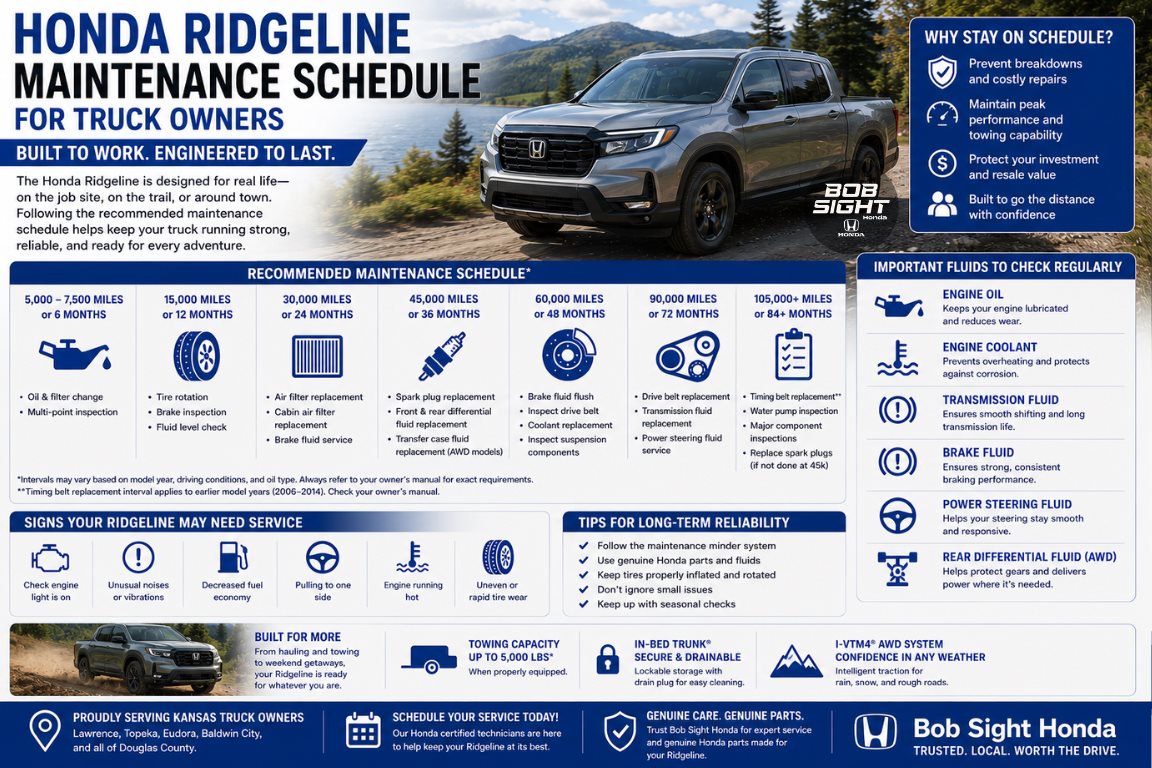
Schedule your Honda Ridgeline service at Bob Sight Honda in Lawrence, KS today
In This Guide You'll Learn
Keep your pickup running smoothly across Douglas County and the greater Kansas City area by following our complete ownership guide:
- How to interpret Honda Maintenance Minder codes on your digital dashboard display
- Recommended service intervals for engine oil, differential fluid, and transmission fluid
- How local Kansas weather and heavy trailering impact your truck maintenance schedule
- Comparison of dealership factory-certified service versus independent local mechanic shops
- Specific maintenance requirements for the Honda i-VTM4 all-wheel drive system
- Proactive ownership strategies to preserve long-term resale value and reliability
Understanding the Honda Ridgeline Maintenance Minder System
The Honda Maintenance Minder system automatically monitors your driving habits, engine operating conditions, and climate exposures to calculate precise service timing rather than relying on strict rigid mileage intervals. This intelligent onboard system uses sophisticated algorithms to analyze engine revolutions, operating temperatures, and vehicle speeds while commuting along Highway 10 or navigating stop-and-go city traffic near Iowa Street in Lawrence. When a main code or sub-code appears on your multi-information instrument panel, it gives you clear visibility into exactly what maintenance your midsize truck requires. Paying attention to these alerts keeps your 3.5L V6 engine running efficiently through every hot Midwest summer and icy Kansas winter.
When the system activates, it displays a main item letter paired with numeric sub-items that pinpoint required maintenance actions. Main code A indicates that your engine oil needs replacement, while main code B signifies that your truck requires a fresh oil change, a new oil filter, a comprehensive multi-point inspection, and brake pad inspection. The numeric sub-codes provide deeper clarity for specific system checks. Sub-code 1 requests a tire rotation, sub-code 2 specifies cabin and engine air filter replacements, sub-code 3 indicates transmission fluid replacement, sub-code 4 calls for spark plug replacement and timing belt inspection, sub-code 5 requests fresh engine coolant, and sub-code 6 signals rear differential fluid replacement for i-VTM4 all-wheel drive models.
Relying on this onboard technology prevents premature oil breakdown while ensuring you never skip crucial drivetrain upkeep. Driving habits in eastern Kansas vary significantly, from short local errands across downtown Lawrence to daily high-speed highway trips toward Kansas City or Topeka. The Maintenance Minder system adjusts fluid life calculations dynamically based on whether you frequently tow heavy cargo toward Clinton Lake or idle in heavy commuting traffic. Understanding these codes empowers you to schedule timely visits to your local honda service center lawrence ks before minor fluid degradation leads to avoidable mechanical wear.
Essential Routine Maintenance: Oil Changes and Fluid Services
Routine oil changes and fluid replacements are the single most important preventative measures for protecting your Honda Ridgeline powertrain against premature wear. Modern Honda 3.5L V6 engines require high-performance synthetic oil formulations that maintain proper viscosity under extreme heat and heavy towing loads. Keeping fresh fluid circulating through your engine, transmission, and transfer case prevents internal friction, reduces carbon buildup, and optimizes fuel economy whether you commute daily down K-10 or haul gear across Douglas County. Neglecting fluid service intervals can compromise internal tolerances and shorten the operating life of critical mechanical components.
To ensure your pickup remains in peak mechanical condition, local truck owners should follow this essential step-by-step fluid inspection and service routine:
- Check your engine oil level monthly using the dipstick while parked on a level surface, ensuring the level stays between the upper and lower crosshatch marks.
- Schedule a honda synthetic oil change lawrence ks whenever your Maintenance Minder reaches 15 percent oil life or at maximum 12-month intervals.
- Verify that factory-recommended 0W-20 full synthetic engine oil meeting API certification standards is utilized during every oil service.
- Inspect coolant levels in the expansion tank periodically, ensuring the Honda Long Life Type 2 antifreeze remains clean and properly mixed.
- Monitor the condition and fluid level of your rear differential and transfer assembly during every scheduled tire rotation.
Extreme regional weather conditions throughout northeast Kansas create additional stress on vehicle fluids. During frozen winter periods, short driving trips can allow fuel moisture condensation to accumulate in the oil pan if the engine does not reach full operating temperature. Conversely, summer driving along Interstate 70 with heavy payloads places higher thermal demands on transmission fluid and differential lubricants. Utilizing genuine OEM fluids engineered specifically for your truck guarantees optimal thermal stability and protects internal components during high-demand driving scenarios across Baldwin City, Eudora, and the greater Kansas City metro area.
Honda Ridgeline Maintenance Schedule by Mileage Milestones
Following a structured mileage milestone maintenance schedule ensures that major vehicle systems undergo regular inspection and timely component replacements throughout the life of your truck. While the Maintenance Minder provides real-time alerts, establishing clear mileage reference points helps truck owners plan and budget for necessary service procedures. A proactive maintenance strategy protects your investment, maintains optimal fuel efficiency, and prevents unexpected breakdowns during road trips or work commutes. Sticking to regular service intervals keeps all mechanical, electrical, and hydraulic systems operating in complete harmony.
Between 7,500 and 15,000 miles, your Ridgeline requires its initial engine oil service, oil filter replacement, and tire rotation. Technician teams perform a detailed honda multi point inspection lawrence ks to check brake pad thickness, suspension bushings, exhaust components, and steering linkages. At the 30,000-mile mark, owners should replace both the engine air filter and cabin air filter, especially when frequently driving along dusty rural gravel roads around Douglas County. This mileage milestone also serves as an ideal time for a thorough brake fluid flush to remove accumulated moisture from hydraulic lines.
When your pickup reaches 60,000 to 105,000 miles, secondary fluid and major system services become critical for long-term mechanical reliability. At 60,000 miles, perform a full honda transmission service lawrence ks along with fresh transfer assembly fluid replacement. Reaching 100,000 to 105,000 miles requires replacing the engine spark plugs, inspecting or replacing the timing belt and water pump assembly, and performing a full engine coolant flush. Adhering to these established milestones keeps your powertrain responsive, quiet, and dependable for hundreds of thousands of miles.
Transmission, i-VTM4 AWD Differential, and Drivetrain Care
Proper maintenance of the 9-speed automatic transmission and intelligent Variable Torque Management all-wheel drive system is vital for preserving smooth shifting and maximum traction. The advanced i-VTM4 all-wheel drive system continuously calculates torque distribution between the front and rear axles, actively overdriving individual rear wheels to enhance cornering precision and off-road capability. This sophisticated hydraulic clutch pack system relies on clean specialized fluid to operate without slipping or overheating. Routine maintenance of differential and transmission fluids preserves this exceptional handling capability across wet, muddy, or snow-covered Kansas highways.
The rear differential fluid in i-VTM4 equipped trucks requires replacement earlier than many traditional rear-wheel-drive pickups. The initial rear differential fluid service is scheduled at approximately 15,000 miles under normal conditions, or at 7,500 miles if you regularly tow heavy trailers or navigate steep unpaved grades near the Kansas River. Subsequent differential fluid service should take place every 30,000 miles using specialized Honda Dual Pump Fluid II. Neglecting this specific fluid change can cause rear clutch chatter, reduced torque transfer efficiency, and premature rear unit wear.
Automatic transmission service requires equal attention to ensure long-term durability under heavy stress. Modern multi-speed transmissions utilize precise electronic valves and internal clutch packs that require clean fluid with stable friction properties. Scheduling a honda transmission service near me at Bob Sight Honda ensures that factory-trained technicians use genuine Honda ATF-Type 3.1 fluid. Fresh transmission fluid dissipates heat efficiently, prevents harsh shifting behaviors, and protects sensitive internal solenoids during stop-and-go travel through downtown Lawrence or high-speed highway cruising toward Topeka.
Honda Ridgeline Maintenance Cost vs Toyota Tacoma Maintenance Comparison
Comparing ownership and maintenance requirements reveals that the Honda Ridgeline offers lower long-term servicing friction and superior everyday ride comfort compared to traditional body-on-frame midsize trucks. Many truck buyers evaluating a honda ridgeline for sale lawrence ks against a Toyota Tacoma focus heavily on initial utility, but long-term maintenance needs play a major role in overall cost of ownership. The Ridgeline utilizes an unibody construction paired with independent front and rear suspension, eliminating many of the rigid grease points and heavy-duty leaf spring wear items found on traditional truck chassis.
When analyzing the honda ridgeline vs toyota tacoma maintenance experience, fluid accessibility, system monitoring, and component longevity stand out. The table below highlights key operational and service differences between these popular midsize pickup choices for Kansas drivers:
| Maintenance & Engineering Feature | Honda Ridgeline | Toyota Tacoma |
|---|---|---|
| Service Monitoring System | Dynamic Maintenance Minder algorithm based on driver habits | Standard fixed mileage counter interval alerts |
| Rear Suspension Design | Independent multi-link suspension with coil springs | Solid rear axle with traditional leaf springs |
| All-Wheel Drive System Fluid | Honda Dual Pump Fluid II (i-VTM4 rear differential) | Standard gear lube for traditional transfer case & rear diff |
| Engine Configuration | Naturally aspirated 3.5L V6 engine | Turbocharged 4-cylinder engine platform |
| Primary Drive Comfort Maintenance | Smooth car-like unibody ride with minimal bushing wear | Stiff truck ride requiring frequent chassis lubrication checks |
Choosing between dealership maintenance and independent repair shops is another important consideration for local truck owners. While independent shops may offer basic oil changes, factory-certified dealership technicians possess specialized diagnostic tools, exact OEM fluid specifications, and dedicated technical training for advanced features like the i-VTM4 system and Honda Sensing active safety equipment. Furthermore, servicing at an authorized dealership maintains clear service history records that enhance vehicle resale value and ensure full compliance with factory warranty terms.
Brake, Tire, and Suspension Care for Kansas Weather and Highway Driving
Maintaining your braking system, tire tread integrity, and suspension alignment is essential for safely navigating unpredictable Kansas weather and challenging road conditions. Severe seasonal temperature shifts across Douglas County cause pavement expanding and contracting, leading to deep potholes along Highway 56 and local municipal streets. Heavy midsize trucks place significant demands on brake pads and suspension dampening components, making regular inspections vital for driver safety and vehicle control during emergency stopping situations.
To maximize tire life and preserve predictable stopping power, follow this recommended chassis care maintenance routine:
- Schedule a honda tire rotations lawrence ks service every 5,000 to 7,500 miles to promote even tread wear across all four tires.
- Perform a precision honda wheel alignment lawrence ks annually or whenever you notice steering wheel off-center alignment or vehicle drifting on the highway.
- Inspect front and rear brake pads during every oil change, scheduling a honda brake pads replacement lawrence ks before friction material wears below 3 millimeters.
- Flush hydraulic brake fluid every three years regardless of mileage to prevent internal moisture accumulation and fluid boiling under heavy braking.
Winter weather brings road salt and chemical de-icers that accelerate corrosion on exposed chassis parts, brake calipers, and suspension linkages. Regular undercarriage washing during winter months prevents rust formation around brake lines and exhaust heat shields. Pairing consistent tire pressure adjustments with proper tread depth guarantees maximum grip during sudden summer downpours or winter ice storms along I-70. Professional brake rotor resurfacing and caliper slide lubrication performed during routine service appointments ensures smooth, quiet stopping power year-round.
Quick Facts: Honda Ridgeline Service Specifications and Interval Summary
Quick reference specifications allow truck owners to quickly review essential fluid capacities, recommended viscosities, and primary service intervals for their vehicle. Keeping key technical parameters handy helps you stay informed about your truck's maintenance requirements and ensures proper care during every service visit.
- Recommended Engine Oil Viscosity: API-certified 0W-20 full synthetic engine oil
- Engine Oil Capacity: 5.4 quarts with filter replacement (3.5L V6 engine)
- All-Wheel Drive System Fluid: Honda Genuine Dual Pump Fluid II for rear differential unit
- Transmission Fluid Specification: Honda Genuine ATF-Type 3.1 for 9-speed automatic transmission
- Tire Rotation Interval: Every 5,000 to 7,500 miles (or alongside Maintenance Minder main code A/B)
- Brake Fluid Replacement Schedule: Flush every 36 months with Genuine Honda Heavy Duty Brake Fluid DOT 3
- Spark Plug Service Milestone: Replace at 105,000 miles (or when Maintenance Minder sub-code 4 appears)
Following these concise factory technical specifications protects internal mechanical components from excessive heat, friction, and fluid shear. Using genuine Honda fluids designed specifically for your powertrain guarantees optimal efficiency and long-term durability whether commuting daily across Lawrence or hauling cargo across regional Midwest highways.
Long-Term Ownership Planning for Lawrence and Northeast Kansas Truck Owners
Developing a long-term maintenance plan preserves your truck's mechanical performance, reduces long-term operating expenses, and maximizes resale value over years of ownership. The Honda Ridgeline is widely recognized for exceptional durability and high resale retention, frequently achieving over 200,000 miles when properly maintained. Establishing consistent service habits early in your vehicle's lifecycle protects key mechanical systems and helps prevent major component failures down the road.
Regional driving conditions across northeast Kansas present unique challenges that make structured ownership planning essential. Frequent stop-and-go driving through college campus traffic near the University of Kansas, combined with winter road salt treatment and hot Midwest summers, accelerates wear on fluids, rubber bushings, and braking components. Proactively replacing cabin air filters, engine air filters, and wiper blades before seasonal shifts guarantees comfortable, clear visibility and optimal cabin climate control throughout the year.
Consistent maintenance documentation at a local dealership like Bob Sight Honda creates a verifiable service history that adds significant market value when trading or selling your vehicle. Utilizing convenient dealer services such as honda pickup and delivery service lawrence ks makes maintaining your truck easy and hassle-free, fitting seamlessly into your busy routine. Protecting your truck with certified technicians and OEM parts guarantees long-term peace of mind on every journey.
Frequently Asked Questions About Honda Ridgeline Service in Lawrence, KS
How often does a Honda Ridgeline require an oil change?
A Honda Ridgeline typically requires an oil change every 5,000 to 7,500 miles or when the onboard Maintenance Minder display indicates 15 percent remaining oil life. The exact interval varies based on individual driving conditions, engine loads, ambient temperatures, and trip lengths. Drivers who frequently tow trailers or navigate heavy city traffic in Lawrence may see the indicator light illuminate sooner than highway commuters.
Modern Honda 3.5L V6 engines utilize high-grade 0W-20 full synthetic oil engineered to provide maximum thermal protection and immediate cold-start lubrication. Even if you drive low annual mileage, Honda guidelines recommend replacing your engine oil at least once every 12 months to prevent oil breakdown and moisture contamination inside the engine crankcase.
Scheduling a timely honda oil change lawrence ks at Bob Sight Honda keeps your internal engine components clean and friction-free. Our certified service center uses genuine OEM oil filters designed with precise drain-back valves to protect your engine upon startup during cold Kansas winter mornings.
What does Maintenance Minder sub-code 6 mean on my dashboard?
Maintenance Minder sub-code 6 indicates that your Honda Ridgeline requires a rear differential fluid replacement for its i-VTM4 all-wheel drive system. This fluid lubricates internal clutch packs that actively transfer power to the rear wheels for superior traction and stability. Replacing this fluid on schedule prevents clutch noise, slippage, and premature wear within the rear drive unit.
The initial rear differential fluid service typically occurs around 15,000 miles under normal driving conditions, or earlier at 7,500 miles for trucks used in severe conditions like frequent mountain driving or heavy towing. Subsequent differential fluid replacements are generally required every 30,000 miles to maintain optimal all-wheel drive response.
Drivers around Baldwin City, Eudora, and Topeka rely on their all-wheel drive system during icy winter commutes and muddy backroad conditions. Servicing your rear differential with genuine Honda Dual Pump Fluid II ensures smooth power delivery and keeps your truck fully prepared for all seasonal road conditions.
Is dealership service better than an independent mechanic for my truck?
Factory-certified dealership service offers specialized expertise, diagnostic equipment, and genuine OEM parts engineered specifically for your Honda Ridgeline. While independent mechanics handle basic maintenance, dealer technicians receive ongoing factory training on complex Honda mechanical systems, including the i-VTM4 AWD system and electronic safety features.
Choosing dealership service guarantees that every replacement component meets strict factory performance and tolerance standards. Additionally, dealership visits ensure that relevant factory software updates, service campaigns, and recall checks are automatically completed during your service visit, keeping your truck updated with the latest manufacturer enhancements.
Servicing your vehicle at Bob Sight Honda in Lawrence establishes a complete, official service record linked directly to your vehicle identification number. This documented dealer maintenance history helps preserve vehicle resale value and simplifies warranty claim processing throughout your ownership journey.
How does Kansas winter weather affect my truck maintenance schedule?
Kansas winter weather introduces freezing temperatures, road salt corrosion, and increased battery strain that demand proactive vehicle maintenance. Cold ambient temperatures slow down internal chemical reactions inside your car battery, making a honda battery replacement lawrence ks inspection critical before severe winter weather arrives.
Road salt used on Highways 10 and 59 can cause rust and corrosion on undercarriage components, brake calipers, and exhaust hardware. Frequent vehicle washes with underbody spraying, along with regular brake inspections and slide lubrication, protect key components from corrosion and help maintain peak braking performance throughout the winter season.
Furthermore, tire pressure drops naturally as outside temperatures fall, decreasing approximately one pound per square inch for every ten-degree drop in temperature. Maintaining proper tire inflation and tread depth ensures optimal traction on slick, snow-covered roads across Lawrence, Topeka, and the greater Kansas City metro area.
When should I replace the brake pads on my Honda Ridgeline?
Brake pads on a Honda Ridgeline generally require replacement every 30,000 to 60,000 miles depending on driving habits, towing frequency, and traffic conditions. City driving involving frequent stop-and-go stops accelerates pad wear compared to steady highway commuting along Interstate 70.
Common signs that your vehicle requires a honda brake service lawrence ks include high-pitched squealing noises, grinding sounds during deceleration, a soft brake pedal feel, or vibration through the pedal when stopping. Inspecting brake pads during routine tire rotations allows technicians to identify uneven wear before rotor damage occurs.
If you regularly haul heavy payloads or tow trailers around Clinton Lake, your braking system experiences higher operating temperatures that can accelerate pad wear. Replacing worn friction pads with genuine OEM brake components restores confident, quiet stopping performance in all driving conditions.
Why Local Honda Maintenance Matters for Lawrence and Kansas City Drivers
Choosing local factory-certified maintenance supports reliable everyday driving while keeping your vehicle cared for by technicians who understand regional driving challenges. Local drivers face a unique combination of extreme summer heat, icy winter road conditions, rough suburban asphalt, and heavy highway commutes toward Kansas City or Topeka. Partnering with a dedicated local service center ensures your truck receives tailored care suited to eastern Kansas driving demands.
At Bob Sight Honda, our service department is committed to delivering exceptional customer care, technical precision, and complete community transparency. From routine honda express service oil changes to comprehensive drivetrain maintenance, our factory-trained team uses state-of-the-art diagnostic tools and genuine OEM parts to maintain your vehicle's safety, efficiency, and performance. Check our latest honda service specials lawrence ks to take advantage of competitive offers on routine maintenance items.
Maintaining your truck locally offers unmatched convenience, professional expertise, and long-term peace of mind. Whether you commute along K-10 daily, navigate local roads in Baldwin City or Eudora, or enjoy weekend outdoor adventures around Clinton Lake, keeping up with recommended service ensures your Ridgeline remains dependable for every mile ahead. Schedule your next service appointment with Bob Sight Honda today to experience premium truck care tailored to your driving needs.
Helpful Links
- Schedule Service Online
- Honda Service Department
- Service and Parts Specials
- Honda Express Service
- Order Genuine Honda Parts
Proud to be Part of the Bob Sight Auto Group
Bob Sight Honda is proud to be a member of the Bob Sight Auto Group, serving automotive customers across Kansas and Missouri with integrity, quality vehicles, and expert service for generations. Whether you are searching for a new vehicle, certified pre-owned inventory, or professional service care, our family of dealerships is dedicated to delivering an outstanding customer experience at every location.