Honda Service Appointment in Lawrence, KS: What to Expect Before, During, and After Your Visit
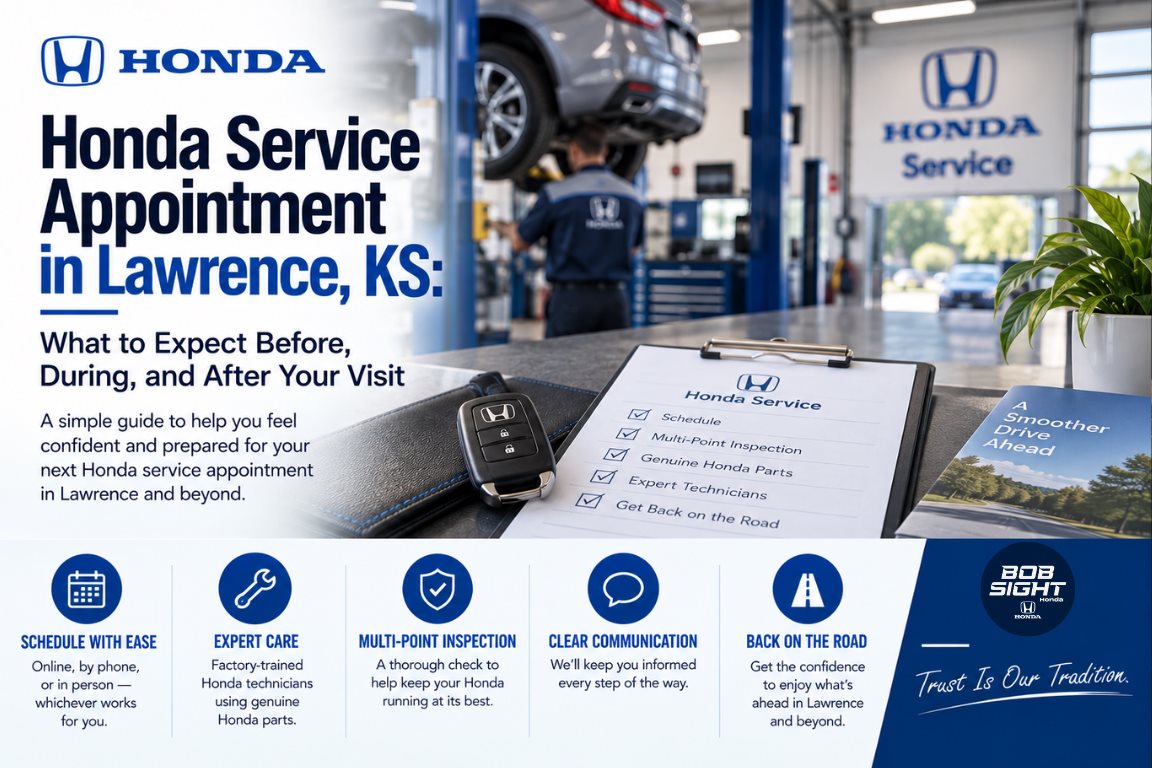
Schedule your Honda service appointment in Lawrence, Kansas
A Honda service appointment at Bob Sight Honda begins with scheduling the visit, sharing accurate vehicle information, and describing the maintenance or repair concerns you want the service team to address. When you arrive, a service advisor reviews the appointment details, confirms the requested work, records relevant symptoms, and explains the next steps. Honda-trained technicians then inspect or service the vehicle using model-specific information and procedures. Afterward, the advisor reviews completed work, inspection findings, maintenance records, and any recommended follow-up.
Knowing what to expect can make a service visit more efficient for Honda owners in Lawrence, Kansas. A routine Maintenance Minder appointment follows a different path from a diagnostic visit involving a warning light, unusual noise, fluid leak, or drivability concern. Providing complete information before the appointment helps the team understand which type of visit you need. Bringing service records and writing down symptoms can also reduce guesswork.
Bob Sight Honda serves drivers from Lawrence, Topeka, Eudora, Baldwin City, Olathe, Overland Park, Douglas County, and the Kansas City Metro. Whether your Honda needs routine maintenance, brake service, a battery test, tire care, fluid service, parts replacement, or diagnosis, preparation helps create a clearer process. This guide walks through what happens before, during, and after a Honda service appointment while explaining the terms owners may hear.
In This Guide You’ll Learn
This guide explains each stage of a Honda service appointment so Lawrence owners can arrive prepared and understand what happens to their vehicles. It covers scheduling, check-in, inspections, diagnostics, approvals, maintenance records, and post-service follow-up. It also explains how routine maintenance differs from diagnostic work. These details can make communication with the service team more productive.
- How to schedule a Honda service appointment
- What information to provide before the visit
- What happens during dealership service check-in
- How routine maintenance differs from diagnostic service
- What a multi-point inspection can reveal
- How service recommendations and approvals work
- What to review before leaving the dealership
A service appointment is most effective when the owner and service team begin with the same expectations. The dealership needs accurate vehicle and concern information. The owner needs a clear understanding of the requested work, inspection process, and communication method. Confirming these details at the beginning helps avoid confusion later.
How Do You Schedule a Honda Service Appointment in Lawrence?
Honda owners can request service through the Bob Sight Honda online scheduler and provide vehicle, mileage, service, and contact information before arriving. Online scheduling allows drivers to choose from available appointment options without waiting to call during business hours. The request should include the full reason for the visit. A complete description helps the service department reserve appropriate time.
Begin by identifying your Honda's model year, model, current mileage, and vehicle identification number when available. The VIN is a unique 17-character identifier connected to the vehicle's original configuration. It can be found on the driver's side of the dashboard near the windshield, on the driver's door-jamb label, and on registration or insurance documents. Providing the correct VIN helps separate vehicles that may share a model name but use different engines, drivetrains, parts, or procedures.
Next, choose the type of service needed. Routine requests can include oil and filter service, tire rotation, brake inspection, battery testing, fluid service, filter replacement, or Maintenance Minder work. Diagnostic requests should describe a warning light, sound, vibration, leak, odor, starting concern, climate-control issue, or change in vehicle behavior. Avoid selecting only “oil change” if the vehicle also has another concern.
Include the complete Maintenance Minder code when one appears. A code such as A1, B12, or B16 communicates more than the oil-life percentage alone. The letter identifies the main maintenance item, while the numbers identify additional services. Taking a photo of the driver information display can help preserve the exact message.
Drivers can begin through the Bob Sight Honda service scheduler. Appointment availability can vary by day, requested work, technician scheduling, and required parts. A requested time may also represent an arrival or check-in time rather than a guaranteed completion time. Confirm timing expectations with the service advisor, particularly when travel, work, school pickup, or another commitment depends on the vehicle.
What Information Should You Provide Before the Appointment?
The most useful information includes the vehicle identification number, mileage, Maintenance Minder code, service history, symptoms, warning messages, and conditions under which a problem occurs. Accurate details help the service team distinguish planned maintenance from diagnostic work. They also help technicians recreate an intermittent concern. Vague descriptions can make a problem harder to identify.
If the vehicle makes a noise, describe the sound without trying to diagnose the component yourself. Note whether it happens during startup, acceleration, braking, turning, idling, or travel over bumps. Record whether the engine is cold or warm and whether the sound changes with vehicle speed. A short video or audio recording may help when the concern does not occur consistently.
For a vibration, note where it is felt. A steering-wheel vibration may present differently from a vibration felt through the seat or brake pedal. Record the approximate speed, road type, braking condition, and weather. A vibration that appears at highway speed on K-10 may require a different test than one that occurs only while stopped.
Warning lights should be described by color, symbol, message, and timing. A red oil-pressure or temperature warning can require immediate action, while a Maintenance Minder notification identifies planned service. If a warning is flashing, note that detail. Do not continue driving when the owner's manual directs you to stop.
Use this preparation checklist:
- Record the VIN and mileage. Confirm both before submitting the appointment.
- Photograph dashboard messages. Include warning lights, Maintenance Minder codes, and oil-life percentage.
- Write down symptoms. Describe when, where, and how often they occur.
- Gather service records. Bring documentation for work completed outside Bob Sight Honda.
- List recent changes. Mention repairs, battery replacement, tire work, accidents, or accessory installation.
- Remove necessary personal items. Clear areas technicians may need to access.
- Confirm transportation plans. Discuss timing and available options before the appointment.
- Bring keys and wheel-lock hardware. Include any required adapter or security key.
A driver traveling from Topeka, Eudora, or Baldwin City should confirm the appointment details before leaving. Ask whether the planned work can reasonably be completed during the visit or whether diagnosis may require additional time. If a part must be ordered, the vehicle may need a follow-up appointment. Clear timing expectations help owners plan transportation without assuming an immediate completion.
What Happens When You Arrive at Bob Sight Honda Service?
During check-in, a service advisor verifies the vehicle, confirms the requested work, reviews concerns, and prepares a repair order for owner authorization. The repair order is the written record of the services or diagnostic work requested at that stage. It should identify the vehicle, mileage, customer concerns, and approved work. Review it before the vehicle enters the service process.
The advisor may ask follow-up questions about symptoms. These questions help technicians reproduce the concern rather than challenge the owner's description. If a noise occurs only after driving for 20 minutes or a warning appears only during cold starts, that detail changes the diagnostic approach. Conditions are often as important as the symptom itself.
You may also be asked whether the vehicle has been modified or repaired elsewhere. Aftermarket electrical equipment, suspension changes, wheel-and-tire changes, remote-start systems, or previous body repairs can affect diagnosis. Share the information even if you believe it is unrelated. Technicians need the complete vehicle context.
The advisor should also clarify how updates will be delivered. Depending on the available process, communication may occur by phone, text, email, or an in-person conversation. Confirm which method you monitor most reliably. Missing an approval request can delay work because the dealership should not proceed with additional owner-pay services without authorization.
Before leaving the vehicle, remove valuables and personal information that does not need to remain inside. Child seats, cargo, and personal belongings may stay when they do not block access, but ask if technicians need to reach a particular area. If the concern involves the spare tire, third row, cargo floor, cabin filter, or electrical system, items may need to be moved. Leave enough fuel or charge for any necessary road testing.
Routine Maintenance vs. Diagnostic Service
Routine maintenance follows known procedures for scheduled items, while diagnostic service requires a technician to identify the cause of a symptom, warning, or system failure. An oil change, tire rotation, filter replacement, or specified fluid service can usually be planned from vehicle information and maintenance history. A check-engine light, intermittent noise, battery drain, or vibration requires investigation. The two types of work involve different time and information needs.
Routine maintenance helps preserve the vehicle's intended operation. Honda's Maintenance Minder can identify engine-oil service and additional items such as tire rotation, filters, transmission fluid, spark plugs, coolant, rear differential fluid, or brake fluid when applicable. Procedures vary by model, model year, powertrain, and drivetrain. A Civic Hybrid does not have the same maintenance components as an all-wheel-drive Pilot.
Diagnosis is the structured process of identifying why a vehicle behaves abnormally. A technician may begin by confirming the symptom, checking diagnostic trouble codes, reviewing technical information, inspecting related systems, testing electrical circuits, measuring component operation, or completing a road test. A diagnostic trouble code does not automatically identify the failed part. It identifies a system condition that requires interpretation.
For example, a battery warning does not necessarily mean the battery alone is defective. The concern could involve the charging system, connections, wiring, control modules, or another electrical condition. Replacing a part without diagnosis may fail to resolve the issue. Proper testing helps separate the symptom from its cause.
A Lawrence owner should state both routine and diagnostic needs when scheduling. If the Honda needs B1 maintenance and also vibrates at highway speed, list both concerns. The maintenance can be completed through established procedures, while the vibration requires evaluation. Combining the descriptions helps the department reserve time and communicate separate findings.
What Does a Honda Multi-Point Inspection Include?
A multi-point inspection is a structured review of visible vehicle systems and maintenance items that can identify wear, damage, leaks, fluid concerns, or conditions requiring further evaluation. It does not guarantee that every hidden or future problem will be found. Inspection scope can vary based on the vehicle and service being performed. Ask the advisor what is included with your appointment.
Common inspection areas can include tires, brakes, fluid levels, wiper blades, exterior lights, belts, hoses, steering components, suspension components, and visible underbody areas. The technician may record condition, remaining wear, or items requiring attention. Some concerns can be confirmed visually, while others require diagnostic testing. An inspection is not the same as disassembly.
Tire inspection should include tread condition, visible damage, and inflation. Uneven wear can point toward pressure, alignment, suspension, or driving-condition concerns. Tire rotation can promote more even wear but cannot correct an existing alignment problem. Potholes and freeze-thaw damage around Lawrence can make tire and wheel inspection valuable.
Brake inspection may include pad thickness, rotor condition, hoses, lines, fluid, and visible hardware. Brake pads and rotors are normal wear items. Their life depends on traffic, driving habits, vehicle load, road conditions, and component design. Stop-and-go traffic near downtown Lawrence or the University of Kansas can create a different wear pattern than steady highway commuting.
Fluid inspection provides another useful snapshot. Engine oil, coolant, brake fluid, transmission fluid, rear differential fluid, and washer fluid serve different systems. Level and appearance can provide information, but fluid service requirements should follow Honda guidance rather than color alone. The exact fluid specification matters because different systems are not interchangeable.
How Are Service Recommendations and Approvals Handled?
When an inspection or diagnosis identifies additional work, the service advisor should explain the finding, recommended action, and reason before requesting authorization. Owners should ask questions until they understand the recommendation. A clear explanation should connect the observed condition with the proposed service. Approval allows the work to proceed within the discussed scope.
Some recommendations address immediate safety or drivability concerns. Others involve maintenance that is due now, approaching soon, or worth monitoring. Ask the advisor to separate these categories. Understanding urgency helps owners plan without treating every finding as identical.
Useful questions include what was observed, how the condition was measured, what can happen if service is delayed, and whether the concern affects safety, reliability, efficiency, or comfort. Ask whether parts are currently available and whether additional work changes the completion estimate. If a repair depends on further disassembly, clarify how additional approval will be handled.
Owners should also understand the difference between a maintenance recommendation and a warranty determination. Warranty coverage depends on the vehicle, original in-service date, mileage, component, failure, maintenance history, and applicable terms. A service advisor may need to inspect or diagnose the concern before coverage can be evaluated. Never assume that every repair is covered because the vehicle remains within a general warranty period.
Follow this approval process:
- Review the inspection or diagnostic finding. Ask what the technician observed or measured.
- Understand the recommendation. Confirm which system, part, or fluid is involved.
- Ask about urgency. Separate immediate concerns from future planning items.
- Confirm the scope. Know what parts, labor, fluids, and procedures are included.
- Discuss timing. Ask whether parts availability or added work affects completion.
- Provide clear authorization. Approve only after the recommendation is understood.
- Save the final documentation. Keep findings and completed work in the vehicle's records.
If you decline a recommended service, ask for the finding to be documented. This creates a reference for future planning and makes it easier to monitor the condition. Declining work does not remove the underlying need. Ask what signs would indicate that the issue has become more urgent.
Why Honda-Trained Technicians and Genuine Parts Matter
Honda-trained technicians use model-specific service information, diagnostic equipment, procedures, and parts knowledge when maintaining or repairing Honda vehicles. Modern Honda models combine mechanical, electrical, software, safety, hybrid, and driver-assistance systems. Accurate service requires more than general familiarity with cars. Vehicle-specific training supports efficient diagnosis and correct procedures.
Honda service information can identify torque specifications, fluid requirements, calibration steps, diagnostic paths, and component procedures. A transmission-fluid service for a conventional automatic differs from service for a continuously variable transmission or hybrid drive unit. All-wheel-drive models add rear drivetrain components. Following the correct procedure protects system operation.
Genuine Honda parts are designed for specific Honda applications. This includes dimensions, materials, electrical compatibility, attachment points, and system integration. The correct part depends on the VIN and configuration. Two vehicles with the same model name may require different components because of engine, drivetrain, trim, or production changes.
Driver-assistance technology creates another reason for model-specific knowledge. A windshield replacement, wheel alignment, collision repair, suspension repair, or sensor replacement may create calibration needs. Calibration is the process of setting or verifying a sensor or camera so the system interprets information correctly. Requirements vary by repair and vehicle.
Dealership service also creates a centralized record of maintenance and repairs completed there. A consistent record can help future advisors understand the vehicle's history. It can also support warranty conversations and future trade-in evaluation. Owners should still keep their own copies rather than relying on one system as the only record.
What Happens While Your Honda Is Being Serviced?
While the vehicle is in service, the technician follows the approved repair order, documents findings, performs authorized procedures, and communicates additional needs through the service advisor. Routine work may proceed through established maintenance steps. Diagnostic work can require testing, a road test, or additional time to recreate an intermittent concern. Parts availability can also affect the timeline.
The technician may begin by checking the vehicle identification, mileage, and dashboard. Warning lights, Maintenance Minder codes, and stored diagnostic information can provide context. A visual inspection may follow, depending on the service. The technician then performs the approved maintenance or diagnostic procedures.
If a road test is necessary, the technician may drive the vehicle to confirm a symptom or evaluate the result of a repair. Leave enough fuel or charge for this process. Remove items that could move or create noise during the test. If the concern appears only on a specific type of road, describe that condition during check-in.
An intermittent issue may not appear during the first test. Temperature, moisture, vehicle load, drive time, and road surface can affect symptoms. A concern that occurs only during a cold morning in Eudora may not appear after the vehicle reaches Lawrence and warms up. Detailed owner notes make intermittent diagnosis more productive.
The service advisor serves as the primary communication link. Contact the advisor rather than attempting to enter the work area. If a technician identifies additional needs, the advisor should explain the finding and request approval. Monitor the communication method chosen during check-in so the visit does not pause unnecessarily.
What Should You Review When Service Is Complete?
Before leaving, review the completed work, inspection results, declined recommendations, warranty information, Maintenance Minder reset, and any follow-up instructions. The final repair order should provide a written record of the visit. Read it while the information is fresh. Ask questions about anything that does not match your understanding.
Confirm that every original concern is addressed in the documentation. If the vehicle arrived for B12 maintenance and a braking noise, both should appear. The record should show whether the noise was verified, diagnosed, repaired, or not duplicated. “Could not duplicate” does not mean the owner imagined the concern, only that it did not occur during the available test conditions.
For Maintenance Minder service, confirm that the appropriate items were reset after completion. The system should not be reset before the indicated work is performed. An inaccurate reset can disrupt future reminders. Save the mileage and date associated with the reset.
Review parts and fluid information when listed. This is useful for future maintenance and diagnosis. If the work carries a parts or service warranty, ask for the applicable terms. Coverage can vary by item and circumstance, so retain the documentation.
Before driving away, complete a basic check:
- Review the repair order. Confirm requested and completed work.
- Read the inspection report. Note current and future maintenance items.
- Confirm dashboard status. Review Maintenance Minder and warning lights.
- Check vehicle settings. Seat, mirror, climate, audio, and driver-assistance settings may have changed.
- Inspect the immediate area. Look for belongings, keys, adapters, and wheel-lock hardware.
- Ask about follow-up. Confirm break-in, recheck, or monitoring instructions.
- Save the documentation. Add the visit to your maintenance file.
If the original symptom remains after service, contact the advisor with specific information. Describe when it returned and whether it changed. Some repairs require a follow-up inspection or additional diagnosis. Prompt communication provides a clearer connection between the visit and the remaining concern.
Honda Service Appointment Quick Facts
A successful Honda service appointment depends on accurate scheduling information, clear communication, proper authorization, and complete records. The service team needs to know what maintenance is due and what symptoms exist. The owner should understand the approved work and review the final documentation. Preparation improves both sides of the process.
- Provide the VIN, mileage, model year, model, and drivetrain when known.
- Record the complete Maintenance Minder code and oil-life percentage.
- Describe when a symptom occurs instead of naming a part you think has failed.
- Routine maintenance follows known procedures, while diagnosis identifies the cause of a concern.
- A trouble code does not automatically identify the failed part.
- Review the repair order before authorizing work.
- Ask the advisor to separate urgent, due-now, and future recommendations.
- Monitor the selected communication method during the visit.
- Confirm the Maintenance Minder is reset only after service is completed.
- Keep every repair order and inspection report.
- Critical warning lights require the response described in the owner's manual.
- Parts availability and diagnostic complexity can affect completion time.
Owners should also distinguish an appointment time from a completion guarantee. A scheduled time may reserve check-in and workflow placement, while actual completion depends on the work. Routine service may be more predictable than an intermittent electrical diagnosis. Ask for the most realistic timing estimate available.
Local driving conditions provide useful context. Lawrence traffic, K-10 commuting, rural Douglas County roads, winter potholes, summer heat, and highway mileage affect vehicles differently. Share those conditions when they relate to a concern. A technician can work more effectively when the service request reflects real use.
Planning Long-Term Honda Service in Lawrence
Long-term Honda ownership is easier when drivers follow Maintenance Minder codes, schedule seasonal inspections, keep accurate records, and address warning signs promptly. Service should not be limited to reacting when a vehicle stops working. Preventive maintenance supports reliability, safety, efficiency, and long-term value. A consistent local service relationship can simplify that planning.
Honda's Maintenance Minder estimates oil life and displays additional maintenance codes based on vehicle operation. Main codes and subcodes can identify oil service, tire rotation, filters, fluids, spark plugs, coolant, brake fluid, and drivetrain service when applicable. Follow the manual for the exact model and model year. An all-wheel-drive Pilot has different components from a front-wheel-drive Civic.
Seasonal planning is also useful in Kansas. Before winter, inspect the battery, tires, brakes, coolant, wipers, washer fluid, lights, heater, and defrosters. Before summer road trips, review the cooling system, air conditioning, tire condition, fluids, and visible leaks. Seasonal inspections complement the Maintenance Minder.
Create a maintenance file that includes repair orders, inspection reports, tire records, warranty work, and recall documentation. Record services completed outside Bob Sight Honda with the same level of detail. Organized records help prevent duplicate work and identify missed maintenance. They also provide useful history if the vehicle is sold or traded.
Owners can visit the Bob Sight Honda Service Department to learn more about dealership maintenance and repair support. Current Honda service and parts specials can also be reviewed before an appointment. Offers change and may have eligibility requirements. Maintenance timing should continue to follow vehicle needs.
Frequently Asked Questions About Honda Service Appointments
How do I prepare for a Honda service appointment in Lawrence?
Prepare by recording the VIN, mileage, Maintenance Minder code, warning messages, symptoms, and recent service history. Bring the keys, wheel-lock adapter, and any documents connected to previous repairs. Remove valuables and clear areas the technician may need to access. Confirm transportation and communication plans before arriving.
If the vehicle has an intermittent concern, write down the conditions under which it occurs. Include speed, temperature, drive time, road type, weather, and whether the engine is cold or warm. A photo, audio recording, or video may help. Avoid diagnosing the failed part unless it has already been tested.
Drivers coming from Topeka, Eudora, or Baldwin City should confirm timing and appointment details before traveling to Lawrence. Ask whether the requested visit is routine maintenance or requires diagnosis. Parts or additional testing may require a follow-up visit. Clear expectations reduce scheduling surprises.
How long does a Honda service appointment take?
Appointment length depends on the requested maintenance, diagnostic complexity, parts availability, technician workflow, and any additional work approved during the visit. A routine maintenance appointment may be more predictable than diagnosis of an intermittent warning or electrical concern. The arrival time does not always represent a guaranteed completion time. Ask the advisor for the best current estimate.
Multiple services naturally require more time than one procedure. A B-service appointment with tire rotation, filters, transmission fluid, and brake inspection involves more work than an oil change alone. Diagnosis can also require a road test, measurements, technical research, or repeated testing. A concern that cannot be duplicated may require additional owner information.
Lawrence owners should discuss hard deadlines before leaving the vehicle. Work schedules, school pickup, travel, and medical appointments can affect transportation planning. If completion timing changes, the service advisor should provide an update through the agreed communication method. Monitor that method for approval requests.
What is the difference between an inspection and a diagnosis?
An inspection looks for visible or measurable vehicle conditions, while diagnosis identifies the cause of a specific symptom or system problem. A multi-point inspection may identify worn tires, low fluid, brake wear, leakage, or damaged components. Diagnosis may require testing circuits, checking data, reading codes, recreating symptoms, or disassembling a system. They serve different purposes.
A warning light illustrates the difference. An inspection may confirm that the light is present, while diagnosis determines which system condition triggered it. The stored diagnostic trouble code provides a starting point but may not identify the failed component. Additional testing helps prevent unnecessary part replacement.
Owners should ask which type of work is included in the appointment. A routine inspection may not include full diagnosis of every noted concern. If a technician finds a condition requiring more testing, the advisor can explain the next step. Clear authorization is needed before additional owner-pay work proceeds.
Should I bring previous service records to Bob Sight Honda?
Yes, previous service records can help the service team understand completed maintenance, earlier repairs, fluid history, and recurring concerns. Records are useful when work was completed at another dealership or independent shop. They can reduce uncertainty and help prevent duplicate recommendations. Bring paper or digital copies when available.
Useful records include oil services, transmission fluid, coolant, brake fluid, rear differential fluid, spark plugs, filters, battery replacement, tire work, alignments, recalls, and warranty repairs. Each record should include the date, mileage, and service performed. Parts and fluid details add further context. Incomplete records are still more useful than none.
A consistent history supports long-term ownership in Lawrence and may help during future warranty or trade-in discussions. Keep your own copies even when the dealership stores information electronically. Systems and ownership can change over time. A personal maintenance file provides a dependable reference.
Can I schedule Honda service online?
Yes, Honda owners can request an appointment through the Bob Sight Honda online service scheduler. The scheduler allows drivers to provide vehicle details, select services, and review available appointment options. Include the full Maintenance Minder code and any separate vehicle concerns. Accurate information helps the department prepare.
An online request should clearly distinguish routine maintenance from diagnosis. If the Honda needs an oil change and has a check-engine light, list both. If the concern is difficult to describe, add details about when it occurs. The service team may contact you for more information.
Appointment options can vary based on technician availability, parts, and requested work. Drivers traveling from outside Lawrence should confirm the visit before departing. Use the dealership's current service scheduling page rather than an outdated saved link. Keep any confirmation information for check-in.
Schedule Your Honda Service Appointment at Bob Sight Honda
Scheduling Honda service in Lawrence begins with accurate vehicle information, a complete description of the requested work, and clear communication about timing and authorization. Bob Sight Honda can help owners address routine maintenance, Maintenance Minder codes, inspection needs, and vehicle concerns. Preparing before the visit makes the process easier to understand. Reviewing the final documentation helps protect the maintenance history afterward.
Local service can be convenient for drivers throughout Douglas County and surrounding Kansas communities. Lawrence owners can build a consistent history for oil changes, filters, tire rotations, fluid services, brakes, batteries, and other vehicle needs. Drivers from Topeka, Eudora, Baldwin City, Olathe, Overland Park, and the Kansas City Metro can also plan visits around regional travel. Confirm appointment details when coming from outside the immediate area.
Use the Bob Sight Honda online service scheduler when your Maintenance Minder reaches its service point or your Honda needs professional attention. Include the code, mileage, and any separate symptoms. Bring previous records and ask questions about recommendations. A clear service process supports informed ownership.
After the appointment, save the repair order and inspection report. Monitor any condition the advisor asks you to watch and follow recommended recheck instructions. Contact the service department if a repaired concern returns. Long-term Honda care is built through timely maintenance, accurate records, and communication that continues after each visit.
Helpful Links
- Schedule Honda Service
- Honda Service Department
- Honda Express Service
- Service and Parts Specials
- Honda Parts Department
Proud to be part of the Bob Sight Auto Group
Bob Sight Honda is proud to serve Lawrence and surrounding Kansas communities as part of the Bob Sight Auto Group. Our family of dealerships supports drivers shopping for Honda, Chrysler, Dodge, Jeep, Ram, Ford, and Kia vehicles across the region. Customers can also turn to the Bob Sight Collision Center for professional collision-repair support. Across every location, our goal is to build lasting relationships through helpful guidance, dependable service, and a customer-first approach.
Bob Sight Honda serves drivers from Lawrence, Topeka, Eudora, Baldwin City, Douglas County, Olathe, Overland Park, and the Greater Kansas City area. Whether you are scheduling maintenance, interpreting a Maintenance Minder code, ordering parts, or planning long-term Honda ownership, our team is ready to help. We believe dealership relationships should continue throughout ownership rather than end after a purchase. Trust Is Our Tradition.
Service procedures, maintenance needs, warranty coverage, appointment timing, transportation options, and parts availability vary by vehicle and visit. Follow the owner's manual for the exact Honda and confirm all services, recommendations, and timing with the service advisor. Critical warning lights or unsafe vehicle conditions may require immediate action rather than a routine appointment.