Honda Tire Rotations Lawrence KS: Why Routine Service Saves Money
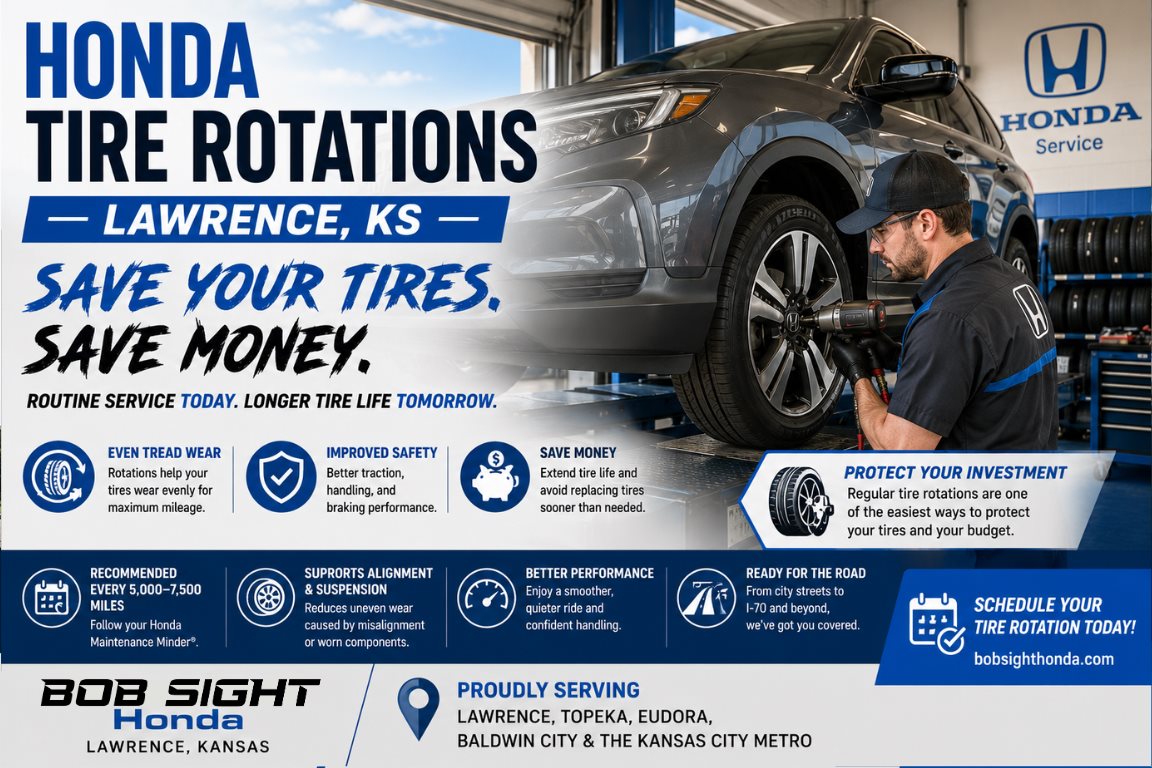
Honda tire rotations in Lawrence KS help drivers protect tire life, improve handling, support safer traction, and avoid replacing tires sooner than necessary. At Bob Sight Honda in Lawrence, Kansas, we help Honda owners from Topeka, Eudora, Baldwin City, Douglas County, and the Kansas City Metro understand why routine tire rotations are one of the simplest maintenance habits for long-term value. Whether you drive a Honda Civic, Accord, CR-V, HR-V, Pilot, Passport, Odyssey, Ridgeline, or Honda hybrid, tire rotations help keep your vehicle more balanced and predictable on Kansas roads.
Schedule Honda tire rotations in Lawrence, KS
In This Guide You’ll Learn
This guide explains why tire rotations matter, how they protect tire life, and when Lawrence-area Honda drivers should schedule service.
- What tire rotations do and why they matter for Honda ownership
- How uneven tire wear develops during everyday Kansas driving
- Why tire rotations can help drivers save money over time
- How tire rotations connect to alignment, pressure, and suspension health
- What rotation patterns may be used on Honda vehicles
- How Kansas weather and local roads affect tire wear
- When to schedule tire service at Bob Sight Honda
What Honda Tire Rotations Mean in Plain Language
A Honda tire rotation means moving each tire to a different position on the vehicle so the tread wears more evenly over time. Tires do not wear at the same rate on every corner of the vehicle because each position handles different forces from steering, braking, acceleration, road impact, and weight distribution. Rotating tires helps spread that wear across all four tires instead of allowing one pair to wear out too quickly.
For many Honda vehicles, the front tires work harder than the rear tires during normal driving. Front tires often handle steering input, a large share of braking force, and much of the weight from the engine and front structure. On front-wheel-drive Honda models, the front tires also help deliver power to the road. That extra work can cause front tires to wear faster if they stay in the same position for too long.
Tire rotations are different from wheel alignment and tire balancing. A rotation changes tire position. Alignment adjusts wheel angles so tires meet the road correctly. Balancing corrects uneven weight distribution in a tire and wheel assembly. These services can work together, but they solve different tire-related concerns. A driver may need a rotation for even wear, an alignment for pulling or edge wear, and balancing for highway vibration.
Lawrence drivers often use their Hondas in mixed conditions. A week may include short trips near downtown Lawrence, school drop-offs, rural roads around Douglas County, and highway travel toward Kansas City or Topeka. This variety creates different wear patterns. Routine tire rotations help keep that wear from becoming uneven and costly.
At Bob Sight Honda’s service department, technicians can inspect tire condition during rotation service and look for warning signs like uneven tread depth, shoulder wear, cupping, punctures, sidewall damage, or alignment-related patterns. That inspection value is one reason tire rotations are more important than simply moving tires around.
Why Tire Rotations Help Save Money Over Time
Tire rotations help save money over time by extending usable tire life and reducing the chance that one or two tires wear out early. When tires wear evenly, drivers can usually get more consistent performance from the full set. When tires wear unevenly, replacement may be needed sooner, and the vehicle may not handle as confidently.
Tires are a long-term ownership investment. Replacing tires earlier than expected can disrupt your budget and your schedule. Uneven tread wear may also create ride noise, vibration, reduced wet-weather traction, and less predictable braking. Routine rotations help reduce those risks by keeping tread wear more balanced across the tire set.
For busy drivers around Lawrence, routine service is often easier than emergency replacement. A driver who commutes on I-70, takes children to activities near Rock Chalk Park, or travels regularly to Topeka may not have time to deal with unexpected tire problems. Rotations help turn tire care into a planned maintenance habit instead of a last-minute issue.
Tire rotations can also help technicians identify small problems before they become larger repairs. During a rotation, tire wear patterns may reveal alignment issues, suspension concerns, improper inflation, or driving-related wear. Catching those patterns early can help prevent premature tire replacement and improve overall vehicle confidence.
Saving money through tire rotations does not mean avoiding all tire expenses. Tires are wear items, and they will eventually need replacement. The goal is to help the tires wear as evenly and efficiently as possible so drivers get strong value from the full set. For Honda owners in Lawrence, this is practical maintenance that supports both safety and long-term cost control.
| Routine Tire Rotation Benefit | How It Helps | Why It Matters Locally |
|---|---|---|
| More even tread wear | Spreads wear across all four tires | Helpful for mixed city, highway, and rural driving |
| Longer usable tire life | Reduces premature wear on one axle | Supports commuters driving to Topeka or Kansas City |
| Better ride quality | Helps limit noise and vibration from uneven wear | Improves comfort on I-70, K-10, and US-59 |
| Early issue detection | Reveals alignment, pressure, or suspension concerns | Useful after potholes, curbs, and construction zones |
How Uneven Tire Wear Develops on Honda Vehicles
Uneven tire wear develops when tires experience different loads, angles, pressures, road forces, or driving patterns over time. Even when a Honda is maintained well, tires naturally wear differently depending on their position. Tire rotations help reduce that difference before it becomes a bigger issue.
Front tires often wear faster because they manage steering and braking forces. In many Honda models, they also help pull the vehicle forward. Rear tires may wear more slowly, but they still play an important role in stability and traction. If tires are never rotated, the front pair may become noticeably more worn than the rear pair, which can affect handling balance.
Improper tire pressure is another major contributor. Low tire pressure can cause outer shoulder wear and excess heat buildup. High tire pressure can increase center tread wear and reduce ride comfort. Kansas temperature swings can change tire pressure quickly, with cold mornings lowering pressure and hot pavement increasing pressure after driving.
Alignment problems can create more aggressive wear patterns. If toe, camber, or caster angles are out of specification, tires may scrub against the road or wear heavily on one edge. Potholes, curbs, rough rural roads, and winter-damaged pavement around Lawrence can all affect alignment. Tire rotations can reveal these patterns, but alignment service may be needed to correct the root cause.
Driving habits also matter. Frequent short trips, hard braking, quick turns, gravel-road travel, and heavy cargo loads can all influence tire wear. A family using a Honda Pilot or Odyssey for school routines and weekend sports may create different wear patterns than a commuter driving an Accord or Civic to Kansas City each day. Routine inspections help connect tire wear to actual driving conditions.
When Lawrence Drivers Should Schedule Tire Rotations
Honda drivers should schedule tire rotations based on Honda Maintenance Minder guidance, owner’s manual recommendations, tire condition, driving habits, and service advisor guidance. Many drivers rotate tires during oil change visits because it is convenient and helps keep maintenance organized. The most important thing is consistency.
The Honda Maintenance Minder system may display service codes that include tire rotation as part of recommended maintenance. Exact codes and timing can vary by model year and driving conditions, so drivers should review the owner’s manual or ask a Honda service advisor when a reminder appears. Busy drivers should not ignore these messages because they help prevent maintenance from becoming overdue.
Lawrence-area driving can make regular tire rotations more important. City streets, parking lots, rural roads, highway miles, and construction zones all affect tires differently. Drivers who frequently travel between Lawrence and Topeka or Kansas City may accumulate mileage quickly, while drivers making short local trips may still create wear through braking, turning, and stop-and-go traffic.
Drivers should also schedule a tire rotation if they notice symptoms such as increased road noise, uneven tread depth, vibration, or visible wear differences between front and rear tires. If the vehicle pulls or the steering wheel is off center, an alignment check may also be needed. A rotation can help with position-based wear, but it will not fix poor alignment.
Here is a simple step-by-step tire rotation planning process:
- Check your Honda Maintenance Minder regularly for service reminders.
- Inspect tires monthly for pressure, tread depth, and visible damage.
- Rotate tires during routine service when recommended.
- Ask technicians to check for uneven wear patterns during rotation.
- Schedule alignment service if edge wear, pulling, or off-center steering appears.
- Keep service records so tire care stays easy to track over time.
For drivers with packed schedules, combining tire rotations with routine maintenance can save time and reduce stress. Bob Sight Honda can help Honda owners plan tire care around oil changes, inspections, and seasonal service needs.
Tire Rotation Patterns and Why They Matter
Tire rotation patterns matter because different vehicles, tire types, drivetrain layouts, and tread designs may require different rotation methods. A proper rotation pattern helps tires wear evenly while respecting the tire’s construction and the vehicle’s requirements. Technicians choose the pattern based on how the vehicle and tires are configured.
Many front-wheel-drive vehicles may use a forward cross pattern, where front tires move straight back and rear tires cross to the front. Rear-wheel-drive or all-wheel-drive vehicles may use different patterns depending on tire design. Some directional tires can only rotate front to rear on the same side because the tread is designed to roll in one direction. Staggered tire sizes may limit rotation options if front and rear tires are different sizes.
Honda vehicles vary by model, trim, and drivetrain. A Honda Civic may have different tire requirements than a Honda CR-V, Pilot, Passport, Odyssey, Ridgeline, or hybrid model. Available all-wheel drive, wheel size, tire type, and tread direction all influence rotation planning. That is why it is helpful to have technicians check your specific vehicle instead of assuming one pattern fits every Honda.
Rotation patterns also matter for tire monitoring systems. Modern Honda vehicles use tire pressure monitoring systems that alert drivers when pressure is low or a system issue appears. After tire service, technicians may need to confirm pressures are correct and that the system is operating properly. Correct pressure is part of the rotation process because tire position alone will not protect tread life if pressure is wrong.
For Lawrence drivers, this level of detail matters because tire service should protect the vehicle you actually drive. A daily commuter, family SUV, minivan, and pickup all place different demands on tires. Bob Sight Honda can rotate tires according to the correct pattern for your Honda model and inspect whether the tire set is wearing the way it should.
| Rotation Consideration | Why It Matters | Example |
|---|---|---|
| Drivetrain | Front-wheel drive and all-wheel drive can wear tires differently | CR-V AWD may need different attention than Civic FWD |
| Directional tires | Tread must roll in the correct direction | Tires may rotate front to rear on the same side |
| Staggered sizing | Different front and rear sizes can limit rotation | Some performance setups have restricted patterns |
| TPMS | Pressure monitoring must remain accurate | Correct pressure should be confirmed after service |
How Tire Rotations Connect to Alignment and Suspension
Tire rotations, alignment, and suspension health are connected because all three affect how tires contact the road and wear over time. Rotating tires helps even out normal wear, while alignment corrects wheel angles and suspension components help control tire movement. If one part of the system is neglected, tire life can suffer.
Wheel alignment refers to the angles of the wheels relative to the vehicle and road. The three primary alignment angles are camber, caster, and toe. Camber is the inward or outward tilt of the wheel, caster affects steering stability, and toe describes whether the tires point slightly inward or outward. Incorrect toe is one of the fastest ways to wear tires unevenly.
Suspension components also influence tire wear. Shocks, struts, control arms, bushings, ball joints, and tie rods all help maintain control of the wheel and tire. If a suspension component is worn or damaged, tire contact can become inconsistent. This may create cupping, feathering, vibration, or unpredictable handling. A tire rotation may reveal the symptom, but suspension inspection may identify the cause.
Local road impacts make this connection important in Lawrence. A pothole on a winter-damaged road or a hard curb impact near a tight parking lot can affect alignment or suspension. Drivers may not notice immediately, but tire wear can begin changing. Rotations give technicians a chance to see whether the tread pattern looks normal.
A good tire maintenance plan does not treat rotations as the only service that matters. It combines rotations with pressure checks, tread inspections, alignment checks, and suspension awareness. Bob Sight Honda can help drivers understand whether tire wear is normal or whether another issue needs attention.
How Kansas Weather Affects Tire Pressure and Tire Life
Kansas weather affects tire pressure and tire life because temperature changes cause air pressure to rise and fall, while seasonal road conditions affect tread wear and traction. Drivers in Lawrence experience hot summers, cold winters, spring rain, fall temperature swings, and road construction seasons that all influence tire care.
Tire pressure generally drops when temperatures fall and rises when temperatures increase. A cold morning in Lawrence can make tire pressure lower than it was during a warmer afternoon the week before. Low pressure can increase shoulder wear, reduce efficiency, and make tires run hotter. That is why checking pressure regularly is important even when tires look normal.
Summer heat creates a different challenge. Hot pavement, long highway drives, and underinflated tires can create extra heat in the tire. Heat can accelerate wear and increase stress on tire materials. Drivers traveling on I-70 toward Kansas City or west toward Topeka during summer should make tire pressure and tread checks part of trip planning.
Winter road conditions also matter. Slush, salt, potholes, and rough pavement can affect traction and wear. Proper tread depth is important for wet and winter driving confidence. Tire rotations help maintain more consistent tread depth across all four tires, which can support more balanced handling in changing weather.
Spring and fall are good times for tire inspections because they sit between the most extreme seasons. A spring check can identify winter damage, while a fall check can prepare the vehicle for colder weather. Busy drivers who combine tire rotations with seasonal inspections can stay ahead of problems without adding unnecessary appointments.
Quick Facts About Honda Tire Rotations in Lawrence KS
Honda tire rotations in Lawrence KS help extend tire life, support safer handling, reduce uneven wear, and keep maintenance costs more predictable over time. For busy drivers, tire rotations are one of the easiest ways to protect a Honda used for commuting, family travel, errands, and regional driving.
- Tire rotations move tires to different positions so tread wears more evenly.
- Front tires often wear faster because they manage steering and braking forces.
- Tire rotations are different from wheel alignment and tire balancing.
- Uneven tire wear can reduce traction, ride comfort, and tire life.
- Honda Maintenance Minder may recommend tire rotations based on vehicle use.
- Correct tire pressure is essential for proper tread wear.
- Kansas weather can change tire pressure quickly.
- Potholes, gravel roads, and construction zones can affect tire wear.
- Bob Sight Honda serves Honda tire service customers from Lawrence, Topeka, Eudora, Baldwin City, and the Kansas City Metro.
These quick facts are useful because tire care is often easy to delay until a problem becomes obvious. Routine rotations help drivers prevent uneven wear before it affects safety, comfort, and long-term value. For Honda owners who rely on one vehicle every day, that prevention matters.
Ownership Planning for Tire Life and Long-Term Value
Ownership planning for tire life means creating a consistent routine for tire rotations, pressure checks, alignment inspections, tread measurements, and seasonal maintenance. This approach helps Honda drivers protect long-term value while reducing the risk of surprise tire issues. For busy Lawrence-area drivers, a simple plan is easier to follow than waiting for visible wear.
Start by connecting tire rotations with services you already schedule. Many drivers rotate tires during oil changes or multi-point inspections. This keeps maintenance simple and helps technicians review tire condition regularly. If your Honda Maintenance Minder displays a tire rotation code, schedule service before the reminder becomes overdue.
Next, check tire pressure regularly. Tire pressure may change with temperature, and Kansas weather can shift quickly between seasons. A tire that was properly inflated during warm weather may be low during a cold morning. Correct pressure helps support fuel efficiency, tread life, ride quality, and braking confidence.
Drivers should also plan alignment checks strategically. If tires show edge wear, the vehicle pulls, or the steering wheel sits off center, alignment should be inspected. If you install new tires, alignment may help protect them from premature wear. If your vehicle recently hit a pothole or curb, alignment inspection can confirm whether wheel angles shifted.
For long-term ownership, tire records can also be helpful. Keeping track of rotations, alignments, tire replacements, and inspections gives drivers a clearer picture of vehicle care. This can support ownership confidence and future trade-in planning. Bob Sight Honda can help drivers build a maintenance routine that fits commuting, family schedules, and regional Kansas driving.
Frequently Asked Questions About Honda Tire Rotations Near Me in Lawrence KS
How often should I rotate tires on my Honda?
You should rotate tires on your Honda according to Honda Maintenance Minder guidance, owner’s manual recommendations, and technician advice based on tire condition. Many drivers rotate tires during routine oil change visits because it keeps service organized. The exact timing can vary depending on model, tire type, driving habits, and road conditions.
Driving conditions around Lawrence can influence tire wear. Short trips, school traffic, highway commuting, potholes, gravel roads, and frequent turning can all affect how tires wear. A commuter traveling daily toward Kansas City may accumulate mileage quickly, while a driver making mostly local trips may still wear front tires through steering and braking demands.
If you are unsure whether your tires are due for rotation, Bob Sight Honda can inspect tread depth, pressure, and wear patterns. A tire rotation is quick compared to the inconvenience of early tire replacement. Staying consistent helps protect both safety and long-term value.
Can tire rotations really help save money?
Yes, tire rotations can help save money by reducing uneven tire wear and helping drivers get more usable life from a complete tire set. When tires wear evenly, replacement timing is more predictable. When tires wear unevenly, one or two tires may need replacement sooner than expected.
Tire rotations can also reveal issues before they become expensive. If a technician notices edge wear, cupping, feathering, or abnormal tread patterns, they can recommend an alignment check or suspension inspection. Catching these issues early can protect tire life and prevent repeated wear problems.
For families and commuters in Lawrence, tire replacement can be an unwanted interruption. Routine rotations are a simple maintenance habit that helps keep tire expenses more manageable over time. Bob Sight Honda can help drivers plan rotations around oil changes and other routine services.
What happens if I do not rotate my tires?
If you do not rotate your tires, the front and rear tires may wear unevenly, which can shorten tire life and affect handling, traction, and ride comfort. On many Honda vehicles, the front tires carry more workload from steering, braking, and power delivery. Without rotation, they may wear noticeably faster than the rear tires.
Uneven tire wear can create road noise, vibration, pulling, and reduced wet-weather traction. It can also make it harder to maintain balanced handling in rain, snow, or sudden braking situations. Once tread wear becomes severe, a rotation cannot restore missing tread. That is why preventive rotation matters.
Drivers around Lawrence may notice uneven wear after months of mixed city and highway driving. Potholes, construction zones, curbs, and rural roads can make wear patterns worse. Scheduling tire rotations before the wear becomes obvious is the best way to protect the full tire set.
Are tire rotations the same as wheel alignment?
No, tire rotations and wheel alignment are different services, although both help protect tire life. A tire rotation moves tires to different positions on the vehicle. A wheel alignment adjusts wheel angles so the tires contact the road correctly.
If tires are wearing evenly, a rotation may be the right maintenance step. If tires show edge wear, the vehicle pulls, or the steering wheel is off center, alignment may also be needed. Rotating tires will not correct misaligned wheel angles. It may only move the uneven wear pattern to a different position.
Bob Sight Honda can inspect your tire wear and recommend the right service. Some drivers need only a rotation, while others may need rotation plus alignment inspection. The right recommendation depends on tire condition, symptoms, and vehicle measurements.
Why schedule Honda tire rotations at Bob Sight Honda?
Scheduling Honda tire rotations at Bob Sight Honda gives Lawrence-area drivers access to Honda-focused service, tire inspections, and local maintenance guidance. A rotation is more valuable when technicians also check tread depth, tire pressure, visible damage, and wear patterns. This helps drivers understand whether tires are wearing normally.
Bob Sight Honda serves drivers from Lawrence, Topeka, Eudora, Baldwin City, Douglas County, and the Kansas City Metro. Our team understands local road conditions that affect tire wear, including potholes, winter road damage, rural routes, and highway commuting. That local knowledge helps make tire care more practical.
Choosing local Honda service also makes maintenance easier to manage. Tire rotations can often be combined with oil changes, brake inspections, alignment checks, and seasonal maintenance. For busy Honda owners, that convenience helps keep tire care consistent.
Schedule Honda Tire Rotations in Lawrence KS at Bob Sight Honda
Bob Sight Honda is a trusted local resource for Honda tire rotations in Lawrence KS because routine tire care helps protect tire life, ride comfort, traction, and long-term ownership value. Tire rotations are simple, but their impact can be significant for drivers who depend on their Honda every day.
Servicing locally matters because tire wear is shaped by the roads you drive. Lawrence-area drivers deal with city traffic, rural roads, highway commutes, winter potholes, construction zones, and seasonal temperature swings. A local Honda service team understands those conditions and can help drivers protect tires before uneven wear becomes a bigger concern.
Whether you drive a Honda sedan, SUV, minivan, truck, or hybrid, tire rotations should be part of your maintenance routine. Keeping tires properly rotated, inflated, aligned, and inspected supports safer driving and helps avoid unnecessary tire replacement. It also makes ownership more predictable for busy families and commuters.
Schedule your next Honda tire rotations at Bob Sight Honda in Lawrence. Our team is here to help drivers from Lawrence, Topeka, Eudora, Baldwin City, and the Kansas City Metro keep their vehicles ready for daily travel.
Helpful Links
- Schedule Honda Service
- Honda Service Department
- Honda Parts Department
- Honda Service Specials
- Bob Sight Honda
Proud to be part of the Bob Sight Auto Group
Bob Sight Honda is proud to serve drivers in Lawrence, Kansas, as part of the Bob Sight Auto Group. Our Honda dealership supports shoppers and owners across Douglas County, Topeka, Eudora, Baldwin City, and the greater Kansas City Metro with helpful automotive resources, trusted service support, and locally grounded dealership care. Whether you are maintaining your current Honda, comparing vehicles, or exploring another Bob Sight location, our group is here to help drivers across the region.