Honda Wheel Alignment Lawrence KS: Why It Matters for Tire Life
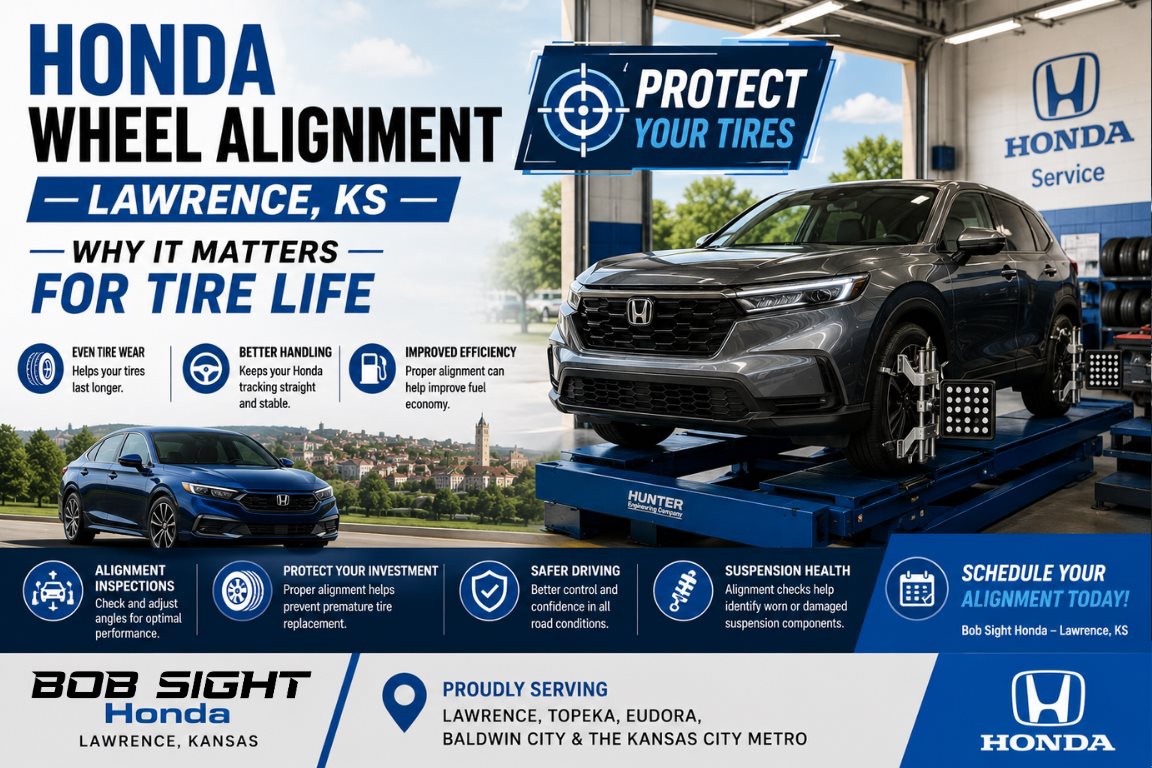
Honda wheel alignment in Lawrence KS matters because proper alignment helps your tires wear evenly, supports safer handling, improves ride comfort, and protects long-term vehicle performance. At Bob Sight Honda in Lawrence, Kansas, drivers from Topeka, Eudora, Baldwin City, Douglas County, and the Kansas City Metro often schedule alignment service after noticing pulling, uneven tire wear, steering wheel vibration, or a vehicle that no longer feels centered on the road.
Schedule Honda wheel alignment service in Lawrence, KS
In This Guide You’ll Learn
This guide explains how wheel alignment affects tire life, safety, comfort, and everyday Honda ownership.
- What wheel alignment means in plain language
- Why Kansas roads can knock your Honda out of alignment
- Common signs your Honda may need an alignment
- How alignment affects tire life and fuel efficiency
- What camber, caster, and toe mean
- How alignment service works at a Honda service center
- When Lawrence-area drivers should schedule an alignment check
What Honda Wheel Alignment Means in Plain Language
Wheel alignment means adjusting your Honda’s wheel angles so the tires contact the road correctly and the vehicle tracks straight. Proper alignment helps the tires roll evenly instead of dragging, scrubbing, or wearing more heavily on one edge. For drivers in Lawrence, alignment is one of the most important services for protecting tire life and keeping daily driving comfortable.
Alignment is not the same as tire balancing. Tire balancing corrects weight distribution around the tire and wheel assembly, while alignment corrects the angles of the wheels relative to the vehicle and road. Both can affect ride quality, but they solve different problems. A vibration at highway speed may involve tire balance, while pulling, uneven tread wear, or an off-center steering wheel often points toward alignment.
Honda vehicles are engineered with specific alignment specifications. These specifications are measured in degrees and help determine how the tires meet the road. If those measurements drift outside the correct range, the vehicle may still drive, but tire wear and handling can suffer. Even a small alignment change can shorten tire life when the vehicle is driven daily around Lawrence or on longer trips to Kansas City.
Wheel alignment also affects steering feel. A properly aligned Honda should feel predictable, stable, and centered when driving on a level road. If the vehicle wanders, pulls, or feels like it requires constant steering correction, alignment should be checked. These symptoms can become more noticeable on I-70, K-10, US-59, or long open roads outside Lawrence where the vehicle should track smoothly.
For busy drivers, alignment service is easy to overlook because the vehicle may not stop running when alignment is off. However, misalignment quietly wears tires and can affect confidence behind the wheel. Scheduling service at Bob Sight Honda’s service department helps identify whether alignment, tire condition, suspension wear, or another issue is affecting your Honda.
Why Kansas Roads Can Knock Your Honda Out of Alignment
Kansas roads can affect wheel alignment because potholes, rough pavement, curb impacts, gravel roads, construction zones, and winter road damage all place stress on suspension and steering components. Drivers in Lawrence experience a mix of city streets, university-area traffic, rural routes, and highway travel, which creates many opportunities for alignment angles to shift over time.
A single hard pothole hit can change alignment enough to affect tire wear. This is common after winter, when freezing temperatures and moisture create pavement damage across northeast Kansas. Drivers who regularly travel through construction zones along major corridors or rough neighborhood streets may notice their Honda begins pulling or the steering wheel no longer sits perfectly straight.
Curbs are another common alignment issue. Lightly brushing a curb while parking near Massachusetts Street, navigating a tight lot around campus, or turning into a crowded shopping center can change wheel angles. The damage may not be visible from outside the vehicle, but the tires may begin wearing unevenly over time. That is why alignment checks are helpful after any noticeable curb or road impact.
Rural driving around Eudora, Baldwin City, and Douglas County can also influence alignment. Gravel roads, uneven shoulders, washboard surfaces, and road edges can create repeated suspension movement. Over months of driving, these repeated impacts can shift alignment gradually. Drivers may not notice the change right away until tire wear becomes visible.
Weather adds another layer. Summer heat can increase tire pressure changes, while winter cold can lower tire pressure and make road impacts feel harsher. Tires, suspension components, and steering systems all work together. When one area is affected, alignment and tire wear may follow.
| Local Driving Condition | How It Affects Alignment | What Drivers May Notice |
|---|---|---|
| Potholes | Can shift wheel angles suddenly | Pulling, vibration, uneven tread wear |
| Curbs | Can affect steering and suspension geometry | Off-center steering wheel |
| Gravel roads | Create repeated suspension movement | Gradual tire wear changes |
| Construction zones | Expose tires to uneven pavement and road edges | Vehicle wandering or rougher ride |
| Winter road damage | Creates rough pavement after freeze-thaw cycles | Alignment drift after seasonal driving |
Common Signs Your Honda Needs a Wheel Alignment
The most common signs your Honda needs a wheel alignment include pulling to one side, uneven tire wear, an off-center steering wheel, vibration, wandering, or a vehicle that feels less stable than usual. These symptoms may appear gradually or after a specific road impact. If you notice them, an alignment check can help protect your tires and restore driving confidence.
Pulling is one of the clearest signs. If your Honda drifts left or right on a level road when you lightly hold the wheel, the alignment may be off. However, road crown, tire pressure, brake drag, or tire condition can also contribute to pulling. A proper inspection helps identify whether alignment is the cause or whether another issue is present.
Uneven tire wear is another important warning sign. If the inner or outer edge of a tire wears faster than the rest of the tread, alignment may be incorrect. Feathered tread, cupping, or diagonal wear patterns can point toward alignment, suspension, or rotation concerns. Tires are a major ownership investment, so catching these patterns early can help extend usable tire life.
An off-center steering wheel often appears after alignment changes. When driving straight on a flat road, the steering wheel should sit centered. If it points slightly left or right while the vehicle travels straight, the wheel angles may need correction. This can be frustrating during highway driving because it forces constant small steering adjustments.
Drivers may also notice vibration, wandering, or reduced confidence in turns. While vibration can involve tire balance, tire damage, wheel issues, or suspension wear, alignment should be part of the diagnostic process. Around Lawrence, symptoms often become more obvious after long drives on I-70, K-10, or US-59 because steady-speed driving makes tracking issues easier to feel.
How Alignment Problems Shorten Tire Life
Alignment problems shorten tire life by causing the tread to scrub against the road instead of rolling evenly. When wheel angles are incorrect, one part of the tire may carry more load or drag across the pavement. Over time, that uneven contact pattern can wear tires faster and reduce performance.
Tires are designed to meet the road with the correct contact patch. The contact patch is the portion of the tire touching the pavement at any given moment. When alignment is correct, the contact patch spreads load evenly across the tread. When alignment is off, the tread may wear more on the inside edge, outside edge, or in a feathered pattern across the surface.
Improper toe alignment can be particularly damaging. Toe refers to whether the tires point slightly inward or outward when viewed from above. If toe is out of specification, the tires may scrub sideways as the vehicle moves forward. This can wear tread quickly, even if the vehicle does not feel dramatically different during short trips.
Camber can also affect tire life. Camber refers to the inward or outward tilt of the wheel when viewed from the front of the vehicle. Too much negative or positive camber can concentrate wear on one edge of the tire. This may happen after suspension wear, impact damage, or alignment drift.
For drivers in Lawrence, tire life matters because family schedules, commuting needs, and regional travel can add mileage quickly. A vehicle used for daily errands, school routines, and highway drives to Topeka or Kansas City may accumulate wear faster than expected. Keeping alignment correct helps protect tire investment and supports safer traction in rain, winter weather, and everyday driving.
Camber, Caster, and Toe Explained for Honda Owners
Camber, caster, and toe are the three main wheel alignment angles that determine how your Honda tracks, steers, and wears tires. These terms sound technical, but they are easier to understand when connected to real driving symptoms. Each angle affects a different part of steering feel and tire contact.
Camber is the tilt of the tire when viewed from the front of the vehicle. If the top of the tire leans inward, that is negative camber. If it leans outward, that is positive camber. Some camber is part of normal suspension design, but too much in either direction can cause edge wear. A Honda with incorrect camber may wear the inside or outside of the tire faster than the center.
Caster is the forward or backward angle of the steering axis when viewed from the side. Caster affects steering stability and how the steering wheel returns to center after a turn. If caster is uneven from side to side, the vehicle may pull or feel unstable. Drivers may not see caster by looking at the tire, but they may feel the effect through steering behavior.
Toe is the inward or outward direction of the tires when viewed from above. Toe is one of the most important alignment angles for tire wear. If the front edges of the tires point slightly toward each other, that is toe-in. If they point away from each other, that is toe-out. Incorrect toe can scrub tires across the road and wear tread quickly.
Honda alignment service uses precise equipment to measure these angles and compare them with factory specifications. Technicians then adjust what is adjustable on the vehicle to bring alignment back into range. The goal is not to make every vehicle identical. The goal is to return your specific Honda model to the correct geometry for safe, predictable driving.
| Alignment Angle | Plain-Language Meaning | Common Symptom When Incorrect |
|---|---|---|
| Camber | Inward or outward tilt of the wheel | Inner or outer edge tire wear |
| Caster | Forward or backward steering axis angle | Pulling or poor steering return |
| Toe | Whether tires point inward or outward | Rapid or feathered tread wear |
How Honda Wheel Alignment Service Works
Honda wheel alignment service works by measuring your vehicle’s wheel angles, comparing them to Honda specifications, and adjusting the suspension geometry where needed. A proper alignment check also considers tire condition, tire pressure, steering components, and suspension health. Alignment should be based on measurements, not guesswork.
Here is a typical step-by-step alignment process:
- The technician confirms the customer concern, such as pulling, uneven wear, or steering wheel position.
- The tires are inspected for pressure, tread depth, uneven wear, and visible damage.
- The vehicle is placed on alignment equipment that measures camber, caster, and toe.
- The measurements are compared with Honda factory specifications for that model.
- Adjustments are made where the suspension design allows.
- The steering wheel position and vehicle tracking are verified.
- The technician reviews findings and notes any tire or suspension concerns.
This process helps identify whether alignment alone solves the concern. Sometimes a vehicle cannot be aligned properly because a suspension part is bent, worn, or damaged. A severe pothole hit, curb impact, or worn component may require repair before alignment can be completed correctly. That is why inspection is part of the process.
Modern Honda vehicles may also include advanced driver-assistance systems that rely on predictable vehicle tracking. Systems such as Lane Keeping Assist and Adaptive Cruise Control do not replace proper alignment, but a vehicle that pulls or wanders can affect driving confidence when using driver-support features. Keeping mechanical alignment correct helps the vehicle feel more stable and predictable.
For Lawrence drivers, alignment service is useful after major road impacts, tire replacement, suspension work, or signs of uneven tire wear. It can also be part of seasonal maintenance if local roads have been rough. Bob Sight Honda can help determine whether an alignment check is needed based on symptoms, tire condition, and driving habits.
Wheel Alignment vs Tire Rotation: Why You May Need Both
Wheel alignment and tire rotations are different services, and many Honda owners need both to maximize tire life. Alignment corrects wheel angles, while tire rotations move tires to different positions on the vehicle to promote even wear. Together, they help protect your tires and improve long-term driving comfort.
Tire rotations are important because tires do not always wear evenly from front to rear. Front tires often handle more steering and braking force, especially on front-wheel-drive Honda models. Rotating tires helps distribute wear more evenly across all four tires. This can extend tire life and help maintain more consistent traction.
Alignment addresses a different problem. If the wheels are pointing or tilting incorrectly, rotating the tires will not fix the underlying geometry issue. You may move the uneven wear pattern to a different position, but the vehicle can continue wearing tires improperly. That is why uneven tire wear should prompt an alignment inspection, not just a rotation.
Drivers sometimes assume that a tire rotation automatically includes alignment, but these services require different equipment and procedures. A rotation is a physical repositioning of the tires. Alignment uses measurement equipment to evaluate wheel angles and steering geometry. Both are valuable, but they are not interchangeable.
A practical rule for busy Lawrence drivers is to rotate tires regularly and request an alignment check when symptoms appear. If the steering wheel is off center, the vehicle pulls, or the tires show edge wear, alignment should be inspected. If tires are wearing evenly but mileage is accumulating, tire rotations remain important. Bob Sight Honda can help drivers plan both services based on model, tire condition, and local driving demands.
Quick Facts About Honda Wheel Alignment in Lawrence KS
Honda wheel alignment in Lawrence KS helps protect tire life, steering stability, fuel efficiency, and ride comfort by keeping wheel angles within factory specifications. Because misalignment can develop slowly, drivers should watch for symptoms and schedule service when the vehicle does not feel normal.
- Alignment adjusts wheel angles so tires meet the road correctly.
- Misalignment can cause pulling, wandering, vibration, and uneven tire wear.
- Camber, caster, and toe are the primary alignment angles technicians measure.
- Toe problems can wear tires quickly because the tread scrubs against the road.
- Potholes, curbs, rough roads, and construction zones can affect alignment.
- Tire rotations do not replace alignment service.
- Alignment checks are smart after tire replacement or suspension repairs.
- Proper alignment supports better handling and long-term tire performance.
- Drivers from Lawrence, Topeka, Eudora, Baldwin City, and the Kansas City Metro can schedule alignment service at Bob Sight Honda.
These quick facts are helpful for Honda owners who want to understand why alignment matters before tire wear becomes obvious. Proper alignment is not only about comfort. It is part of tire protection, safe handling, and practical ownership planning.
Ownership Planning for Tire Life and Alignment Care
Ownership planning for tire life means combining alignment checks, tire rotations, pressure monitoring, tread inspections, and seasonal service into one simple maintenance routine. Busy drivers are more likely to protect their tires when tire care becomes part of a regular service plan instead of an emergency reaction to uneven wear.
Start with tire pressure. Tire pressure changes with temperature, and Kansas weather can swing quickly between seasons. Low tire pressure can cause excess shoulder wear, reduce efficiency, and affect handling. Overinflation can reduce ride comfort and cause center tread wear. Checking pressure monthly is a simple habit that supports tire life.
Next, rotate tires consistently. Tire rotations help distribute wear across all four tires. During rotation service, technicians can also inspect tread depth, sidewall condition, puncture damage, and unusual wear patterns. If a pattern suggests alignment trouble, the issue can be addressed before the tire is ruined.
Alignment checks should be planned after impacts, tire replacement, suspension work, or visible wear. If you buy new tires, alignment is often a smart way to protect them from premature wear. If your Honda has recently hit a pothole or curb, an alignment check can confirm whether geometry shifted. These steps help prevent small road impacts from turning into early tire replacement.
For drivers around Lawrence, tire care also supports seasonal safety. Good tread and proper alignment help maintain traction during rain, winter slush, and sudden weather changes. Bob Sight Honda can help drivers create a practical maintenance rhythm that fits commuting, school schedules, family responsibilities, and long-term Honda ownership.
Frequently Asked Questions About Honda Wheel Alignment Near Me in Lawrence KS
How do I know if my Honda needs a wheel alignment?
Your Honda may need a wheel alignment if it pulls to one side, the steering wheel is off center, the tires wear unevenly, or the vehicle feels unstable at speed. These symptoms often appear after hitting a pothole, brushing a curb, driving through rough construction zones, or accumulating normal road wear over time. If your vehicle no longer tracks straight on a level road, alignment should be checked.
Uneven tire wear is one of the most important signs to watch for because it can become expensive if ignored. Inner-edge wear, outer-edge wear, feathering, or unusual tread patterns may indicate that the tires are not meeting the road correctly. Tire pressure and suspension condition can also affect wear, so a complete inspection is helpful.
Drivers in Lawrence, Topeka, Eudora, Baldwin City, and the Kansas City Metro often notice alignment concerns after winter road damage or highway construction. If your Honda feels different after a hard impact, schedule an alignment inspection at Bob Sight Honda. Early service can help protect your tires and restore driving confidence.
How often should Honda drivers schedule alignment service?
Honda drivers should schedule alignment service when symptoms appear, after major road impacts, after tire replacement, or when uneven tire wear is found during inspection. Some drivers also choose periodic alignment checks as part of seasonal maintenance, particularly if they drive on rough roads or commute long distances. There is no single schedule that fits every driver because road conditions and driving habits vary.
A driver who mostly travels smooth highways may need alignment checks less often than someone who frequently drives gravel roads, construction zones, or pothole-heavy streets. Lawrence-area roads can vary from smooth commuter routes to rougher rural surfaces. That variety makes inspection-based service important.
If you are unsure whether alignment is needed, tire wear can provide clues. During routine service, technicians can inspect tread patterns and determine whether alignment should be checked. Bob Sight Honda can help busy drivers decide when alignment service makes sense based on symptoms, tire condition, and ownership goals.
Can bad alignment ruin new tires?
Yes, bad alignment can wear new tires unevenly and shorten their useful life if the issue is not corrected. New tires have full tread depth, but they are still vulnerable to improper wheel angles. If the tires scrub or carry load unevenly, tread can wear quickly on one edge or develop feathering.
This is why alignment is often recommended when replacing tires or when uneven wear caused the old tires to wear out early. Installing new tires without correcting the alignment problem can repeat the same wear pattern. Protecting new tires starts with proper pressure, regular rotations, and correct alignment.
For Lawrence drivers who commute to Kansas City, Topeka, or surrounding towns, tire replacement is an important ownership investment. Alignment service can help protect that investment by ensuring the tires begin their life on the vehicle with correct road contact. Bob Sight Honda can inspect alignment when new tires are installed or when tire wear concerns appear.
Is wheel alignment the same as tire balancing?
No, wheel alignment and tire balancing are different services that solve different problems. Alignment adjusts wheel angles so the tires contact the road correctly. Tire balancing corrects uneven weight distribution in the tire and wheel assembly to reduce vibration.
A balancing issue often causes vibration at certain speeds, particularly on highways. An alignment issue is more likely to cause pulling, uneven tire wear, wandering, or an off-center steering wheel. Some symptoms can overlap, which is why technicians inspect tires, wheels, suspension, and alignment measurements before recommending service.
Drivers may need both services at different times. For example, a Honda that vibrates on I-70 may need tire balancing, while a Honda that pulls on a level road may need alignment. Bob Sight Honda can help diagnose the source so the correct service is performed.
Why schedule Honda wheel alignment at Bob Sight Honda?
Scheduling Honda wheel alignment at Bob Sight Honda gives Lawrence-area drivers access to Honda-focused service, alignment equipment, and technicians familiar with Honda specifications. Proper alignment requires accurate measurements and model-specific settings. A Honda service team can compare your vehicle to the correct factory specifications and inspect related tire and suspension concerns.
Bob Sight Honda serves drivers from Lawrence, Topeka, Eudora, Baldwin City, Douglas County, and the Kansas City Metro. Local service support matters because alignment concerns are often tied to regional road conditions. Potholes, construction zones, rural roads, and winter pavement damage are familiar issues for northeast Kansas drivers.
Choosing local Honda alignment service also makes maintenance easier to manage. You can combine alignment checks with tire rotations, oil changes, brake inspections, and multi-point inspections. That helps busy drivers keep their Honda safe, efficient, comfortable, and ready for daily travel.
Schedule Honda Wheel Alignment in Lawrence KS at Bob Sight Honda
Bob Sight Honda is a trusted local resource for Honda wheel alignment in Lawrence KS because proper alignment helps drivers protect tire life, ride comfort, steering confidence, and long-term vehicle health. Alignment issues may seem minor at first, but uneven tire wear and poor tracking can become frustrating and costly if ignored.
Servicing locally matters because Lawrence-area drivers deal with real road conditions that affect alignment. Potholes, curbs, construction zones, gravel roads, winter damage, and highway commuting all influence tire wear over time. A local Honda service team understands those conditions and can help identify whether alignment, tire pressure, suspension wear, or another issue is affecting your vehicle.
Whether you drive a Honda Civic, Accord, CR-V, HR-V, Pilot, Passport, Odyssey, Ridgeline, or Honda hybrid, alignment service can help keep your vehicle driving the way it should. If your steering wheel is off center, your vehicle pulls, or your tires show uneven wear, do not wait for the problem to get worse.
Schedule your Honda wheel alignment service at Bob Sight Honda in Lawrence. Our team is here to help drivers from Lawrence, Topeka, Eudora, Baldwin City, and the Kansas City Metro protect their tires and drive with confidence.
Helpful Links
- Schedule Honda Service
- Honda Service Department
- Honda Parts Department
- Honda Service Specials
- Bob Sight Honda
Proud to be part of the Bob Sight Auto Group
Bob Sight Honda is proud to serve drivers in Lawrence, Kansas, as part of the Bob Sight Auto Group. Our Honda dealership supports shoppers and owners across Douglas County, Topeka, Eudora, Baldwin City, and the greater Kansas City Metro with helpful automotive resources, trusted service support, and locally grounded dealership care. Whether you are maintaining your current Honda, comparing vehicles, or exploring another Bob Sight location, our group is here to help drivers across the region.