Honda Winter Maintenance Checklist for Lawrence Owners
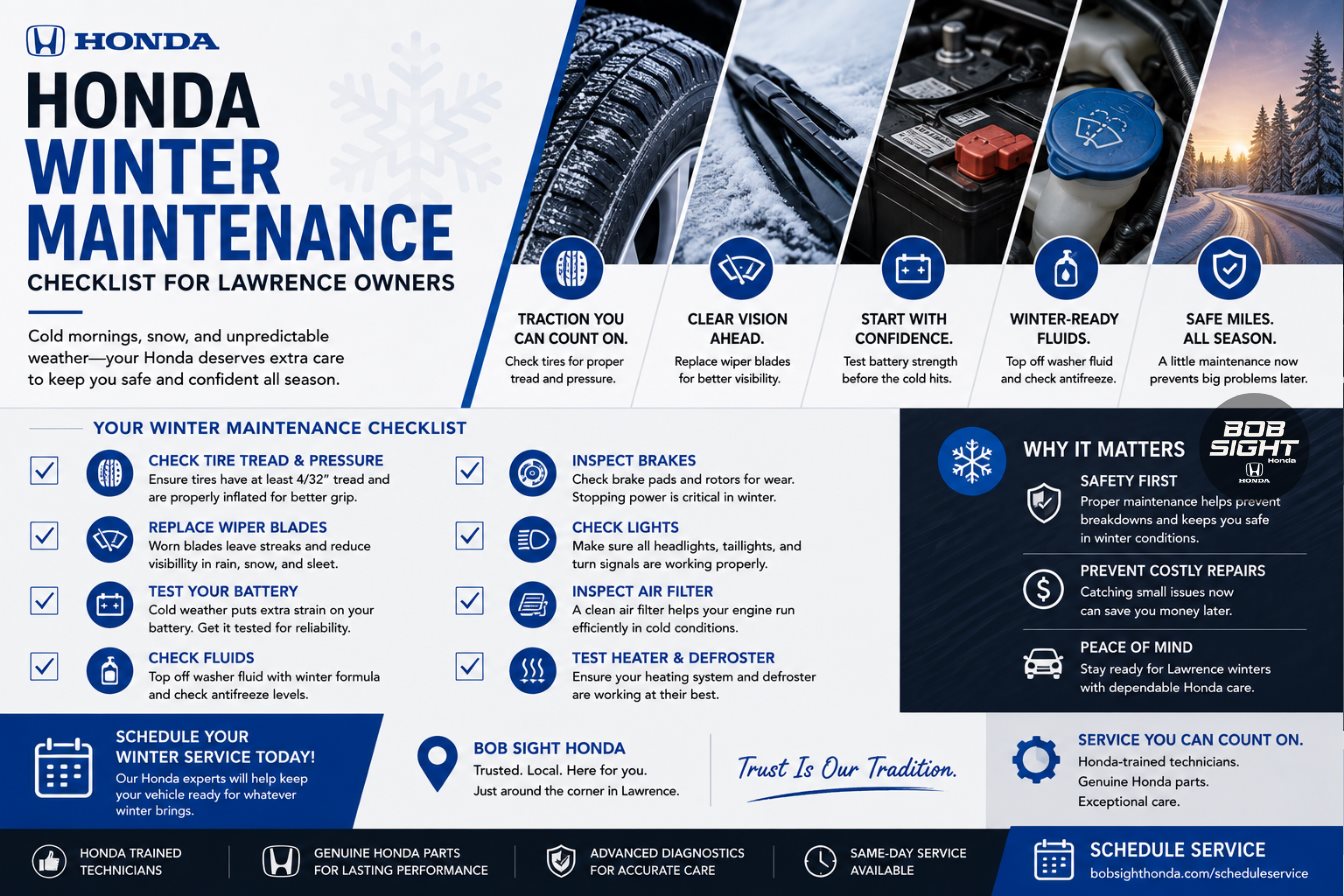
Preparing your vehicle for freezing temperatures, sudden ice storms, and heavy road salt is essential to maintaining long-term reliability and driving safety across Douglas County and the greater Kansas City metro area. At Bob Sight Honda in Lawrence, KS, our certified technicians provide comprehensive cold-weather inspection and maintenance packages engineered to keep your Honda Accord, Civic, CR-V, Pilot, Passport, Odyssey, HR-V, or Ridgeline operating at peak efficiency through harsh Midwest winters. Whether you are daily commuting along K-10 toward Olathe, driving north on Highway 59 toward Topeka, or navigating icy neighborhood streets near the University of Kansas campus, staying ahead of winter maintenance prevents unexpected breakdowns and safeguards your investment. This winter ownership checklist covers essential battery testing, engine oil viscosities, tire pressure adjustments, brake salt corrosion protection, and emergency road preparation tailored specifically for local drivers.
Ensure your vehicle is fully prepared for sub-zero Midwest weather by scheduling a comprehensive winter inspection at Bob Sight Honda in Lawrence, KS today.
In This Guide You'll Learn
This winter maintenance guide breaks down essential factory recommendations and seasonal preparation strategies for Kansas vehicle owners:
- How freezing Midwest temperatures impact battery Cold Cranking Amps (CCA) and electrical load capacity
- Why winter tire inflation adjustments and tread inspections are critical for all-wheel-drive traction
- The exact 50/50 engine coolant and antifreeze ratio required to prevent internal engine block freezing
- How road deicers and chemical salt spray accelerate brake rotor wear and caliper slide pin binding
- Why 0W-20 and 0W-16 full synthetic engine oils are required for effortless sub-zero engine starting
- Step-by-step procedures for building a practical emergency winter road safety kit for your trunk
Essential Winter Battery Diagnostics and Electrical System Health
Freezing winter temperatures reduce a vehicle battery's chemical efficiency by up to 50 percent while simultaneously doubling the electrical power required to turn over a cold engine. During severe Midwest cold snaps in Lawrence, KS, an aging or weakened automotive battery can fail without warning, leaving drivers stranded in freezing weather. Having your battery tested digitally before sub-zero winter temperatures arrive ensures that internal cell health, reserve capacity, and terminal connections are fully capable of handling demanding cold-weather starts.
Modern Honda vehicles place heavy electrical demands on the alternator and battery during winter months due to high-draw comfort accessories. Running heated front seats, heated steering wheels, rear window defrosters, cabin blower fans, and exterior headlights continuously during short winter days taxes the charging system heavily. If a battery has lost significant Cold Cranking Amps capacity, the alternator must work overtime to compensate, which can lead to premature wear on internal voltage regulators and charging system components.
Checking battery terminal connections for corrosive lead-sulfate buildup is another vital component of winter electrical maintenance. Corrosion on battery posts creates electrical resistance, preventing the alternator from recharging the battery completely during short trips along W 23rd Street or Iowa Street. Cleaning terminal posts, applying protective anti-corrosion grease, and verifying clamp tightness guarantees clean electrical contact and reliable starting power throughout the freezing months ahead.
Follow these four diagnostic steps when evaluating your vehicle's electrical system before winter arrives:
- Conduct a Digital Battery Conductance Test: Service technicians connect specialized diagnostic tools to measure precise Cold Cranking Amps and internal cell resistance, identifying weak cells before complete failure occurs.
- Inspect and Clean Battery Terminals: Remove powdery white or blue oxidation from battery terminals using specialized cleaning brushes and apply terminal sealant to prevent future moisture corrosion.
- Evaluate Charging System Output: Test the alternator output voltage under full electrical load to ensure it delivers between 13.8 and 14.5 volts while powering winter accessories.
- Inspect Battery Hold-Down Brackets: Verify that physical mounting brackets are secured tightly to prevent battery vibration damage while driving over rough winter potholes on local roads.
Tire Tread Depth, Winter Pressure Adjustments, and All-Wheel-Drive Inspection
Maintaining proper tire tread depth and correct cold inflation pressure is the single most effective way to ensure stopping power and steering control on snow and ice. Ambient air temperatures in Douglas County drop significantly during late autumn and winter, causing tire inflation pressure to decrease naturally by approximately one pound per square inch (PSI) for every 10-degree Fahrenheit drop in outside temperature. Driving on underinflated tires increases tread wear along outer tire shoulders and degrades handling responsiveness on slippery roads.
Tire tread depth plays a crucial role in channeling slush, water, and loose snow away from the tire contact patch to prevent hydroplaning. While legal minimum tread depth is 2/32 of an inch, winter driving on Kansas highways requires at least 4/32 to 5/32 of an inch of tread depth to maintain safe braking distances on icy surfaces. Inspecting tire tread depth using a digital depth gauge reveals whether your tires have sufficient siping and groove depth to grip packed snow along Clinton Parkway or K-10.
For vehicles equipped with Real Time All-Wheel Drive or i-VTM4 AWD, maintaining uniform tire circumference across all four wheels is essential to protect electronic transfer cases and rear differentials. Driving with mismatched tire inflation pressures or uneven tread wear forces the all-wheel-drive system to detect artificial speed variances between axles, causing unnecessary thermal stress on internal clutch packs. Checking all four tires monthly guarantees balanced traction and protects expensive drivetrain components.
To define an essential tire service term in plain language, tire siping refers to microscopic slits molded into the tire tread blocks that expand under weight to create biting edges on ice and hard-packed snow. Premium all-season and winter tires utilize high-density siping to trap snow within the tread grooves, as snow-on-snow traction provides significantly better grip on frozen pavement than bare rubber alone.
Engine Coolant Concentration, HVAC Performance, and Thermostat Operation
Engine coolant acts as both a heat transfer fluid in summer and a freeze inhibitor during winter, protecting internal engine blocks and radiator cores from cracking. The engine cooling system must maintain an exact 50/50 mixture of genuine Honda Long Life Type 2 Coolant and deionized water to achieve maximum freeze protection down to minus 34 degrees Fahrenheit. If water concentration is too high due to previous improper top-offs, coolant can freeze inside delicate radiator channels, causing engine block cracking and severe mechanical damage.
Testing coolant chemical concentration using a professional optical refractometer determines the exact freezing point of the fluid in your cooling system. Over time, anti-corrosion additives in engine coolant breakdown due to heat cycling, allowing rust and scale to accumulate inside water jackets and heater core passages. Flushing spent coolant and refilling the system with fresh OEM fluid preserves internal aluminum components and restores proper thermal protection before severe winter cold arrives.
Heating and ventilation system efficiency directly impacts winter driving comfort and windshield defrosting speed. The cabin heater core relies on hot engine coolant circulating through internal tubes to generate warm cabin air, while the air conditioning compressor runs during defrost mode to dehumidify interior air and clear fogged glass quickly. If your vehicle heater takes an excessively long time to warm up while driving along Mass Street, a stuck-open cooling system thermostat may be preventing the engine from reaching normal operating temperature.
Replacing interior cabin air filters before winter is another crucial maintenance step for optimal HVAC airflow. A clogged cabin filter restricts air volume passing through defrost vents, severely delaying the time required to clear frost and ice from the front windshield. Installing a clean OEM cabin filter restores full blower performance, ensuring rapid defrosting and a warm, comfortable passenger cabin during cold morning commutes.
Brake System Inspection and Deicer Salt Corrosion Protection
Corrosive chemical deicers and rock salt applied to Douglas County roads accelerate surface oxidation on metallic brake components, causing caliper slide pins to bind and brake pads to drag. Winter road treatments utilized across Lawrence and highway corridors like I-70 create a harsh, saline environment that penetrates wheel openings and coats exposed brake assemblies. Without periodic inspection and cleaning, salt crust accumulation leads to uneven brake pad wear, rotor pitting, and reduced braking performance on slick pavement.
Routine winter brake inspections evaluate friction material thickness, rotor surface condition, caliper hardware movement, and hydraulic brake fluid quality. Hydraulic brake fluid is naturally hygroscopic, meaning it absorbs moisture from atmospheric humidity over time, which lowers the boiling point of the fluid and causes internal corrosion within anti-lock braking system (ABS) hydraulic modulators. Honda specifies replacing brake fluid every three years regardless of mileage to prevent internal brake component damage.
Cleaning and lubricating brake caliper slide pins and pad mounting brackets removes built-up road salt and debris, ensuring that brake calipers slide freely when you release the brake pedal. Calipers that stick due to rust or corrosion cause brake pads to remain in constant contact with the rotor, generating excessive friction heat, premature pad wear, and decreased fuel economy during long highway drives across Eastern Kansas.
The table below summarizes critical winter brake and chassis maintenance tasks recommended for local drivers:
| Maintenance Component | Winter Service Focus | Potential Risk of Neglect |
|---|---|---|
| Brake Caliper Slide Pins | Clean, remove salt scale, and apply synthetic grease | Caliper binding, uneven pad wear, overheated rotors |
| Hydraulic Brake Fluid | Test moisture content and flush every 3 years | Spongy pedal feel, internal ABS module corrosion |
| Brake Rotor Surfaces | Inspect for deep rust pitting and thickness variation | Pulsation during braking, reduced stopping power |
| Underbody Chassis Wash | Rinse road salt accumulation from brake lines and frame | Premature corrosion on brake lines and suspension arms |
Rinsing your vehicle's undercarriage regularly at a car wash during winter months removes trapped salt slush from brake assemblies and suspension mountings. Combining regular underbody washing with professional brake inspections guarantees smooth, responsive braking performance when stopping on icy road surfaces.
Engine Oil Viscosity Selection for Sub-Zero Midwest Starts
Modern Honda engines require low-viscosity 0W-20 or 0W-16 full synthetic engine oil to ensure rapid oil circulation and immediate lubrication during cold winter starts. When ambient temperatures drop below freezing in Lawrence, traditional thick engine oil thickens significantly, creating high mechanical drag inside the engine during cranking. Utilizing advanced full synthetic oil formulated to meet API SP and ILSAC GF-6A specifications guarantees that oil flows effortlessly to overhead valvetrain components and turbocharger bearings within seconds of engine startup.
Turbocharged Earth Dreams engines found in recent Accord, Civic, and CR-V models operate under precise internal clearances and high thermal stress. During cold starts, low-viscosity synthetic oil reduces friction, allowing the engine to start quickly without putting excessive strain on the starter motor or battery. Full synthetic formulations also contain specialized detergent packages that prevent internal engine sludge buildup caused by frequent short-distance winter driving.
Short winter trips under five miles—such as driving to local schools or grocery shopping near 23rd Street—prevent engine oil from reaching complete operating temperature. When engine oil stays cool, moisture condensation and unburned fuel vapor accumulate inside the crankcase, accelerating oil contamination. Following Maintenance Minder engine oil change recommendations or servicing oil at six-month intervals ensures that contaminated oil is drained before internal engine wear occurs.
Choosing genuine OEM engine oil filters during every winter oil change is equally vital for cold-weather protection. OEM oil filters feature precise silicone anti-drainback valves that prevent oil from draining out of the filter housing when the engine is turned off overnight. Maintaining oil inside the filter ensures instantaneous oil pressure buildup the moment you turn the ignition key on cold Midwest mornings.
Dealership Winter Preparation vs. DIY Quick-Lube Care
Entrusting your vehicle's winter preparation to an authorized dealership guarantees comprehensive inspection by factory-trained technicians using specialized diagnostic equipment and genuine OEM parts. While quick-lube outlets offer basic fluid drain-and-fill services, they frequently lack specialized diagnostic tools required to evaluate complex electronic systems, all-wheel-drive modules, and Sensing safety cameras. Understanding the distinct differences between dealership care and third-party facilities helps owners make informed decisions about vehicle maintenance.
Factory-certified technicians undergo rigorous manufacturer training to understand the exact mechanical tolerances, technical service bulletins, and recall updates specific to every model year. During a dealership winter inspection, technicians utilize specialized Honda i-HDS diagnostic software to scan vehicle control modules for pending fault codes that universal auto parts store scanners cannot read. Identifying subtle sensor glitches early prevents unexpected dashboard warning lights during winter travel.
Furthermore, dealerships exclusively install genuine OEM parts engineered specifically for your vehicle model. From exact-fit wiper blades designed for aerodynamic windshield contours to original specification long-life coolants and brake pads, OEM components guarantee factory performance and fitment. Independent quick-lube shops frequently use universal aftermarket fluids or generic filters that may not satisfy strict manufacturer warranty standards.
Comparing these two service paths highlights key ownership benefits for local shoppers:
- Authorized Dealership Service: Features factory-trained technicians, OEM diagnostic software, genuine parts, complete recall verification, and automated manufacturer warranty service logging.
- Quick-Lube / Independent Facilities: Offers basic fast fluid changes but lacks model-specific diagnostic tools, OEM software updates, and specialized hybrid/AWD training.
- Warranty Protection Compliance: Dealership service documentation provides indisputable proof of strict factory compliance should warranty coverage questions arise.
- Safety System Calibration: Dealerships possess specialized target boards and alignment tools needed to calibrate Sensing windshield cameras after winter glass repairs.
Step-by-Step Emergency Winter Road Kit and Vehicle Inspection
Assembling a well-equipped emergency winter road safety kit in your trunk provides peace of mind and vital protection if you experience an unexpected breakdown on rural Kansas roads. Winter storms in Eastern Kansas can cause sudden highway closures, severe traffic delays, or slide-offs into snowbanks along rural county roads surrounding Eudora, Baldwin City, or Lecompton. Carrying essential cold-weather supplies guarantees that you and your passengers stay warm and safe while awaiting roadside assistance.
Follow these steps to assemble a practical winter emergency kit and inspect your vehicle's emergency equipment before winter arrives:
- Pack Essential Thermal and Warmth Supplies: Store thick fleece blankets, insulated gloves, knit hats, hand warmers, and waterproof boots in a durable storage tote inside your cargo area.
- Assemble Emergency Lighting and Power Tools: Include a high-lumen LED flashlight with extra batteries, reflective emergency triangles, a compact folding snow shovel, and a heavy-duty ice scraper with a brass blade.
- Include Traction Aids and Towing Equipment: Carry a bag of heavy coarse cat litter or sand for tire traction on glare ice, alongside a rated tow strap for vehicle recovery from roadside snowbanks.
- Pack Food, Water, and First-Aid Supplies: Store non-perishable protein bars, canned water bottles, a fully stocked medical first-aid kit, and a portable USB phone charger bank.
- Verify Spare Tire and Jack Functionality: Check the inflation pressure of your compact spare tire, inspect the mechanical lifting jack, and verify that the lug wrench and wheel lock key are present in your trunk.
Taking time to organize emergency equipment converts your vehicle into a safe sanctuary during unexpected winter delays. Store winter emergency supplies securely in your cargo area using luggage tie-downs to prevent items from shifting during driving.
Reviewing emergency kit contents annually before snow season begins allows you to replace expired batteries, food bars, and damaged tools. Staying prepared empowers you to handle minor winter roadside inconveniences with calm confidence.
Quick Facts: Honda Winter Maintenance at a Glance
Reviewing essential winter maintenance facts helps vehicle owners keep core service milestones and cold-weather parameters clearly in mind:
- Battery Capacity Loss: Automotive batteries lose up to 50% of their Cold Cranking Amps capacity when ambient temperatures drop to zero degrees Fahrenheit.
- Tire Pressure Rule: Tire pressure drops approximately 1 PSI for every 10°F drop in outside air temperature during winter months.
- Coolant Mix Ratio: Engine cooling systems require an exact 50/50 mix of genuine Long Life Type 2 Coolant to protect against freezing down to -34°F.
- Brake Fluid Flush: Hydraulic brake fluid should be replaced every 3 years to purge absorbed moisture and prevent internal ABS module corrosion.
- Recommended Oil Viscosity: Modern engines require full synthetic 0W-20 or 0W-16 oil to ensure rapid lubrication during sub-zero cold starts.
Keeping these baseline technical parameters in mind ensures proactive vehicle care throughout snow season. Timely winter maintenance prevents major component failures and guarantees safe, dependable transportation for your family.
Long-Term Winter Ownership Planning and Vehicle Longevity in Kansas
Adopting a long-term winter maintenance plan safeguards mechanical durability, protects body sheet metal from rust, and maximizes resale trade-in value over years of ownership. Operating a vehicle through Midwest winters subjects engine components, electrical systems, suspension joints, and body paint to harsh thermal stress and corrosive road chemicals. Developing proactive maintenance habits minimizes cumulative environmental wear, allowing your vehicle to deliver reliable service well past 100,000 miles.
Protecting exterior body paint and underbody metal coatings from chemical deicers requires seasonal preparation before winter arrives. Applying a coat of high-quality synthetic paint sealant or ceramic coating to exterior paint surfaces creates a protective barrier that repels salt spray, road grime, and acid rain. Regularly washing your vehicle during winter months at automated facilities equipped with undercarriage blasters removes accumulated salt slush from frame rails, fuel lines, and brake assemblies.
Maintaining accurate, complete digital service records at an authorized dealership significantly enhances pre-owned trade-in valuations when you decide to upgrade vehicles in the future. Prospective pre-owned buyers and dealership appraisers in the Kansas City market place a high premium on vehicles accompanied by verified dealership maintenance logs showing timely fluid changes, battery replacements, and winter rust protection. Complete records prove that your vehicle received expert care throughout its operational life.
Partnering with a trusted local dealership service center ensures your vehicle receives ongoing software updates, recall completions, and specialized multi-point safety inspections during every routine visit. Our factory-certified technicians utilize specialized diagnostic tools engineered specifically for advanced powertrains, Sensing safety suites, and electronic drive systems. This expert oversight guarantees that your vehicle provides safe, quiet, and dependable transportation across Douglas County through every season.
Frequently Asked Questions About Honda Winter Maintenance in Lawrence, KS
What is included in a Honda winter maintenance inspection in Lawrence, KS?
A comprehensive winter maintenance inspection at Bob Sight Honda includes a digital battery health test, coolant concentration check, tire tread and pressure evaluation, brake salt corrosion inspection, wiper blade test, and complete underbody fluid leak check. Technicians measure battery Cold Cranking Amps capacity to ensure reliable starting power during freezing weather while testing engine coolant freeze protection down to minus 34 degrees Fahrenheit using an optical refractometer.
Additionally, technicians evaluate tire tread depth and adjust inflation pressures across all four tires to account for cold weather pressure drops. Inspecting brake pads, rotors, caliper slide pins, and underbody fluid lines ensures that road salt spray has not caused binding or severe surface oxidation on critical braking hardware.
Our comprehensive winter inspection provides Douglas County drivers with complete confidence before snow season arrives. Receiving a detailed digital inspection report with clear health ratings allows you to approve necessary maintenance items easily from your smartphone.
Why does my tire pressure warning light come on during cold Lawrence mornings?
Your tire pressure warning light illuminates on cold mornings because ambient temperature drops cause air inside your tires to contract, dropping inflation pressure below the safe threshold monitored by the Tire Pressure Monitoring System (TPMS). Air pressure inside pneumatic tires decreases by approximately one PSI for every 10-degree Fahrenheit drop in outside temperature. When your vehicle sits outdoors overnight during a sudden cold snap, pressure drops enough to trigger the dashboard warning light.
Driving on underinflated tires increases tread wear along outer shoulders, reduces fuel economy, and compromises handling responsiveness on wet or snow-covered pavement. Checking tire pressure monthly using a digital tire pressure gauge and inflating tires to the recommended cold PSI listed on the driver door jamb sticker resolves low-pressure warnings.
If your TPMS warning light remains illuminated after setting correct inflation pressures, the system may require recalibration through your touchscreen menu or multi-information display. Our service department at Bob Sight Honda can quickly adjust tire pressures and recalibrate your TPMS system during any routine service visit.
How often should I replace wiper blades during Kansas winter months?
You should inspect wiper blades regularly and replace them every six to twelve months, or immediately if you notice streaking, chattering, or tearing during winter rain and snowstorms. Winter ice, heavy snow, and corrosive road salt spray accelerate rubber blade wear, causing micro-tears in the squeegee edge that leave dangerous blind streaks across your windshield when driving on Highway 59 or K-10.
Installing heavy-duty winter wiper blades or genuine OEM beam blades provides superior wipe quality during cold weather. Winter blades feature flexible rubber boots that prevent ice and packed snow from building up inside the wiper frame structure, maintaining even pressure across the curved windshield glass.
To extend wiper blade life during winter, never use your wiper blades to scrape thick ice off a frozen windshield, as sharp ice edges will tear delicate rubber squeegees instantly. Use a plastic ice scraper and allow your vehicle defrost system to warm the glass before operating wiper arms.
What is the difference between 0W-20 engine oil and conventional oil for winter driving?
Full synthetic 0W-20 engine oil maintains low viscosity and rapid flow in sub-zero temperatures, whereas conventional oil thickens significantly when cold, creating severe engine drag and delayed lubrication during cold starts. The "0W" rating designates cold-temperature pumpability, indicating that the oil remains thin enough to circulate rapidly to overhead camshafts and turbochargers the moment a cold engine starts in sub-zero Kansas winter weather.
Full synthetic oil formulations also offer superior resistance to thermal breakdown, oxidation, and sludge formation compared to traditional conventional oils. Turbocharged engines and advanced variable timing systems require full synthetic formulations meeting API SP and ILSAC GF-6A specifications to preserve internal mechanical clearances over extended service intervals.
Utilizing full synthetic 0W-20 or 0W-16 engine oil during winter months protects starter motors, reduces battery load during engine cranking, and guarantees instant oil pressure. Our service department exclusively fills vehicles with high-grade synthetic oil engineered specifically for modern engine requirements.
Where can I get winter maintenance for my Honda near Lawrence, KS?
You can get certified winter maintenance for your vehicle at Bob Sight Honda, conveniently located on Iowa Street in Lawrence, KS, serving drivers across Douglas County, Topeka, Eudora, and Baldwin City. Our modern service center features factory-trained technicians, advanced diagnostic equipment, comfortable customer amenities, and Express Service lanes for quick routine maintenance visits.
Servicing your vehicle at our local dealership guarantees that all maintenance is performed using genuine OEM parts engineered specifically for your model year. Complete digital service records are automatically logged into the central manufacturer database, preserving your factory warranty coverage and maximizing future trade-in value.
Whether you need a digital battery test, full synthetic oil change, brake inspection, or winter tire installation, our service team is prepared to keep your vehicle performing safely all winter long. Schedule your winter service appointment online or visit our service department today.
Why Local Dealership Expertise Matters for Lawrence Winter Driving
Entrusting your vehicle to a locally grounded, factory-authorized service center ensures that maintenance care is tailored specifically to Midwest climate challenges and regional driving routes. At Bob Sight Honda, our service staff and factory-trained technicians reside in the local community, understanding firsthand the driving demands created by icy commutes along K-10, stop-and-go travel on W 23rd Street, and sub-zero winter temperatures in Douglas County. We combine local driving experience with technical manufacturer training to deliver thorough automotive care.
We invest continually in specialized diagnostic tools, state-of-the-art service bays, and genuine OEM inventory to maintain the exact engineering standards set by the factory. Beyond technical excellence, our commitment to transparent customer service guarantees that you receive clear digital inspection reports, upfront pricing estimates, and clear explanations for all recommended maintenance tasks. Choosing expert local dealership care guarantees safe, reliable performance and driving peace of mind through every winter storm.
Whether your vehicle requires a cold-weather battery replacement, winter brake inspection, synthetic oil change, or complete winter prep evaluation, our service team is ready to assist you. Visit us on Iowa Street in Lawrence, KS, or utilize our secure online portal to schedule your winter service appointment today.
Helpful Links
Explore these essential dealership links to schedule service, view current service coupons, or order genuine OEM accessories online:
- Schedule Service Online in Lawrence, KS
- Current Honda Service and Parts Specials
- Honda Express Service Lane Information
- Order Genuine OEM Honda Parts
- Learn More About Our Honda Service Center
Proud to Be Part of the Bob Sight Auto Group
Bob Sight Honda is proud to serve drivers across Lawrence and Eastern Kansas as a member of the family-owned Bob Sight Auto Group. For generations, our automotive group has provided exceptional customer care, transparent automotive sales, and expert service across the Kansas City region. Explore our group dealership locations below to find sales, service, or collision repair near you: