Kansas Winter Car Battery Guide for Honda Owners: Cold-Weather Warning Signs, Testing, Starting Habits, and When to Replace
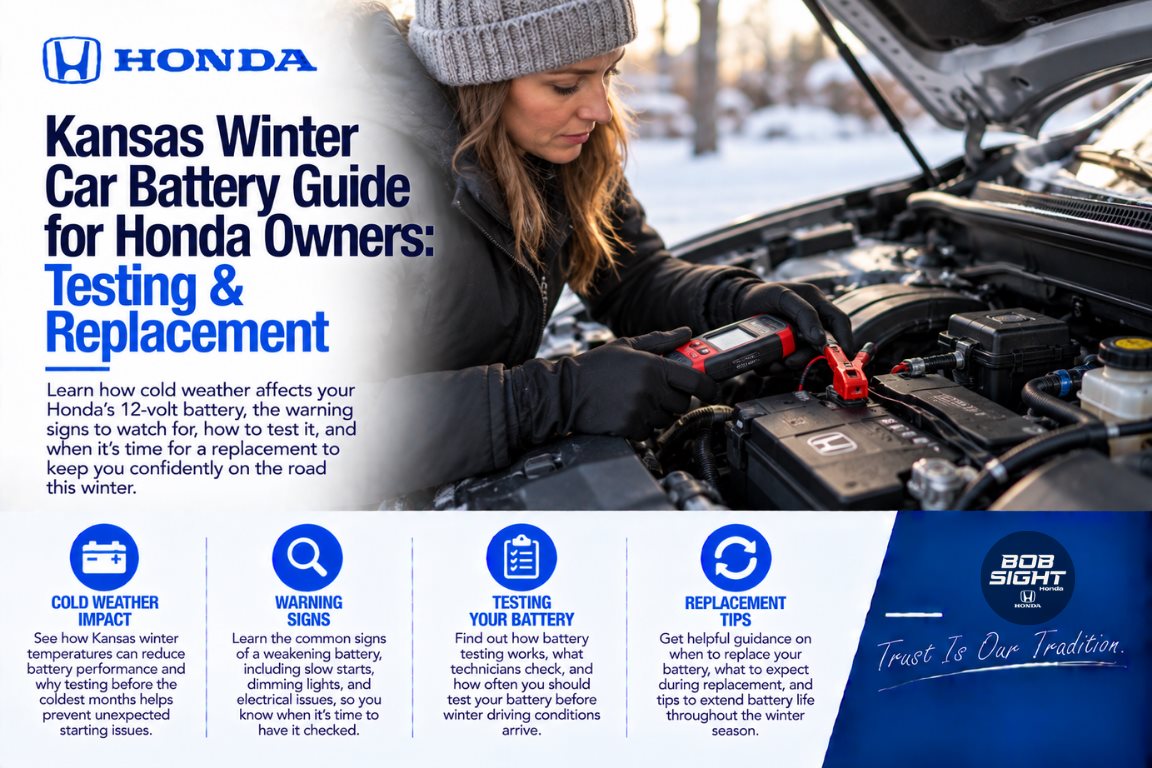
When Midwest winter temperatures drop below freezing across Douglas County and Johnson County, your Honda's 12-volt battery faces its toughest test of the year. At Bob Sight Honda in Lawrence, Kansas, our service department sees a sharp increase in battery failure service calls during the first severe cold snap of winter. Whether you commute daily along Interstate 70 toward downtown Kansas City, take Kansas Highway 10 into Olathe, or leave your car parked outdoors near the University of Kansas campus overnight, cold weather drastically reduces battery output while simultaneously increasing the energy needed to crank a frozen engine. This comprehensive guide breaks down how cold weather weakens car batteries, critical warning signs of impending battery failure, DIY and professional testing procedures, best cold-start driving habits, battery care for gas and hybrid models, and what to look for when purchasing a replacement battery for your Honda Civic, Accord, CR-V, Pilot, or hybrid vehicle.
If your vehicle is cranking slowly or your battery is more than three years old, schedule a professional battery health check at our Bob Sight Honda service center in Lawrence, KS today. Our factory-certified technicians will test your battery's Cold Cranking Amps (CCA) and charging system to ensure reliable starts all winter long.
In This Guide You'll Learn
Below is an overview of what this complete winter battery guide for Kansas Honda owners covers:
- The chemical and physical reasons why cold temperatures reduce battery capacity while increasing engine starter load.
- Primary warning signs indicating your Honda battery is reaching the end of its functional service life.
- How to test battery voltage using a digital multimeter at home and what professional conductance load testing reveals.
- Best cold-weather starting habits to minimize electrical strain during freezing morning starts on K-10 and I-70.
- Specific battery considerations for Honda hybrid vehicles (Civic Hybrid, CR-V Hybrid, Accord Hybrid) and 12V auxiliary system health.
- Deep-dive analysis on parasitic electrical draws, alternator diode health, and emergency jump-starting safety procedures.
- Key specifications to verify when replacing your battery, including Group Size, Cold Cranking Amps (CCA), and OEM Honda 100-month warranty coverage.
- Embedded JSON-LD structured data schema markup for search engine optimization.
1. The Science of Cold Weather and Battery Degradation
Sub-freezing temperatures create a double-jeopardy scenario for automotive lead-acid batteries. Inside a standard 12-volt battery, electrical energy is produced through a chemical reaction between lead plates and a liquid electrolyte solution composed of sulfuric acid and water. As ambient temperatures drop, this chemical reaction slows down dramatically.
At 32 degrees Fahrenheit (0 degrees Celsius), a fully charged car battery loses approximately 20 to 35 percent of its maximum cranking power. When temperatures plummet toward 0 degrees Fahrenheit during severe Kansas winter storms, available battery capacity drops by as much as 50 to 60 percent. At the exact moment your battery is producing half its normal power, your engine requires significantly more energy to turn over. Engine oil thickens in cold weather, creating heavy fluid drag on internal crankshaft journals and pistons that forces the starter motor to draw maximum amperage from the battery.
Furthermore, summer heat is actually what causes internal battery damage, while winter cold reveals the damage. Scorching Kansas summer temperatures accelerate internal grid corrosion and evaporate water from the electrolyte fluid. A battery damaged by summer heat may function adequately during autumn, but the first freezing morning in Lawrence will expose its degraded capacity, leaving you stranded with a non-starting engine.
2. 6 Critical Warning Signs of a Weak Honda Battery
Car batteries rarely fail without providing preliminary warning indicators. Recognizing these subtle symptoms allows you to replace a weak battery proactively before getting stranded in a frozen parking lot at KU or a highway rest stop along I-470.
Watch for these six common warning signs in your Honda:
- Slow or Hesitant Engine Crank: When you press the ENGINE START/STOP button or turn the ignition key, the starter motor sounds sluggish, turning over slower than normal before the engine fires.
- Dim Headlights and Flickering Interior Lights: Dashboard displays, infotainment touchscreens, or interior dome lights dim noticeably when starting the engine or idling at traffic lights on Iowa Street.
- Clicking Sound Upon Ignition: Pressing the start button produces a rapid metallic clicking noise from under the hood. This occurs when the battery lacks sufficient voltage to keep the starter solenoid engaged.
- Illuminated Battery / Charging System Warning Light: A red battery icon on your instrument cluster indicates an issue within the 12V charging system, alternator output, or battery voltage levels.
- Bulging Battery Case: Extreme freezing can cause a discharged battery to freeze solid and swell, bulging the plastic outer casing. A swollen battery case indicates permanent structural damage and requires immediate replacement.
- Corrosion or Crust Around Terminals: A white, blue, or greenish powdery substance buildup around the positive (+) or negative (-) battery terminals restricts electrical current flow, causing high resistance.
3. Testing Battery Health: DIY Multimeter vs. Professional Conductance Testing
Testing your battery's state of charge and internal health takes the guesswork out of winter vehicle preparation. Vehicle owners can perform basic voltage checks at home using a standard digital multimeter, but a complete health assessment requires professional conductance load testing equipment.
The table below summarizes standard battery voltage readings at rest and during engine cranking under normal conditions:
| Multimeter State / Reading | Battery Charge Level | Diagnostic Assessment & Action Required |
|---|---|---|
| 12.6V to 12.8V (Engine Off) | 100% Fully Charged | Healthy state of charge; optimal condition for cold winter starts. |
| 12.2V to 12.4V (Engine Off) | 50% to 75% Charged | Slightly discharged; re-test after driving or connect a slow trickle charger. |
| Below 12.0V (Engine Off) | 25% or Less Charged | Severely discharged; battery may fail during cold temperature drops; immediate recharge or replacement needed. |
| 13.8V to 14.8V (Engine Running) | Alternator Charging State | Normal alternator voltage output; confirms charging system is functioning properly. |
| Below 9.6V (During Crank) | Cranking Voltage Dip | Internal cell breakdown or high internal resistance; battery replacement recommended. |
While a multimeter measures surface voltage, it cannot determine whether a battery can hold an electrical load under heavy starter draw. At Bob Sight Honda, our service center utilizes electronic battery conductance testers that send a micro-load signal through the battery grid. This test evaluates remaining Cold Cranking Amps (CCA), internal plate resistance, and overall health status, letting you know precisely how much reserve capacity remains before severe winter cold sets in.
4. Understanding Parasitic Drain and Alternator Health
A battery that repeatedly dies in cold weather is not always defective; parasitic electrical draws or a failing alternator can drain a brand-new battery overnight. Modern Honda vehicles are packed with sophisticated computers, keyless proximity entry sensors, anti-theft alarms, and telematics modules that draw small amounts of current even when the ignition is turned off.
Under normal conditions, a healthy Honda vehicle should draw less than 50 milliamperes (0.050 amps) of parasitic current while parked and sleeping. However, aftermarket accessories such as dash cams, unapproved remote starters, or OBD-II port tracking devices can draw excessive power continuously. In sub-freezing Kansas weather, an elevated parasitic draw of just 200 to 300 milliamperes can drain a 12-volt battery below cranking voltage in less than 48 hours.
Simultaneously, evaluating alternator charging performance is crucial during winter service checks. When your engine is running, the alternator must generate sufficient current to power headlights, heated seats, rear glass defrosters, blower fans, and wipers while delivering a steady charging current back into the battery. If an alternator diode fails, it can restrict charging efficiency or cause an internal AC current leak that drains the battery when the vehicle is parked. At Bob Sight Honda, our technicians test both charging voltage output and AC ripple current to verify that your alternator is working in perfect harmony with your battery.
5. Safe Winter Jump-Starting Procedures and Emergency Kit Essentials
If you experience a dead battery on a freezing morning in Lawrence or along the highway, knowing the correct jump-starting sequence prevents electrical damage to your vehicle. Modern Honda models use sensitive electronic control units (ECUs) and delicate sensing modules that can be damaged by improper jumper cable placement or sudden voltage spikes.
Follow these safety steps when jump-starting a vehicle:
- Position Vehicles Safely: Park the donor vehicle close enough for jumper cables to reach without stretching, but ensure the two vehicles do not touch physically. Turn off both ignitions and set parking brakes.
- Connect Positive (+) Cable First: Clamp the red positive jumper cable lead to the positive (+) terminal of the dead battery. Connect the opposite red positive lead to the positive (+) terminal of the donor battery.
- Connect Negative (-) Cable Safely: Clamp the black negative jumper cable lead to the negative (-) terminal of the donor battery. Attach the final black negative lead to an unpainted metal ground point on the engine block or frame of the vehicle with the dead battery, away from the battery itself.
- Start Donor Engine and Charge: Start the donor vehicle's engine and let it run at fast idle for 3 to 5 minutes to transfer charge into the depleted battery before attempting to start the dead vehicle.
- Remove Cables in Reverse Order: Once the vehicle starts successfully, disconnect jumper cables in exact reverse order (ground lead first, donor negative lead, donor positive lead, and dead battery positive lead). Leave the freshly started engine running for at least 20 to 30 minutes to rebuild battery charge.
In addition to knowing how to jump-start your car, keeping an emergency winter road kit in your trunk provides peace of mind across Douglas County and Johnson County. Essential kit items include heavy-duty 6-gauge jumper cables or a portable lithium-ion jump-starter pack, an LED flashlight with extra batteries, an ice scraper, a warm blanket, thermal gloves, tire traction mats, and a portable tire inflator.
6. Smart Cold-Weather Starting Habits for Honda Drivers
Adopting proper cold-weather starting habits reduces unnecessary electrical load and protects your battery, starter motor, and engine during winter freezes. Follow these five practical steps when starting your vehicle on freezing Kansas mornings:
- Turn Off All Accessories Before Starting: Turn off seat heaters, cabin blower fans, windshield wipers, defrosters, and radio before pressing the start button. This directs 100 percent of available battery amperage to the starter motor.
- Limit Cranking Duration: If the engine does not start immediately, do not crank continuously for more than 10 to 15 seconds. Wait 30 seconds between attempts to allow the starter motor to cool and the battery voltage to recover.
- Avoid Short 2-Minute Trips: Short trips around 23rd Street or campus don't give the alternator enough time to replenish energy lost during cold engine starts. Drive at highway speeds along K-10 or I-70 for at least 15 to 20 minutes periodically to fully charge the battery.
- Park in a Garage or Shielded Area: Parking inside an unheated garage or under a carport shields your vehicle from wind chill and keeps ambient temperatures several degrees warmer than open driveways.
- Keep Terminals Clean and Tight: Inspect battery terminal clamps for tightness and clean away corrosion using a wire brush and baking soda solution. Secure terminal connections prevent voltage drops.
7. Battery Care for Honda Hybrid Models (12V Auxiliary vs. High-Voltage Pack)
Honda hybrid vehicles (such as the Civic Hybrid, CR-V Hybrid, and Accord Hybrid) utilize two distinct battery systems that require specific understanding. The large high-voltage lithium-ion traction battery powers the electric propulsion motors, while a smaller standard 12-volt auxiliary lead-acid battery powers cabin electronics, safety systems, headlights, and the electronic control units (ECUs) that engage the hybrid system.
Even though the high-voltage traction battery starts the gas engine via the starter-generator motor, your hybrid vehicle will not start or turn on if the 12V auxiliary battery is fully discharged. A dead 12V auxiliary battery prevents the main high-voltage contactor relays from closing, rendering the vehicle inoperable.
In Kansas winter weather, keeping the 12V auxiliary battery in healthy condition is just as vital for hybrid owners as it is for gas-only owners. If your hybrid vehicle sits unused for extended periods during cold winter spells, connecting a 12V smart trickle charger or driving the vehicle weekly preserves auxiliary battery voltage and prevents dead-battery situations.
8. Choosing the Right Replacement Battery: Group Size, CCA, and OEM Quality
When it comes time to replace your Honda battery, selecting the correct battery specifications ensures proper electrical system performance and physical fitment. Never install a replacement battery with a lower Cold Cranking Amp rating than original factory specifications.
Key specifications to consider when purchasing a replacement battery include:
- Group Size: Refers to the physical dimensions, terminal orientation, and hold-down style required for your specific vehicle engine bay (e.g., Group 51R for many Honda Civic models; Group 35 or 24F for Accord, CR-V, and Pilot models).
- Cold Cranking Amps (CCA): Measures the number of amperes a new, fully charged battery can deliver at 0 degrees Fahrenheit (-18 degrees Celsius) for 30 seconds while maintaining at least 7.2 volts. Higher CCA ratings provide stronger starting power during cold Kansas winters.
- Reserve Capacity (RC): Measures how many minutes the battery can power essential accessories if the alternator fails.
- Genuine OEM Honda 100-Month Warranty: Genuine OEM Honda replacement batteries purchased and installed at Bob Sight Honda come backed by an outstanding 100-month (8.3-year) limited warranty package, featuring 100 percent free replacement coverage during the initial 36 months.
Our service department stocks a full inventory of genuine OEM Honda batteries designed specifically for your model's electrical requirements. Browse available battery incentives and service discounts on our Service and Parts Specials page.
Quick Facts: Honda Winter Car Battery Essentials
Below is a quick reference summary highlighting key battery facts for Kansas drivers:
- Average Battery Lifespan: 3 to 5 years under typical Midwest climate conditions.
- Cold Weather Power Loss: Up to 50% capacity drop at 0 degrees Fahrenheit.
- Healthy Resting Voltage: 12.6V to 12.8V with engine turned off.
- OEM Warranty Protection: Genuine Honda replacement batteries feature 100-month limited warranty coverage.
- Complimentary Testing: Free battery load testing available during routine service visits at Bob Sight Honda.
Why Choose Bob Sight Honda in Lawrence, KS for Battery Service
Bob Sight Honda is dedicated to keeping drivers across Lawrence, Eudora, Baldwin City, Olathe, and the Greater Kansas City area safe and mobile through every season. As part of the family-owned Bob Sight Auto Group, our service facility operates with complete transparency, certified technician expertise, and genuine factory parts. We understand the demands Kansas winters place on your vehicle and provide fast, reliable battery testing and replacement services.
When you visit Bob Sight Honda for battery service, our technicians test your battery's CCA output, check charging system alternator output, clean terminal connections, and install genuine OEM Honda batteries with factory warranty backing. Schedule your winter battery test today using our convenient Schedule Service page or stop by our service center on Iowa Street in Lawrence, KS.
Helpful Links
Proud To Be Part Of The Bob Sight Auto Group
Bob Sight Honda is proud to be part of the Bob Sight Auto Group, serving drivers across Kansas and Missouri with exceptional automotive sales, financing, and service. Whether you are looking for a new Honda in Lawrence, a Ford in Lee's Summit, or a Kia or CDJR vehicle in the area, our dealership group is committed to providing top-tier customer care at every location.