Used Cars Under $15,000 in Lawrence, KS: How to Compare Mileage, Service Records, and Upcoming Maintenance
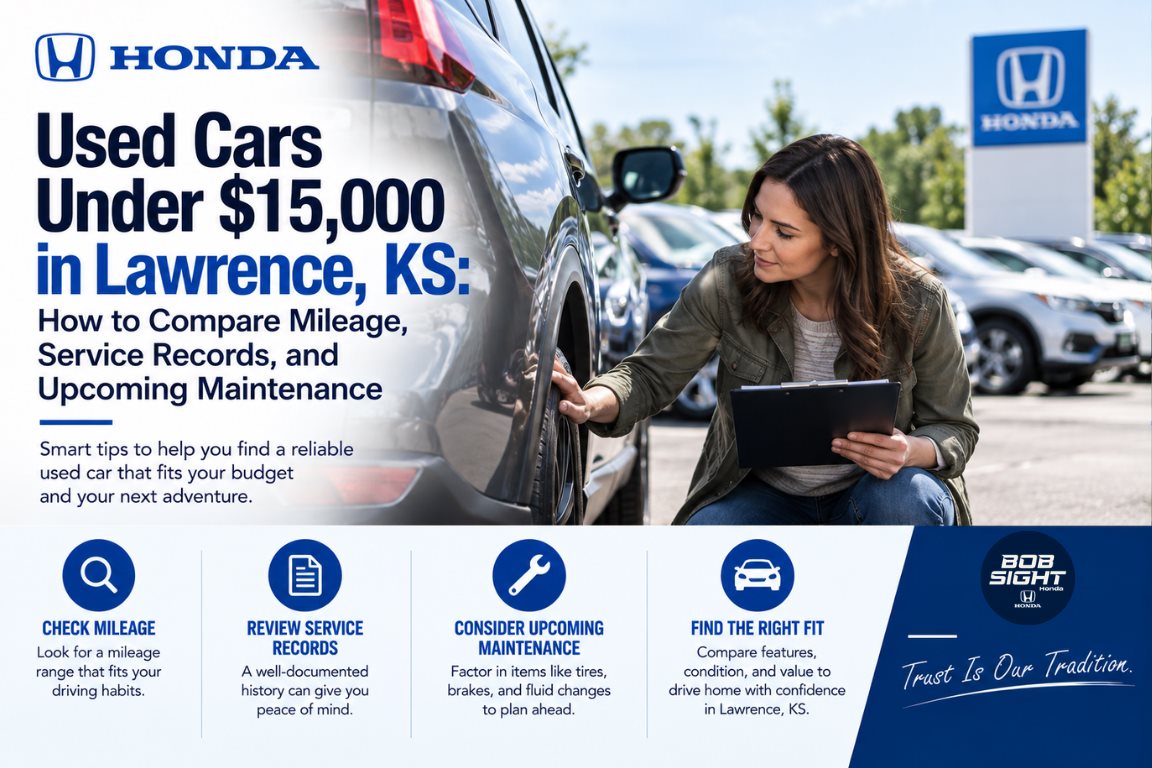
Browse vehicles under $15,000 at Bob Sight Honda
When shopping for used cars under $15,000 in Lawrence, KS, the best comparison goes beyond the number on the listing. Mileage, documented maintenance, current condition, and the work a vehicle may need next can tell you more about how it fits your life. At Bob Sight Honda, shoppers from Lawrence, Topeka, Eudora, and Baldwin City can use those details to narrow their choices before a test drive. This guide provides a practical way to compare individual vehicles without assuming that one model, mileage figure, or service record guarantees future reliability.
In This Guide You’ll Learn
Use the same questions for every vehicle you consider so differences are easier to spot.
- How to interpret mileage alongside a vehicle’s age and condition
- Which service records answer the most useful questions
- How to identify maintenance that may be coming due
- What a vehicle history report can and cannot confirm
- How to compare inspection findings across two used cars
- What to verify before visiting a dealership or choosing a vehicle
Quick Facts for Comparing Used Cars in Lawrence
Compare each used car as an individual vehicle, even when two listings have a similar asking price. An odometer reading is one useful fact, but its meaning depends on maintenance history, current condition, and how you expect to drive.
- Mileage is a starting point: Review it alongside vehicle age, service records, and an inspection.
- Records provide context: Look for dates, odometer readings, and descriptions of completed work.
- History reports have limits: An event may not appear if it was never reported to the information provider.
- Upcoming maintenance matters: Check tires, brakes, fluids, batteries, and model-specific service requirements.
- Recall checks are vehicle-specific: Use the VIN to look for unrepaired safety recalls.
- Inventory changes: Confirm a vehicle’s current availability, displayed terms, and dealership location before traveling.
A student driving mostly around the University of Kansas campus will use a vehicle differently from someone commuting along I-70 toward Topeka. Keep that intended use in mind throughout the comparison. The goal is to find a vehicle whose documented history and present condition support the driving you need it to do.
What Does a Used Car’s Mileage Actually Tell You?
Mileage tells you how far a vehicle has traveled, but it does not tell you how well it was maintained. Compare the odometer reading with the vehicle’s age, available service records, and current condition. No mileage figure by itself proves that a used car is dependable or that it will need repairs soon.
Begin with a simple calculation: divide the current mileage by the vehicle’s age in years for a rough annual average. That number can help you form questions, but it is not a pass-or-fail test. A vehicle driven regularly between Lawrence and Topeka may accumulate miles differently from one used for frequent short trips near downtown Lawrence. Both deserve a review of maintenance and mechanical condition.
Next, look for a consistent mileage trail. Service invoices, inspection reports, and available vehicle history entries may include odometer readings from different dates. Read those entries in order and ask about any gap or apparent inconsistency. A gap does not establish that something is wrong; it means you need more information before drawing a conclusion.
Finally, consider how much you plan to drive after purchase. If you expect regular highway trips from Douglas County to Topeka or the Kansas City area, upcoming maintenance may arrive sooner in calendar time than it would for a low-mileage local driver. Ask what services the manufacturer recommends for the vehicle’s specific model year, engine, and current condition. This turns the odometer reading into an ownership-planning question rather than a judgment about the car.
Which Service Records Are Most Helpful Before a Test Drive?
The most useful service records show what work was completed, when it happened, and the vehicle’s mileage at the time. They help you build a timeline of care. A statement that a car was “well maintained” is less informative than dated records you can review.
Look first for routine work such as oil and filter changes, tire service, brake inspections, and fluid maintenance. Then note any larger repairs or replacements, including a battery, tires, brakes, or suspension components. An invoice should help you distinguish an inspection from an actual replacement. For example, a record saying the brakes were checked does not establish that new brake components were installed.
Match each record to the vehicle you are considering. Confirm the VIN when it appears, review the date, and compare the recorded mileage with other entries. If work was performed outside a dealership, ask whether the seller has invoices or other documentation. Some owners do maintenance themselves, so a missing commercial record does not prove the work was skipped. It does leave a question you should investigate through conversation and inspection.
Service history is valuable when comparing two otherwise similar listings. One vehicle may have more miles but documented maintenance and recently completed work. Another may have fewer miles but little supporting information about care. Rather than declaring either one the better choice from the listing alone, use the records to identify what an inspection needs to confirm.
For a Lawrence driver preparing for frequent trips on K-10 or I-70, ask how the vehicle has been maintained for that type of use. Review the owner’s manual or manufacturer guidance for the exact vehicle. Service requirements vary by make, model, model year, powertrain, and driving conditions. Avoid assuming that a schedule for one Honda, Toyota, Ford, or other vehicle applies to every car on your shortlist.
How Can You Spot Maintenance That May Be Coming Due?
Compare the vehicle’s current condition and records with the maintenance guidance for its exact model. The purpose is to identify questions and plan ahead, not to predict a repair from age or mileage alone. A current inspection can clarify whether an item needs attention now or should simply be monitored.
Start with items you can discuss during a walkaround and test drive. Ask about tire condition and age, brake measurements if available, battery test results, fluid condition, and the date of the most recent service. Check whether warning lights illuminate during startup and then behave as expected. Notice whether the vehicle starts smoothly, steers consistently, and brakes without unusual vibration or noise.
Some maintenance questions depend heavily on the vehicle. An all-wheel-drive SUV, a hybrid, and a front-wheel-drive sedan can have different systems and service needs. Even vehicles with the same nameplate may use different engines or transmissions across model years. Identify the exact year, trim, engine, and drivetrain before researching a maintenance schedule.
- Record the vehicle’s details. Note the VIN, model year, current mileage, engine, and drivetrain.
- Read the available records. Mark confirmed services and the dates or mileage when they occurred.
- Check model-specific guidance. Review the owner’s manual and maintenance information for that vehicle.
- Inspect current condition. Ask what tire, brake, battery, fluid, and other findings mean for near-term use.
- List unanswered questions. Keep confirmed work separate from maintenance that still needs verification.
This process is useful for shoppers comparing vehicles under $15,000 because it keeps the discussion focused on the actual car. If you expect daily travel between Lawrence and Eudora, for example, a tire or brake question may matter immediately to your planning. Ask for the finding and its basis rather than relying on a vague description such as “recently serviced.”
What Can a Vehicle History Report Confirm?
A vehicle history report can provide important background, but it cannot replace a physical inspection or complete service records. Depending on the provider and available data, it may show title information, reported incidents, ownership entries, or recorded maintenance. An event that was not reported may be absent.
Use the vehicle identification number, or VIN, to make sure you are reviewing information for the correct car. The VIN is a unique identifier for the vehicle. Compare it with the listing, the vehicle itself, and any documents you receive. If an entry raises a question, ask for supporting records or an explanation before treating it as resolved.
The Federal Trade Commission’s used-car guidance recommends reviewing vehicle history and explains that a history report is not a substitute for an independent inspection. The federal National Motor Vehicle Title Information System offers access to title-related history through approved providers. Different reports may contain different information, so read what a particular report actually covers.
Run a separate recall check using the VIN. The National Highway Traffic Safety Administration recall lookup can show certain unrepaired safety recalls associated with a specific vehicle. Its results have limits, including some recently announced recalls for which VIN information is still being added. Ask about any open recall and how it will be addressed before purchase.
These checks are relevant whether you are considering a used Honda or another brand in Lawrence. A report can help you decide which questions to ask during an inspection, while an inspection can identify present conditions a report cannot show. Use both kinds of information rather than expecting either one to tell the entire story.
How Should You Compare Two Used Cars Side by Side?
Use the same comparison categories for both vehicles: mileage, documented care, current condition, and fit for your driving. This keeps a familiar badge, appealing photo, or single odometer figure from controlling the entire decision. It also helps you identify what information is missing.
Consider two hypothetical vehicles on your shortlist. Vehicle A has a higher odometer reading and detailed invoices for routine service. Vehicle B has fewer miles, but its maintenance history is incomplete. The records give you more context for Vehicle A, while Vehicle B may still be a good candidate after an inspection. Neither conclusion can be reached confidently from mileage alone.
A short worksheet makes the comparison easier to review:
| Question | Vehicle A | Vehicle B |
|---|---|---|
| Is the VIN consistent across the vehicle and documents? | Record finding | Record finding |
| Which services are documented? | List confirmed work | List confirmed work |
| What did the inspection find? | Note current condition | Note current condition |
| What maintenance needs follow-up? | List open questions | List open questions |
| Does it fit your daily driving? | Note practical fit | Note practical fit |
Fill in the worksheet using actual records, test-drive observations, and inspection findings. If you do not have an answer, write “not verified” rather than guessing. A question about tire wear, for instance, should remain open until someone checks the tires. This makes the final decision more transparent.
Practical fit deserves its own line. A compact sedan might suit a driver making short trips around the University of Kansas, while a different vehicle may better accommodate passengers and gear for regular trips across Douglas County. Test the seating position, visibility, cargo area, controls, and highway behavior for your intended use. A mechanically promising car still has to work for your daily routine.
Why Is an Independent Inspection Worth Discussing?
An independent inspection gives you another assessment of a used vehicle’s present condition before you decide to buy. It can help you investigate concerns raised by a test drive, service records, or vehicle history. No inspection can guarantee that a car will never need a repair, but it can make the current condition clearer.
Ask whether the vehicle can be examined by a mechanic you choose and what arrangements would be needed. The FTC recommends an independent inspection even when a vehicle comes with a history report. Tell the mechanic how you plan to use the car and share any specific questions you identified. A daily Topeka commute may make tire condition, braking, and highway behavior priorities in your discussion.
Request findings you can understand and compare. Which concerns need prompt attention? Which items are normal wear that should be monitored? Were any systems difficult to evaluate without more testing? A clear report is more useful than a general statement that the car “looks fine.” If a finding is significant, ask what additional diagnosis would be needed.
Also review the vehicle’s Buyers Guide, the window document that describes warranty information or indicates an “as is” sale where applicable. The FTC’s used-car consumer guidance explains why shoppers should review the Buyers Guide, obtain vehicle history, consider an independent inspection, and check recalls. Read the actual documents for the vehicle you are considering rather than assuming the same terms apply to every used car.
For a shopper coming from Baldwin City or Ottawa, gathering these details before a second trip to Lawrence can make the visit more productive. Ask about inspection arrangements and available records in advance. You can then spend the test drive evaluating the vehicle itself instead of trying to reconstruct its history on the spot.
What Should You Verify on a Used-Car Listing Before Visiting?
Confirm that the specific vehicle is available, where it is located, and what its listing includes before making the trip. Used inventory can change, and a search page may display vehicles from more than one Bob Sight location. A listing is the starting point for questions about a particular VIN, not a guarantee that the vehicle will still be there when you arrive.
Start with Bob Sight Honda’s vehicles under $15,000 page, then open the individual listing that interests you. Check the VIN, year, mileage, drivetrain, and stated dealership location. If the vehicle is shown at another store in the group, confirm where it can be viewed. Ask for the current listing details and vehicle-specific documents before traveling from Topeka, Eudora, or elsewhere.
Do not assume every vehicle shown on a filtered page will match your requirements once you review its full listing. Filters, inventory updates, and displayed figures should be checked against the vehicle detail page and confirmed with the dealership. If you have a firm purchase limit, ask for the complete written figures and applicable terms for the specific vehicle. That helps you assess the decision using current information.
- Choose a small shortlist. Save the individual listings rather than relying on memory or a search-results page.
- Verify each VIN and location. Confirm that the vehicle you want to see is the one being discussed.
- Request available records. Ask about service history, vehicle history, inspections, and the Buyers Guide.
- Prepare model-specific questions. Note maintenance items that need confirmation for each vehicle.
- Arrange a useful test drive. Include the kinds of streets and speeds that reflect your normal driving when practical.
If you have a vehicle to replace, Bob Sight Honda’s trade-in tool can help you begin that conversation. Keep the trade-in discussion separate from your assessment of the used car’s condition. The vehicle you choose should still stand up to your questions about history, inspection findings, and ownership needs.
How Do Financing and Ongoing Costs Affect the Comparison?
A used car should fit both your purchase plan and your ability to maintain it after you drive home. Comparing a monthly payment alone can hide differences in loan terms, insurance, fuel use, and upcoming service. Review those factors for each vehicle on your shortlist.
The Consumer Financial Protection Bureau advises shoppers to account for ownership expenses such as insurance, fuel, and routine maintenance when deciding what they can afford. A vehicle that fits your initial shopping range may have maintenance needs you should plan for. Ask for inspection findings, then consider how the vehicle’s condition fits your broader transportation budget.
Financing terms also depend on the vehicle and the applicant. If you plan to finance, ask the Bob Sight Honda finance department what information is needed to review the specific vehicle. Compare the full written terms you are offered. Do not assume approval, a particular term length, or the same financing options for every older used car.
Your driving pattern affects the ownership picture. A vehicle used for short trips along Iowa Street may accumulate miles differently from one driven frequently to Topeka. Insurance needs and fuel use can differ between the two vehicles you are comparing. An inspection can help identify maintenance questions, while your own commute and household routine help determine whether the vehicle is a practical fit.
Ownership Planning After You Choose a Used Vehicle
Keep the records you receive and establish a maintenance baseline once you choose a used car. Your first goal is to know what has already been done, what remains unverified, and what the manufacturer recommends next. That plan should reflect the exact vehicle, not a generic used-car checklist.
Save copies of the Buyers Guide, available service records, history report, inspection results, and purchase documents. Write down the vehicle’s mileage when you take possession. If a service item is undocumented, ask a qualified technician how to verify its condition before assuming it was completed or automatically replacing it. Clear records will make later service conversations easier.
Use the owner’s manual and vehicle-specific maintenance guidance as your reference. Pay attention to tires, brakes, fluids, warning lights, and seasonal needs as you drive through Kansas. Cold starts, summer heat, local traffic, and highway commuting all influence how a vehicle is used. The appropriate response depends on the car’s condition and manufacturer guidance.
Bob Sight Honda’s service department can be a resource for ongoing Honda ownership, and the team can help you discuss service questions about vehicles it supports. If you choose another make, ask which service resources are appropriate for that model. Consistent care and good records give you a stronger understanding of the vehicle throughout ownership.
Frequently Asked Questions About Used Cars Under $15,000 in Lawrence
Is a lower-mileage used car always the better choice?
No. A lower odometer reading does not, by itself, establish that a used car is in better condition. Mileage is one factor among several. Review the vehicle’s maintenance records, current condition, history, and inspection findings. Use the same standards for every car you compare.
A vehicle with more miles may have detailed records showing completed maintenance. A lower-mileage vehicle may have an incomplete history or maintenance questions that need investigation. Neither situation proves how the vehicle will perform in the future. The records and inspection give you more useful context than the odometer alone.
For a Lawrence shopper driving regularly toward Topeka, think about the miles you will add after purchase. Ask what work has been completed and what needs checking for that particular model. Review how it behaves on a test drive that reflects your commute. Choose based on the complete picture.
What if a used car has gaps in its service history?
A gap means some maintenance cannot be confirmed from the records you have. It does not automatically mean the work was skipped. Ask whether additional invoices, owner records, or other documentation are available. Keep unverified work separate from confirmed service on your comparison sheet.
Have a qualified mechanic evaluate the vehicle’s present condition and discuss the unanswered questions. Some items can be inspected directly, while others may need further diagnosis or may remain uncertain. Consult the guidance for the exact model rather than assuming a service interval applies to every vehicle. Use the inspection findings to decide whether you are comfortable proceeding.
If you are comparing two cars near Lawrence, write down the same questions for both sellers. Ask when tires, brakes, fluids, and other relevant items were last checked or serviced. Request the supporting records when available. This approach gives you a fairer comparison than treating one missing report entry as a final answer.
Does a clean vehicle history report mean a used car has no problems?
No. A vehicle history report cannot prove that a car has never had damage or mechanical trouble. It reflects the information available to that report provider. Some events and repairs may not have been reported. The FTC recommends a separate independent inspection before buying.
Read the report for title, mileage, ownership, and incident information that it does contain. Check the VIN carefully to make sure it matches the car. Ask questions about entries you do not understand or about gaps in the timeline. Then compare the report with service records and inspection results.
A shopper visiting from Eudora can request available history before driving to Lawrence, which helps prepare questions for the test drive. An inspection remains useful even when the report contains no obvious concerns. The two tools answer different questions. Neither replaces seeing and evaluating the vehicle itself.
How can I check whether a used car has an open safety recall?
Use the vehicle’s VIN with NHTSA’s recall lookup to check for listed unrepaired safety recalls. The VIN identifies the specific vehicle, making the check more useful than searching only by model name. Compare the VIN on the vehicle with the listing and documents first. Ask about any result you find.
NHTSA explains that its VIN search has limits. It may not show a recall that was already repaired, and some recently announced recalls may not yet have all affected VINs identified. If you need clarification, contact the vehicle manufacturer or an authorized dealer. Keep a record of what you checked and when.
Whether you are viewing a used Honda in Lawrence or another brand available through the Bob Sight Auto Group, run the check for that specific vehicle. If a recall is open, ask how and when the remedy can be completed. Resolve the question before making your decision. A recall check is one part of the larger history and condition review.
Make Your Lawrence Used-Car Shortlist Easier to Compare
The strongest used-car shortlist is built from verified details about each individual vehicle. Start with the current listing, then gather its service history, vehicle history, recall information, and inspection findings. Record what you know and what you still need to confirm.
That approach is useful across Lawrence and the surrounding Kansas communities. A University of Kansas student, a Douglas County family, and a driver commuting toward Topeka may have different needs from the same vehicle. Compare seating, cargo room, driving behavior, maintenance plans, and documentation against your own routine.
Bob Sight Honda can help you identify available vehicles and review the information provided for a specific listing. Take your questions and comparison notes with you when you visit. You will be better prepared to choose a used car based on its actual condition and how it fits the miles ahead.
Helpful Links
- Browse vehicles under $15,000
- Explore all used vehicle inventory
- Start a trade-in estimate
- Contact the finance department
- Explore Honda service resources
Proud to Be Part of the Bob Sight Auto Group
Bob Sight Honda serves shoppers and owners in Lawrence, Kansas, and surrounding communities including Topeka, Eudora, Baldwin City, and Ottawa. As part of the Bob Sight Auto Group, our dealership connects drivers with a family of automotive stores across Kansas and Missouri. You can review vehicles and services at the location that fits your needs while getting clear answers about the individual vehicle you are considering.