What to Check Before Buying a Used Honda CR-V | Lawrence, KS Buyer Guide
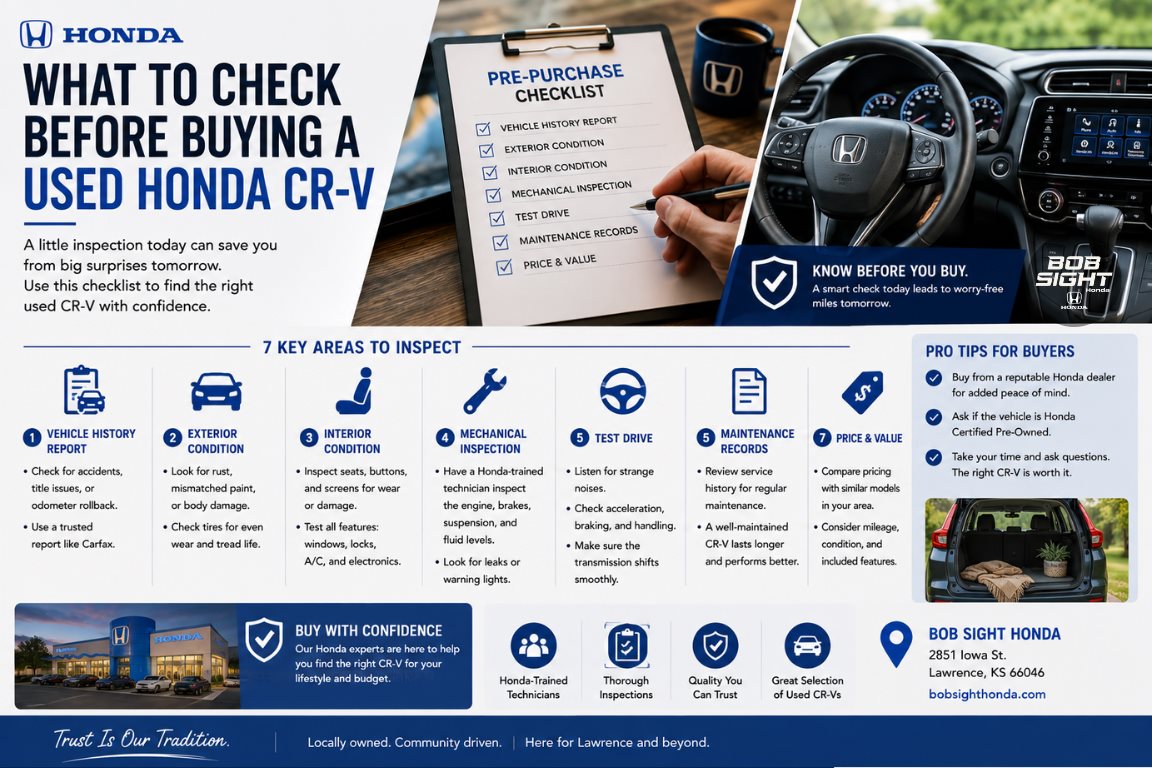
Inspecting a pre-owned compact SUV requires a clear focus on maintenance history, transmission performance, oil change intervals, suspension condition, and overall structural integrity before making a final purchase. Whether you are searching for a reliable commuter for daily trips along Iowa Street in Lawrence, an efficient vehicle for highway driving across K-10 and I-70 to Kansas City, or a safe crossover for family trips around Douglas County, a pre-owned Honda CR-V stands out as one of the most practical and dependable investments on the market. Known for high resale value, exceptional fuel economy, and long-term durability, a used CR-V offers incredible overall ownership value. Conducting a thorough pre-purchase evaluation—or purchasing a Certified Pre-Owned (CPO) model backed by rigorous factory multi-point inspections—ensures you acquire a quality vehicle that fits your budget and lifestyle without unexpected future repair costs.
Browse Quality Used Honda CR-V Inventory at Bob Sight Honda
IN THIS GUIDE YOU’LL LEARN:
- The essential mechanical components and fluid levels to review during a pre-purchase inspection.
- How to evaluate maintenance records, CARFAX vehicle history reports, and Maintenance Minder logs.
- What specific symptoms to test for during a comprehensive road test across local highways and city streets.
- Key differences between generation model years, powertrains, and all-wheel drive systems.
- How Midwest winter road conditions, road salt, and seasonal weather impact underlying chassis longevity.
- The added protection, warranty coverage, and inspection standards of Honda Certified Pre-Owned models.
- Why buying from Bob Sight Honda provides peace of mind, transparent financing, and reliable post-sale support.
Evaluating Maintenance History and CARFAX Vehicle Reports
Reviewing a comprehensive vehicle history report alongside verified service records is the critical first step when shopping for a used Honda CR-V. High-quality pre-owned vehicles usually leave behind a consistent paper trail demonstrating routine maintenance. When examining a potential vehicle at Bob Sight Honda or evaluating a private-party listing, request a full CARFAX® or AutoCheck® report to verify ownership history, reported accidents, service intervals, and title status.
A clean vehicle history report verifies that the vehicle has maintained a regular maintenance routine throughout its life. Pay close attention to oil change intervals, which should consistently occur every 5,000 to 7,500 miles or according to the vehicle's onboard Maintenance Minder system. Consistent oil changes protect the 1.5-liter turbocharged or 2.4-liter naturally aspirated engines from internal wear, timing chain stress, and oil sludge accumulation, ensuring long-term mechanical health.
In addition to oil services, review the history report for major milestone maintenance services. Key intervals to look for include:
- CVT Fluid Replacement: Continuous Variable Transmission (CVT) fluid should be drained and refilled every 30,000 to 45,000 miles to preserve smooth belt operation and internal hydraulic pressure.
- Real Time AWD Dual-Pump Fluid Service: For All-Wheel Drive models, rear differential fluid requires replacement every 30,000 miles to prevent rear differential noise and chatter during sharp turns.
- Brake Fluid Flushes: Honda recommends replacing DOT 3 brake fluid every 3 years regardless of mileage to prevent moisture absorption and internal hydraulic corrosion.
- Spark Plug & Engine Air Filter Replacement: Iridium spark plugs should be changed at approximately 100,000 miles alongside engine air and cabin air filter replacements.
Checking title history ensures the crossover has never been subjected to total loss events, flood damage, or salvage title reassignments. Vehicles that have spent their lives in Douglas County or surrounding Kansas communities with documented dealership service records offer higher transparency and long-term reliability compared to out-of-state vehicles with incomplete history logs.
Under-the-Hood Visual Inspection and Mechanical Checks
A thorough visual inspection of the engine bay allows buyers to spot fluid leaks, aging rubber components, battery corrosion, and signs of poor maintenance before taking a test drive. Before turning the ignition key, open the hood and allow yourself time to inspect the mechanical heart of the vehicle. A clean, well-maintained engine compartment indicates that the previous owner took pride in vehicle care.
Start by pulling the engine oil dipstick to check both oil level and oil quality. Clean engine oil should appear translucent amber or light brown. Dark, black, or thick sludge-like oil indicates neglected maintenance, while a milky, milky-brown appearance signals potential head gasket issues or coolant contamination within the oiling system. Inspect the oil filler cap for white foam or residue, which can point to condensation or internal coolant leaks.
Examine surrounding fluid reservoirs and engine components systematically:
- Engine Coolant Level & Condition: Inspect the clear expansion tank to ensure the Type 2 OEM blue coolant is at the proper fill line and free of oil sheens, rust flakes, or debris.
- Drive Belt Inspection: Check the serpentine drive belt for cracking, fraying, uneven wear along the ribs, or excessive slack that could cause alternator or water pump slippage.
- Battery & Charging Terminals: Inspect battery terminals for white or greenish corrosion scale. Check the battery date stamp to confirm it is less than 3 to 5 years old, ensuring reliable cold starts during Kansas winter mornings.
- Hoses & Vacuum Lines: Squeeze upper and lower radiator hoses gently; they should feel firm yet pliable, without soft spots, cracks, or brittle outer heat shielding.
Look carefully around valve cover gaskets, front main seals, and oil pan rails for dampness or active oil leaks. While minor surface weeping can occur on higher-mileage vehicles, active dripping requires immediate mechanical repair before finalizing a purchase decision.
Interior Quality, Electronics, and Air Conditioning Systems
Inspecting the interior ensures all comfort features, infotainment screens, climate controls, and power accessories operate seamlessly. The cabin of a used Honda CR-V is designed for utility and comfort, but testing every electronic component guarantees you won't encounter frustrating post-purchase repairs.
Begin your interior check by turning the ignition key or pressing the push-button start to power up the electrical system. Verify that all instrument cluster warning lights—including Check Engine, ABS, Airbag (SRS), and Tire Pressure Monitoring System (TPMS)—illuminate briefly during bulb checks and turn off completely once the engine starts. Any warning light remaining lit on the dashboard indicates an active diagnostic fault code that requires professional scanning.
Review interior features and technology components using this practical checklist:
| Interior Component | Inspection Criteria | Potential Red Flags |
|---|---|---|
| HVAC & Climate Control | Test full heat, freezing A/C, defrost vents, and fan speeds. | Warm A/C air, clicking blend door actuators, weak defrost airflow. |
| Infotainment & Touchscreen | Test Bluetooth pairing, Apple CarPlay, Android Auto, radio reception. | Unresponsive touch zones, blank screens, freezing navigation software. |
| Power Windows & Locks | Operate all window switches and door lock toggles from driver master panel. | Slow window regulators, chattering door lock actuators, stuck glass. |
| Seating & Upholstery | Check power seat adjustments, seat heaters, folding rear seats. | Torn upholstery, broken seat track latches, non-functional heating elements. |
| Sunroof & Headliner | Open/close sunroof fully; check headliner edges for water staining. | Stuck slide tracks, wet carpets, clogged sunroof drain tubes causing leaks. |
Pay special attention to climate control performance. Air conditioning systems should blow crisp, freezing air within 60 seconds of activation. Inconsistent cooling or strange clicking noises behind the dashboard can signal worn blend door actuators, low refrigerant charges, or compressor clutch issues. Inspecting interior carpeting around footwells ensures door weatherstripping and sunroof drains remain watertight through heavy rainstorms.
Road Test Evaluation: Performance, Steering, and Braking
Taking a comprehensive road test across both low-speed city streets and high-speed highways reveals true transmission response, suspension health, and cabin acoustics. A proper test drive should last at least 15 to 20 minutes, allowing the engine, transmission, and climate control systems to reach full operating temperatures while navigating varied road surfaces around Lawrence.
Begin your road test on local city streets with frequent stops and turns, such as 23rd Street or Wakarusa Drive. Accelerate gently from a stop to evaluate how the engine and transmission interact. Continuously Variable Transmissions (CVTs) should provide smooth, linear acceleration without sudden shuddering, slipping, or high-pitched whining noises. If the vehicle is equipped with a conventional automatic transmission from earlier model years, gear shifts should feel firm, crisp, and predictable.
Merge onto major thoroughfares like K-10 or I-70 to evaluate high-speed performance and structural stability:
- Highway Acceleration & Merging Power: Accelerate firmly up to highway speeds to confirm the engine pulls smoothly without hesitation, misfires, or excessive exhaust smoke.
- Straight-Line Tracking & Steering Alignment: On a straight, level stretch of highway, ease your grip on the steering wheel slightly; the CR-V should track straight without pulling aggressively toward the shoulder or median.
- Brake System Response & Pedal Feel: Apply the brakes firmly from 55 mph to evaluate stopping power. The brake pedal should feel firm and responsive without pulsation, steering wheel vibration, or high-pitched screeching.
- Suspension Comfort Over Bumps: Drive over minor road imperfections, railroad tracks, or speed bumps; listen for clunking, rattling, or squeaking sounds from worn strut mounts, sway bar links, or control arm bushings.
Listen closely to cabin sound levels during highway cruising. Excessive humming or roaring sounds that increase with road speed typically point to worn wheel bearings rather than tire tread noise. Addressing steering alignment or suspension issues prior to purchase protects tire tread life and ensures comfortable long-distance driving.
Undercarriage Inspection: Rust, Suspension, and All-Wheel Drive Systems
Inspecting the vehicle's undercarriage reveals the extent of Midwest winter salt corrosion, suspension wear, and driveline condition. Because Kansas winters involve aggressive road salting and chemical de-icing along major highways, getting a clear view under the vehicle is critical for long-term ownership planning.
Position a flashlight under the front and rear subframes to check for structural rust scale. Surface rust on heavy iron suspension components is normal for Midwest vehicles, but deep structural flaking, rotted unibody frame rails, or rusted-through exhaust heat shields compromise safety and require costly structural repairs. Ensure pinch welds and jack points remain straight and solid.
Check key suspension and drivetrain components for signs of wear or leakage:
- CV Axle Boots: Inspect outer and inner rubber Constant Velocity (CV) axle boots near the wheels. Split or torn rubber boots fling grease onto surrounding suspension parts, leading to joint failure and metallic clicking sounds during tight turns.
- Shock Absorbers & Struts: Look for oil wetness or heavy dirt accumulation along the shock bodies, indicating blown fluid seals that cause excessive bouncing and floating ride dynamics.
- Real Time AWD Transfer Case & Rear Differential: On All-Wheel Drive models, check the transfer case near the front subframe and the rear differential housing for fluid leaks or wetness around axle seals.
- Exhaust System & Catalytic Converter: Verify the exhaust pipe assembly is free of major rust holes, broken hanger rubbers, or loose heat shields that rattle during acceleration.
Confirming that CV boots, steering rack bellows, and rear differential seals are dry and intact ensures the vehicle's All-Wheel Drive system will perform reliably when severe winter weather arrives in Douglas County.
Understanding Model Generations and Key Trim Differences
Knowing the unique attributes, engineering updates, and feature upgrades across CR-V model generations helps shoppers select the perfect year for their budget. Over its decades of production, the Honda CR-V has evolved through multiple distinct generations, each offering unique strengths, engine choices, and technology features.
Evaluating popular pre-owned CR-V generations allows buyers to align feature preferences with realistic price points:
| Generation & Model Years | Powertrain Options | Key Features & Attributes |
|---|---|---|
| Fourth Generation (2012–2016) | 2.4L 4-Cylinder (5-Speed Auto '12-'14 / CVT '15-'16) | Exceptional long-term mechanical reliability, simple cabin controls, introduced modern ECON efficiency modes and available Honda LaneWatch™. |
| Fifth Generation (2017–2022) | 1.5L Turbo 4-Cylinder or 2.0L Hybrid / CVT | Introduced bold exterior styling, Honda Sensing® standard on EX and above, Android Auto/Apple CarPlay, dynamic interior cargo volume, and efficient hybrid options. |
| Sixth Generation (2023–Present) | 1.5L Turbo or 2.0L 2-Motor Hybrid / CVT or Direct Drive | Modernized digital dashboard, refined acoustic glass insulation, honeycomb interior accents, updated Real Time AWD system, wide-angle Honda Sensing®. |
If advanced active driver assistance is a top priority, shopping for Fifth-Generation (2017–2022) EX trims or higher ensures standard inclusion of Honda Sensing® features like Collision Mitigation Braking, Lane Keeping Assist, and Adaptive Cruise Control. For buyers seeking maximum budget affordability combined with simple mechanical design, late Fourth-Generation models offer exceptional long-term utility.
Trim levels generally follow Honda's intuitive hierarchy: LX (well-equipped base model), EX (popular mid-tier adding sunroof, heated seats, blind-spot monitoring), EX-L (leather seating, power liftgate, premium audio), and Touring/Sport Touring (top-tier featuring navigation, hands-free liftgate, LED headlights, and premium Bose® sound).
Step-by-Step Guide: Performing a Pre-Purchase Vehicle Check
Following a systematic step-by-step checklist prevents overlooked inspection details and ensures complete confidence when buying a used crossover. Print or save this easy guide to follow along while inspecting any pre-owned vehicle on the lot.
Execute your pre-purchase evaluation using these organized steps:
- Perform an Exterior Body Inspection: Walk around the vehicle in bright daylight. Inspect panel gaps, check paint color match across fenders and doors, look for minor dings, and check body seals for overspray indicating prior body shop repairs.
- Inspect Tires and Wheel Alignment: Check tread depth across all four tires using a penny or depth gauge. Verify tread wear is even across the inner, center, and outer tread blocks; uneven wear indicates alignment or suspension issues.
- Check Under-Hood Fluid Levels: With the engine cool, verify engine oil level, transmission fluid (if dipstick equipped), brake fluid, engine coolant, and windshield washer fluid.
- Test All Cabin Controls & Technology: Sit inside and operate power seats, power mirrors, windows, door locks, climate control blower speeds, radio controls, backup camera clarity, and steering wheel buttons.
- Conduct a Cold Engine Start: Have a helper start the engine while you stand near the exhaust. Listen for metallic valve rattle or timing chain noise; check exhaust output for blue smoke (oil burning) or white smoke (coolant leak).
- Take a 20-Minute Varied Road Test: Drive on city streets, take sharp low-speed turns, and cruise at 65+ mph on highways to test acceleration, braking stability, transmission smoothness, and steering alignment.
- Inspect Under the Chassis Post-Drive: Park over clean pavement after the test drive; look underneath with a flashlight to check for fresh fluid drips from the engine, transmission, or differential.
Completing this structured process guarantees you identify potential concerns early, allowing you to request repairs, negotiate pricing, or move forward with total peace of mind.
The Value of Buying Honda Certified Pre-Owned (CPO)
A Honda Certified Pre-Owned (CPO) CR-V provides factory-backed warranty protection, rigorous multi-point inspection standards, and roadside assistance that private sellers cannot match. For shoppers seeking maximum protection without the price tag of a brand-new vehicle, the Honda CPO program represents the ideal middle ground.
To earn factory certification, a pre-owned vehicle must meet strict age and mileage requirements and pass a comprehensive 182-point mechanical and appearance inspection conducted by factory-trained technicians at authorized dealerships like Bob Sight Honda. Any component that fails to meet stringent factory standards is reconditioned or replaced using genuine OEM Honda parts.
Honda CPO vehicles include comprehensive warranty coverage tiers based on vehicle age:
- HondaTrue Certified+ (Vehicles 1 year old or newer / under 12,000 miles): Extends Powertrain coverage to 7 years / 100,000 miles and Non-Powertrain coverage to 5 years / 86,000 miles.
- HondaTrue Certified (Vehicles 5 years old or newer / under 80,000 miles): Extends Powertrain coverage to 7 years / 100,000 miles and Non-Powertrain coverage to 4 years / 48,000 miles (or 1 year / 12,000 miles if original new car warranty has expired).
- HondaTrue Used (Vehicles 10 years old or newer / no mileage limit): Provides Powertrain coverage for 100 days / 5,000 miles and Non-Powertrain coverage for 100 days / 5,000 miles.
Additionally, CPO ownership includes 24/7 Roadside Assistance, complimentary oil changes during the first year of ownership, trip interruption protection, and a 3-day / 300-mile exchange policy. Buying CPO eliminates guesswork and protects your investment long after driving off the lot.
Quick Facts: Used Honda CR-V Buyer Checklist
Essential rules, inspection thresholds, and key verification points for prospective buyers:
- Oil Change Interval Target: Look for consistent service records logged every 5,000 to 7,500 miles.
- CVT Fluid Service Window: Confirm fluid replacements occurred every 30,000 to 45,000 miles.
- AWD Rear Differential Service: Verify Dual-Pump fluid was changed every 30,000 miles on AWD models.
- Tire Tread Safety Limit: Ensure remaining tire tread depth exceeds 4/32 inches for safe wet/snow traction.
- Brake Pad Replacement Spec: Friction material should measure above 3mm to avoid immediate replacement costs.
- Dashboard Warning Light Check: All cluster warning lights must turn off completely after engine ignition.
- Factory CPO Inspection Standard: Honda CPO models undergo a rigorous 182-point technician inspection.
Keeping these vital inspection targets in mind ensures you select a dependable vehicle capable of delivering reliable service for years to come.
Long-Term Ownership Planning: Protecting Your Investment
Following routine service intervals, utilizing genuine OEM parts, and protecting the vehicle from severe weather preserves long-term resale value and reliability. Once you bring your pre-owned Honda CR-V home to Douglas County, establishing a consistent maintenance schedule ensures it remains safe, efficient, and dependable.
Pay close attention to your vehicle's integrated Maintenance Minder system. When main service codes (A or B) and sub-codes (1 through 6) illuminate on your digital dashboard, schedule service promptly. Main code A calls for an oil change, while Code B includes an oil change, brake inspection, steering gearbox check, and suspension review. Sub-codes indicate specific items like tire rotations (1), air filter replacements (2), transmission fluid service (3), spark plugs (4), or coolant flushes (5).
Protecting your vehicle's exterior and undercarriage during Midwest winters is equally important:
- Wash Undercarriage Regularly in Winter: Rinse away corrosive magnesium chloride and road salt from the chassis and wheel wells every two weeks during snowy months.
- Apply Protective Exterior Wax: Wax the paint finish twice a year to protect against sun fading, road grime, and environmental contaminants.
- Use All-Season Rubber Floor Mats: Protect interior carpeting from mud, slush, and salt stains using custom-fit high-wall rubber floor mats.
- Address Minor Maintenance Quickly: Fix minor fluid weeping, squeaky brakes, or alignment pulls immediately before they damage surrounding mechanical parts.
By investing in routine preventative maintenance at Bob Sight Honda, you extend vehicle lifespan, maximize fuel efficiency, and retain top trade-in value when you choose to upgrade in the future.
Frequently Asked Questions About Buying a Used Honda CR-V
What is considered high mileage for a used Honda CR-V?
With consistent routine maintenance, a Honda CR-V can easily exceed 200,000 to 250,000 miles while maintaining excellent mechanical reliability. Thanks to durable engine designs and high-quality build materials, a pre-owned CR-V with 100,000 miles still has substantial operational life remaining if it has been properly cared for by previous owners.
When evaluating higher-mileage models (over 120,000 miles), overall condition and verified service history matter far more than the number on the odometer. A well-maintained 120,000-mile vehicle with complete dealer service records is often a better purchase than an 80,000-mile vehicle with neglected oil changes and missing fluid services.
At Bob Sight Honda, our service department thoroughly inspects all pre-owned inventory regardless of mileage, ensuring every vehicle on our lot meets strict safety and performance standards.
Are certain model years of the used Honda CR-V better than others?
While every CR-V generation offers strong dependability, 2015–2016 late Fourth-Gen models and 2019–2022 Fifth-Gen models are widely praised for refined technology and proven reliability. The 2015 update introduced revised CVT tuning and updated cabin materials, making it a favorite for budget-conscious shoppers.
For buyers seeking modern technology, the 2019 model year updated the Fifth Generation by making the popular 1.5-liter turbocharged engine standard across trims and refining cabin sound insulation. The 2020 model year introduced the efficient CR-V Hybrid powertrain alongside standard Honda Sensing® active safety technology across all trim levels.
Reviewing model features with a certified sales advisor at Bob Sight Honda helps you compare differences between model years to find the perfect match for your needs.
How can I tell if the All-Wheel Drive system works properly on a test drive?
You can test the Real Time AWD system by accelerating smoothly from a complete stop on a steep incline or loose surface and listening for rear differential noises. During normal dry pavement driving, the system operates primarily in front-wheel drive to maximize fuel efficiency, engaging the rear wheels seamlessly when front wheel slip is detected.
During your road test, execute tight, slow-speed maneuvers (such as turning complete circles in a clean parking lot). If you feel severe driveline binding, chatter, or a groaning sound from the rear of the vehicle, the rear differential fluid likely requires replacement or the dual-pump assembly is worn.
Our factory-trained technicians inspect AWD transfer cases, rear differential fluid quality, and electronic engagement solenoids on every pre-owned AWD vehicle before putting it up for sale.
Should I choose the 2.4-liter engine or the 1.5-liter turbo engine?
The naturally aspirated 2.4-liter engine offers classic mechanical simplicity, while the 1.5-liter turbocharged engine delivers stronger low-end torque and better fuel economy. The 2.4-liter 4-cylinder (found in 2012–2016 models and 2017–2019 LX trims) is renowned for bulletproof durability and simple maintenance requirements.
The 1.5-liter turbocharged engine (standard on 2017+ EX trims and above) generates 190 horsepower and 179 lb-ft of torque across a wide RPM range, providing energetic acceleration when merging onto fast highways like K-10. It also achieves superior EPA fuel economy ratings compared to older naturally aspirated engines.
Both engine options offer long-term dependability when paired with regular oil changes using factory-recommended synthetic oils. Test driving both engine choices helps you determine which power delivery style fits your driving preference.
Is buying a pre-owned Honda CR-V better than leasing a new one?
Buying a pre-owned CR-V is ideal for shoppers looking to avoid initial depreciation and own their vehicle outright, while leasing offers lower monthly payments on brand-new technology. Pre-owned vehicles have already experienced their steepest initial depreciation curve, allowing your purchase price to hold value more stably over time.
Purchasing a used or CPO model also eliminates lease mileage restrictions and wear-and-tear guidelines, giving you total freedom to drive unlimited miles across Kansas and customize your vehicle with official accessories. However, if having the newest digital displays, full original warranty coverage, and lower monthly payments appeals to you, leasing a 2026 model may be the preferred path.
Our finance team at Bob Sight Honda can outline payment comparisons between pre-owned vehicle financing and new vehicle leasing options to clarify which route aligns best with your financial goals.
Why Buy Your Used Honda CR-V at Bob Sight Honda
Bob Sight Honda offers a premium selection of inspected pre-owned vehicles, transparent market-based pricing, flexible financing options, and dedicated local customer service in Lawrence, KS. Finding the right used crossover requires a dealership team you can trust. At Bob Sight Honda, we prioritize transparency, fair trade valuations, and customer satisfaction above everything else.
Every pre-owned vehicle on our lot undergoes a thorough safety and mechanical inspection by factory-certified technicians before being offered for sale. We provide complimentary vehicle history reports, clear pricing details, and flexible auto loan financing options tailored to buyers across all credit profiles—including second-chance auto financing options for local drivers working to rebuild credit.
Located conveniently in Lawrence, KS, Bob Sight Honda proudly serves shoppers from Douglas County, Topeka, Eudora, Baldwin City, Overland Park, and the surrounding Kansas City area. Visit our showroom on 23rd Street today to test drive our pre-owned Honda CR-V inventory and experience a higher standard of dealership care.
Helpful Links
- Shop Used Honda CR-V Inventory in Lawrence, KS
- Explore Complete Pre-Owned Vehicle Inventory
- View Current Used Vehicle Specials & Offers
- Value Your Current Trade-In Online
- Apply for Pre-Approved Vehicle Financing Online
Proud to Be Part of the Bob Sight Auto Group
Bob Sight Honda is proud to be a member of the Bob Sight Auto Group, serving drivers across Kansas and Missouri for generations with reliable vehicle sales, expert automotive service, and dedicated community support. Whether you are shopping for a new or pre-owned vehicle, scheduling routine maintenance, or seeking specialized collision repair, our family of dealerships delivers exceptional customer care and automotive expertise across the region.