Honda Passport vs. Honda Pilot in Lawrence, KS: Two-Row Capability or Three-Row Family Space?
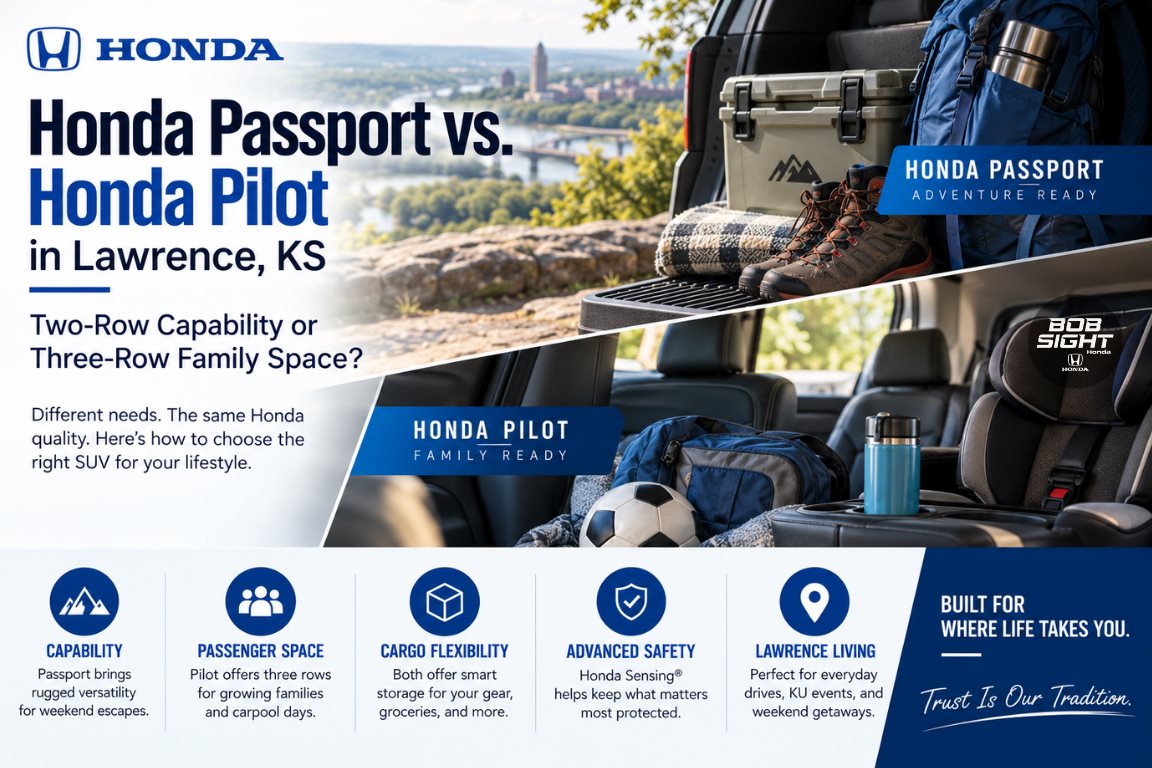
Compare new Honda SUVs at Bob Sight Honda
The Honda Passport is the better choice for drivers who want a spacious two-row SUV with standard all-wheel drive, while the Honda Pilot is designed for families who need three rows and seating for up to eight. Both Honda SUVs offer a 285-horsepower V6 engine, a 10-speed automatic transmission, flexible cargo space, and technology suited to daily driving around Lawrence, Kansas. Their most important differences involve seating capacity, cargo organization, drivetrain availability, exterior size, and how each cabin supports passengers. At Bob Sight Honda, shoppers can compare both SUVs based on the way they commute, travel, tow, and carry family or recreational gear.
The Passport and Pilot share several engineering traits, but they solve different ownership problems. The two-row Passport gives five occupants generous space and keeps the cargo area available without requiring anyone to fold a third row. The three-row Pilot supports larger households, carpools, visiting relatives, and families who sometimes need more than five seats. Choosing between them begins with an honest assessment of how often you carry additional passengers and how you want to divide the cabin between people and cargo.
Local driving conditions also shape the decision. A household traveling between Lawrence and Topeka on I-70 may prioritize passenger comfort and highway efficiency, while a driver heading to Clinton State Park may value ground clearance, all-wheel drive, and accessible cargo space. Families commuting toward Olathe, Overland Park, or the Kansas City Metro may need flexible seating for school, work, and weekend schedules. This comparison explains how the 2026 Honda Passport and 2026 Honda Pilot handle those situations without treating one SUV as the right answer for every Kansas driver.
In This Guide You’ll Learn
This guide compares the Honda Passport and Honda Pilot by focusing on the differences that affect daily ownership. Rather than looking only at exterior styling or trim names, it examines seating, cargo capacity, powertrain specifications, towing, fuel economy, technology, and Kansas driving conditions. Each section connects the specifications with practical examples for families and SUV shoppers in Lawrence. These comparisons can help you decide which model deserves a closer look and test drive.
- How two-row Passport seating compares with three-row Pilot seating
- Which Honda SUV provides the right cargo layout for your routine
- How the Passport and Pilot powertrains compare
- What to know about all-wheel drive, ground clearance, and drive modes
- How towing capacities differ by Pilot drivetrain
- Which SUV may fit commuting, family travel, and outdoor use
- How to compare both models during a dealership test drive
The specifications discussed below are based on current 2026 model information published by Honda. Features, seating configurations, capacities, and equipment can vary by trim. Shoppers should verify the details of the exact vehicle they are considering before making a decision. Current availability can be reviewed through the Bob Sight Honda model inventory pages.
Honda Passport vs. Honda Pilot at a Glance
The Honda Passport is a five-passenger, two-row SUV with standard all-wheel drive, while the Honda Pilot is a three-row SUV that can seat seven or eight passengers depending on configuration. The Passport emphasizes two-row comfort, cargo access, and rugged capability. The Pilot prioritizes passenger flexibility and family transportation while retaining useful cargo and towing capability. Both models use a 3.5-liter V6 engine rated at 285 horsepower and 262 pound-feet of torque.
| 2026 Specification | Honda Passport | Honda Pilot |
|---|---|---|
| Seating Capacity | Five passengers | Seven or eight passengers, depending on trim and configuration |
| Passenger Rows | Two | Three |
| Engine | 3.5-liter V6 | 3.5-liter V6 |
| Horsepower | 285 horsepower | 285 horsepower |
| Torque | 262 pound-feet | 262 pound-feet |
| Transmission | 10-speed automatic | 10-speed automatic |
| Drivetrain | Standard second-generation i-VTM4 all-wheel drive | Front-wheel drive or available second-generation i-VTM4 all-wheel drive, depending on trim |
| Maximum Towing Capacity | 5,000 pounds when properly equipped | Up to 5,000 pounds with all-wheel drive when properly equipped |
| Cargo Volume Behind Second Row | 44.0 cubic feet | 48.5 cubic feet standard measurement, with additional maximum-volume measurements depending on configuration |
| Maximum Seating-Area Cargo Volume | Up to 104.6 cubic feet using Honda's maximum measurement | Up to 113.7 cubic feet using Honda's maximum measurement, depending on trim and configuration |
The table reveals why capacity numbers require context. The Pilot can provide more total cargo volume when its rear seating is folded, but families using all three rows will have a smaller dedicated cargo area behind the third row. The Passport provides its 44.0 cubic feet behind the second row without asking owners to choose between third-row passengers and luggage. The practical winner depends on whether your typical trip carries five or fewer people or regularly requires a sixth, seventh, or eighth seat.
Exterior dimensions also affect daily use. The 2026 Passport measures 191.5 inches long and has 8.3 inches of unladen ground clearance across its current trim lineup. The Pilot is built around an additional passenger row and requires drivers to think about a longer family-oriented cabin, parking needs, and third-row access. In downtown Lawrence or a crowded shopping-center parking lot, both deserve a hands-on maneuverability test rather than a decision based only on measurements.
Which SUV Has the Right Seating for Your Family?
Choose the Honda Passport when five seats are enough, and choose the Honda Pilot when your routine requires a third row or room for up to eight people. Seating capacity is the clearest difference between these SUVs and should be the first decision point. The Passport provides two rows and substantial room for five occupants. The Pilot adds a third row and offers seven- or eight-passenger configurations, depending on trim and seating layout.
The Passport works well for couples, smaller households, parents with one or two children, and drivers who frequently carry adults in the second row. Its 40.9 inches of second-row legroom supports a spacious two-row cabin. Because there is no third row, second-row occupants do not need to share the rear half of the vehicle with another seating area. That design also makes it easier to leave the cargo space available for luggage, groceries, sports gear, pet supplies, or outdoor equipment.
The Pilot is designed for households whose passenger count changes throughout the week. An eight-passenger configuration can support parents, children, friends, grandparents, or a school carpool in one vehicle. Certain configurations use a removable second-row middle seat, allowing owners to create a center passage when needed and reinstall the seat when maximum capacity matters. Some Pilot configurations seat seven with second-row captain's chairs, so buyers should verify the seating layout of the exact trim.
For a Lawrence family, the difference becomes clear during real routines. A household carrying four people to Rock Chalk Park may find the Passport spacious and straightforward, with the rear cargo area always ready for equipment. A family transporting six people to activities across Douglas County needs the Pilot because the Passport cannot provide more than five seating positions. Buying for a passenger need that happens every week is usually wiser than hoping a two-row SUV can compensate through cargo room.
Third-row space should also be tested with the passengers who will use it. Children, teenagers, and adults have different needs for entry, legroom, visibility, and seat comfort. Ask each passenger to enter and exit the Pilot, then check whether child seats affect access to the rear. A third row provides valuable flexibility, but the convenience depends on seating configuration and how the family actually uses the cabin.
How Do Passport and Pilot Cargo Areas Compare?
The Passport provides a simpler cargo-first layout behind its second row, while the Pilot offers greater maximum flexibility by combining a third row with multiple cargo configurations. The 2026 Passport provides 44.0 cubic feet of cargo volume behind the second row. Honda lists up to 83.8 cubic feet behind the first row using its standard measurement and up to 104.6 cubic feet using its maximum measurement on most trims. The Pilot provides more potential maximum volume, but available space changes substantially based on whether the third row is upright or folded.
Honda lists 18.6 cubic feet of standard cargo volume behind the Pilot's third row. Behind the second row, the standard measurement is 48.5 cubic feet, while the standard measurement behind the first row is 87.0 cubic feet on several configurations. Honda's maximum measurements can reach 22.4 cubic feet behind the third row, 60.1 cubic feet behind the second row, and as much as 113.7 cubic feet behind the first row, depending on trim and configuration. These paired measurements account for different ways of measuring available storage areas, so shoppers should compare the physical shape of each cargo space rather than relying on one number.
The Passport is often easier to understand for everyday packing. With all five seating positions available, owners still have the full rear cargo area behind the second row. That can be useful for a couple carrying camping equipment to Clinton Lake, a family loading sports bags, or a dog owner who needs an open rear area. The wide cargo opening and two-row layout reduce the need to reconfigure seats before routine trips.
The Pilot provides more choices. With all three rows upright, it can carry the greatest number of passengers but leaves less space behind them. Folding the third row creates an expansive cargo area while retaining second-row seating. Folding both rear rows creates the largest load floor, making the Pilot useful for bulky purchases, moving supplies, or longer trips where passenger capacity is not required.
Use this process during a test drive to evaluate cargo fit:
- Count the seats you use weekly. Do not base the decision only on the largest group you might carry once a year.
- Identify your largest recurring cargo. Consider strollers, coolers, sports equipment, mobility equipment, pet crates, musical instruments, or work supplies.
- Test every seating position. Fold and raise the second and third rows without relying only on a demonstration.
- Measure bulky items. Compare their dimensions with the cargo opening, floor length, and interior height.
- Check storage with passengers aboard. The most useful measurement is the space remaining in your normal seating configuration.
- Review small-item storage. Look at door pockets, console space, cupholders, underfloor storage, and charging locations.
A family heading from Lawrence to Kansas City International Airport may need every passenger seat and enough room for luggage at the same time. That situation favors testing the Pilot with the third row upright and actual luggage dimensions in mind. A household of four taking the same trip may prefer the Passport because its rear cargo area remains fully accessible without seat management. Cargo usability is determined by the combination of people and belongings, not maximum capacity alone.
Do the Honda Passport and Honda Pilot Have the Same Engine?
The 2026 Honda Passport and 2026 Honda Pilot use closely matched 3.5-liter V6 powertrains rated at 285 horsepower and 262 pound-feet of torque. Both pair the V6 with a 10-speed automatic transmission featuring shift-by-wire operation and paddle shifters. Their shared output means the decision is not about choosing a dramatically stronger engine. Differences in vehicle configuration, weight, drivetrain, drive modes, tires, and intended use shape how each SUV feels.
Honda's 3,471-cc V6 uses direct fuel injection, a 24-valve dual-overhead-cam design, and Dual Variable Timing Control. Variable Cylinder Management can reduce the number of active cylinders under suitable light-load conditions. Both SUVs recommend regular unleaded fuel and use an 18.5-gallon fuel tank. These specifications give Passport and Pilot drivers a familiar foundation for highway merging, passing, family travel, and towing when properly equipped.
The 10-speed automatic transmission provides a broad range of gear ratios. Lower gears support acceleration and low-speed control, while the upper gears help the engine settle into highway travel. Paddle shifters give the driver additional control when descending grades, preparing to pass, or managing changing road conditions. Drivers should evaluate the transmission in normal traffic because smoothness and responsiveness matter more in everyday ownership than the number of gears by itself.
The Passport comes standard with Honda's second-generation Intelligent Variable Torque Management all-wheel-drive system, commonly called i-VTM4. The system can distribute torque between the front and rear axles and between the left and right rear wheels as conditions require. The Pilot offers front-wheel drive on certain trims and i-VTM4 all-wheel drive on others. That difference gives Pilot shoppers a drivetrain choice, while every current Passport starts with all-wheel-drive capability.
For a driver using K-10 between Lawrence and Johnson County, both V6 engines provide useful power for merging and sustained highway travel. On wet, snowy, gravel, or uneven surfaces, tires and driver decisions remain critical even when all-wheel drive is present. All-wheel drive can help the vehicle accelerate and distribute power, but it does not shorten braking distances on ice. Kansas owners should treat drivetrain technology as one part of a broader plan that includes proper tires, maintenance, visibility, and speed selection.
Which Honda SUV Is Better for Towing and Outdoor Use?
The Passport offers a straightforward 5,000-pound towing rating across the 2026 lineup when properly equipped, while the Pilot can tow up to 5,000 pounds with all-wheel drive or up to 3,500 pounds in applicable two-wheel-drive configurations. Neither number should be used without checking the exact vehicle, hitch equipment, trailer, passenger load, and owner's manual. Towing capacity describes an upper vehicle rating under defined conditions. It does not mean every trailer below that number is automatically suitable.
The Passport's standard i-VTM4 all-wheel drive, 8.3 inches of ground clearance, and integrated Normal, Econ, Sport, Snow, Tow, Trail, and Sand modes support its capability-focused character. TrailSport versions add all-terrain tires and an off-road-tuned suspension. These features can be useful for gravel access roads, campsites, trailheads, rural property, and changing surfaces. Drivers should still understand that the Passport is a unibody SUV and follow all Honda limits and operating guidance.
The Pilot offers its own TrailSport configuration with all-wheel drive, all-terrain tires, off-road-focused tuning, and Trail and Sand modes. The key advantage is that the Pilot can combine this equipment with three-row seating. A larger family can carry more passengers to an outdoor destination without moving to a different vehicle category. The tradeoff is that people, cargo, accessories, and trailer tongue weight all contribute to load calculations.
Before towing with either SUV, follow a structured preparation process:
- Identify the exact drivetrain and trim. Pilot towing ratings differ between two-wheel-drive and all-wheel-drive configurations.
- Read the owner's manual. Confirm required equipment, load limits, hitch requirements, and operating instructions.
- Calculate the complete trailer load. Include the trailer, cargo, fluids, batteries, propane, accessories, and any equipment added after purchase.
- Account for vehicle occupants and cargo. Passenger and cargo weight can affect the available capacity for towing.
- Check tongue weight and hitch setup. Proper balance supports stability and predictable handling.
- Inspect tires, brakes, lights, and connections. Confirm safe operating condition before every trip.
- Adjust driving habits. Allow more following distance, brake earlier, reduce speed, and plan wider turns.
A Lawrence owner towing a small recreational trailer west on I-70 should account for wind, highway speed, temperature, and changing traffic. Crosswinds across open Kansas terrain can affect trailer stability even when the vehicle remains within its maximum rating. Hills, stop-and-go traffic, and hot-weather travel also increase the importance of correct loading and maintenance. A product specialist can explain vehicle equipment, but the owner remains responsible for verifying the trailer and load combination.
Passport vs. Pilot Fuel Economy and Daily Commuting
The Pilot offers the highest published 2026 fuel-economy rating of the two SUVs in available two-wheel-drive form, while Passport and Pilot all-wheel-drive ratings are closely matched in comparable configurations. The 2026 Pilot is rated at 19 mpg city, 27 mpg highway, and 22 mpg combined in applicable two-wheel-drive configurations. Many Pilot all-wheel-drive trims are rated at 19 mpg city, 25 mpg highway, and 21 mpg combined. The Passport RTL family is also rated at 19 mpg city, 25 mpg highway, and 21 mpg combined, while Passport TrailSport variants are rated at 18 mpg city, 23 mpg highway, and 20 mpg combined.
EPA estimates provide a standardized comparison, but actual fuel economy varies. Speed, temperature, wind, terrain, tire choice, roof-mounted equipment, cargo, passengers, maintenance, traffic, and driving habits can all change results. A TrailSport model with all-terrain tires is designed around a different capability balance than a road-focused trim. Drivers should compare the configuration they plan to buy rather than applying one model-wide estimate.
A commuter driving from Lawrence to Topeka may spend more time at steady highway speeds than someone navigating short trips near the University of Kansas campus. The highway commuter may place more weight on the Pilot's available two-wheel-drive rating, while a driver who wants standard all-wheel drive may compare similarly equipped versions of both SUVs. Short trips can produce different fuel-use patterns because the engine and drivetrain repeatedly warm up. Winter idling and summer air-conditioning use can also affect observed efficiency.
The Passport may feel more natural for a household that rarely uses more than five seats and wants all-wheel drive included across the lineup. The Pilot may suit a buyer who wants the option of front-wheel drive or needs the third row enough to accept the larger cabin. Both use regular unleaded fuel and an 18.5-gallon tank, which simplifies the fuel-type comparison. The meaningful difference comes from configuration, passenger requirements, and the type of driving completed each week.
During your test drive, reset the trip display only if dealership staff confirms it is appropriate, and focus on driving behavior rather than a brief fuel-economy number. A short test cannot replicate a complete ownership pattern. Evaluate visibility, seating comfort, noise, ride quality, steering effort, and power delivery on roads similar to your routine. Those factors affect every trip and may be more important than a small difference in an EPA estimate.
How Do Technology and Safety Features Compare?
Both the 2026 Honda Passport and Honda Pilot include Honda Sensing driver-assistance technology, but trim-specific comfort, camera, audio, connectivity, and parking features can shape the ownership experience. Core Honda Sensing features include systems designed to support braking, lane awareness, adaptive cruise control, and road-departure mitigation. These technologies assist an attentive driver rather than replace one. Buyers should test the controls and understand how alerts and interventions work before relying on them.
Honda lists features such as the Collision Mitigation Braking System, Road Departure Mitigation System, Lane Keeping Assist System, Adaptive Cruise Control with Low-Speed Follow, Traffic Sign Recognition, and Traffic Jam Assist across the current Passport lineup. Blind Spot Information with Lane Change Assist and Cross Traffic Monitor add support during lane changes and reversing. Available camera technology can provide added visibility in parking areas or on uneven trails. Equipment should always be verified by trim because similar-looking vehicles may include different features.
The Pilot also includes a broad Honda Sensing suite and three-row-specific safety considerations. Honda lists three-row side-curtain airbags with a rollover sensor, seat belts at all seating positions, and lower anchors and tethers for children in defined second- and third-row positions. A Rear Seat Reminder can help prompt the driver to check the cabin after a trip. Families using child seats should confirm the exact LATCH locations and test their own seats for fit before choosing a configuration.
Technology usability matters during daily life. Connect your phone, test wireless or wired smartphone integration, explore the touchscreen menus, locate USB ports, and check charging access from every occupied row. Pilot shoppers should pay close attention to second- and third-row charging because more passengers can create more demand for connected devices. Passport shoppers may value a simpler two-row layout in which the driver and passengers can reach storage and and charging points more easily.
Consider a family returning to Lawrence after dark on K-10. Adaptive cruise control and lane-support features may reduce certain repetitive driver inputs, but construction zones, faded markings, weather, and traffic still demand full attention. Parking sensors and camera views may help in a crowded lot near downtown Lawrence, but mirrors and direct observation remain necessary. The best technology package is one the driver understands and will use correctly.
Which SUV Handles Kansas Weather and Roads Better?
The Passport provides the strongest standard capability package because every 2026 model includes i-VTM4 all-wheel drive and 8.3 inches of ground clearance, while the Pilot provides more drivetrain choice and can add similar all-wheel-drive capability. Passport TrailSport models further emphasize uneven-surface use with all-terrain tires and off-road-tuned suspension. Pilot TrailSport brings capability-focused equipment to a three-row cabin. The right choice depends on whether standard ruggedness or additional passenger seating matters more.
All-wheel drive can direct power to the wheels with useful traction, but tire condition remains central to winter performance. Tread depth, rubber condition, inflation pressure, and tire design influence acceleration, turning, and braking. Cold weather naturally reduces tire pressure, while the freeze-thaw cycle can create potholes and broken pavement. Drivers should inspect tires regularly and respond promptly to Tire Pressure Monitoring System alerts.
The Passport's 8.3 inches of unladen ground clearance can help on rutted gravel roads, snow-covered residential streets, and rough access areas. Ground clearance does not make the SUV immune to deep snow, standing water, ice, or hidden road damage. Drivers should avoid obstacles that exceed the vehicle's capabilities and follow Honda's operating guidance. Trail and Sand modes adjust vehicle-system behavior but cannot change the physical traction available from the surface.
The Pilot's advantage is its ability to combine family seating with available i-VTM4 all-wheel drive. A household that regularly carries six people cannot replace the third row with extra ground clearance. An all-wheel-drive Pilot can support school transportation during the week and family travel during changing Kansas weather. The Pilot TrailSport adds an outdoor-oriented configuration for buyers who need both passenger capacity and additional capability features.
For travel between Lawrence and Baldwin City on US-59, drivers may encounter wind, rain, rural traffic, darkness, and seasonal weather changes. On I-70 toward Topeka, highway speeds increase the importance of proper tire pressure and following distance. Around Eudora and eastern Douglas County, a mix of paved and rural roads may make all-wheel drive more relevant. Match the drivetrain and tires to the conditions you encounter regularly, not to a single rare scenario.
Which Honda SUV Is Better for Road Trips?
The Pilot is generally better for road trips with more than five travelers, while the Passport is often the more convenient choice for five or fewer people carrying substantial luggage or outdoor gear. The Pilot's third row expands passenger capacity, but using every seat reduces the cargo area available behind it. The Passport cannot carry more than five occupants, yet its two-row design preserves 44.0 cubic feet behind the rear seats. Road-trip suitability depends on the exact combination of people, luggage, comfort needs, and destination.
A family of six heading from Lawrence to Colorado needs the Pilot's third row. Before leaving, that household should confirm whether the remaining rear cargo area can hold luggage, food, and equipment without blocking visibility or creating unsafe loose items. A roof system or other genuine Honda accessory may help in certain situations, provided all load limits are followed. Passenger access, charging ports, cupholders, climate control, and seating comfort should be tested before a long trip.
A couple or family of four traveling to the Ozarks may prefer the Passport. The second row provides generous passenger space, and the rear cargo area can remain dedicated to coolers, suitcases, outdoor gear, or pet equipment. Standard all-wheel drive and available TrailSport equipment can support travel that includes gravel access roads or campsites. The shorter passenger layout also reduces the need to fold and raise seats during each stop.
Ride comfort should be evaluated by every regular passenger. Front-seat comfort alone does not reveal second- or third-row support, visibility, climate airflow, and motion over uneven pavement. Ask passengers to sit in their expected positions during a test drive. In the Pilot, confirm whether adults can use the third row comfortably for the distance you plan to travel.
Highway range depends on more than published fuel economy. Headwinds, speed, cargo, elevation, all-terrain tires, and climate-control use can change fuel consumption. Both SUVs use an 18.5-gallon fuel tank and regular unleaded fuel, making route planning relatively familiar. Consistent maintenance and correct tire pressure help either Honda perform as intended during long Kansas and Midwest trips.
Honda Passport vs. Honda Pilot Quick Facts
The Passport is the two-row, five-passenger choice, while the Pilot is the three-row family choice with seating for seven or eight. Both use a 285-horsepower V6 and 10-speed automatic transmission. The Passport includes all-wheel drive throughout its current lineup. The Pilot offers front-wheel drive on certain trims and all-wheel drive on others.
- The 2026 Honda Passport seats five passengers in two rows.
- The 2026 Honda Pilot seats seven or eight passengers, depending on configuration.
- Both SUVs use a 3.5-liter V6 rated at 285 horsepower and 262 pound-feet of torque.
- Both models use a 10-speed automatic transmission.
- Every current Passport includes second-generation i-VTM4 all-wheel drive.
- The Pilot offers front-wheel drive or available i-VTM4 all-wheel drive, depending on trim.
- The Passport provides 44.0 cubic feet of cargo volume behind the second row.
- The Pilot provides 18.6 cubic feet of standard cargo volume behind the third row.
- The Pilot provides 48.5 cubic feet of standard cargo volume behind the second row.
- The Passport is rated to tow 5,000 pounds when properly equipped.
- The Pilot can tow up to 5,000 pounds with all-wheel drive or up to 3,500 pounds in applicable two-wheel-drive configurations when properly equipped.
- Passport TrailSport models add all-terrain tires and off-road-tuned suspension.
- Pilot TrailSport combines three-row seating with capability-focused equipment.
The most important takeaway is that the shared engine does not make these SUVs interchangeable. Seating design affects cargo availability, passenger access, vehicle use, and daily convenience. A driver who never needs a third row may get more practical value from the Passport's cargo-first layout. A driver who carries more than five people needs the Pilot regardless of the Passport's other advantages.
Trim selection can also change the comparison. Tires, seating arrangement, audio systems, camera technology, upholstery, drive modes, and comfort features vary. Review the current Honda Passport specifications and Honda Pilot specifications for detailed manufacturer information. Then verify equipment on the exact vehicle at the dealership.
Ownership Planning for a Passport or Pilot
Long-term ownership planning should account for mileage, maintenance, tires, drivetrain service, passenger needs, towing, and how quickly your household may outgrow the cabin. Both vehicles use Honda's Maintenance Minder system to communicate service needs based on vehicle operation. Owners should respond to displayed maintenance codes and follow the instructions for their exact model and model year. Keeping service records supports reliability, warranty documentation, and future trade-in evaluation.
The Maintenance Minder can identify needs related to engine oil, tire rotation, filters, transmission fluid, spark plugs, coolant, and inspections. Service requirements vary with powertrain, drivetrain, operating conditions, and mileage. A Passport or all-wheel-drive Pilot has drivetrain components that should be maintained according to Honda guidance. Towing, dusty roads, frequent short trips, and extensive stop-and-go driving can also affect how owners plan inspections and service.
Tires deserve specific attention because the two models may use different tire types across trims. Passport TrailSport and Pilot TrailSport configurations use all-terrain tires designed around a broader range of surfaces. All-terrain tires can change ride, noise, efficiency, and replacement considerations compared with road-focused all-season tires. Owners should preserve the correct size, load rating, speed rating, and Honda requirements when replacement becomes necessary.
Families considering the Pilot should think several years ahead. A household with young children may need child-seat access now and adult-friendly third-row space later. A removable second-row center seat can add flexibility, but only if the family has a practical place to store it when removed. Buyers should practice moving seats and accessing the third row before deciding on a configuration.
Passport shoppers should consider whether five seats will remain enough throughout the planned ownership period. If grandparents, teammates, visiting relatives, or additional children regularly join the household, the lack of a third row may become limiting. If those situations are rare, maintaining a larger cargo area every day may be more valuable. Buying for realistic future needs can reduce the likelihood of replacing the SUV earlier than planned.
The Bob Sight Honda Service Department supports Passport and Pilot owners in Lawrence and surrounding communities. Drivers can use the dealership's online service scheduler when maintenance is due. Whether you drive primarily within Douglas County or commute throughout northeast Kansas, a consistent service plan helps protect the capability and flexibility that influenced your original choice.
How to Test Drive the Passport and Pilot Back to Back
A back-to-back test drive is the best way to determine whether the Passport's two-row layout or the Pilot's three-row flexibility feels right in daily use. Drive both vehicles on similar roads and evaluate them using the same criteria. Bring the passengers and equipment that influence your decision whenever practical. A consistent test makes differences easier to identify than separate drives completed days apart.
- Set up the driver's position. Adjust the seat, steering wheel, mirrors, and displays before moving.
- Check visibility. Compare forward views, rear visibility, mirror coverage, camera views, and blind spots.
- Load every passenger row. Have regular passengers test entry, exit, legroom, headroom, and climate airflow.
- Operate the seating systems. Fold the Passport's second row and the Pilot's second and third rows yourself.
- Inspect cargo fit. Use measurements or representative gear to assess the cargo opening and floor.
- Drive in town. Compare steering effort, braking, ride comfort, parking, and low-speed maneuverability.
- Include a highway segment. Evaluate merging, transmission response, wind noise, seat support, and stability.
- Test technology. Connect a phone, use the touchscreen, locate charging ports, and review driver-assistance settings.
- Discuss towing needs. Verify the exact drivetrain, rating, and required equipment if towing is part of your plan.
- Review both configurations again. Compare how each vehicle would handle your busiest normal week.
A test route around Lawrence should reflect real ownership. Stop-and-go traffic near 23rd Street can reveal brake feel and low-speed behavior. A suitable segment of K-10 can demonstrate merging, road noise, and adaptive cruise control operation. A parking exercise can show whether the Pilot's family-oriented footprint or the Passport's proportions feel more natural.
Do not judge the Pilot solely from the driver's seat if the third row is the reason you are considering it. Sit in every row and ask regular passengers for direct feedback. Do not judge the Passport solely by its seating limit if five seats meet your needs. Load planning may reveal that the Passport's permanent rear cargo area is more useful than an unused third row.
After both drives, write down the differences before discussing trims. Note passenger access, seat comfort, cargo configuration, visibility, control layout, road noise, ride quality, and ease of parking. Then compare available features and inventory. This order keeps the decision centered on the correct vehicle architecture before smaller equipment differences enter the conversation.
Frequently Asked Questions About the Honda Passport and Honda Pilot
Is the Honda Passport or Honda Pilot bigger?
The Honda Pilot is the larger passenger vehicle in practical terms because it includes three rows and seating for seven or eight, while the Passport provides two rows and seating for five. The 2026 Passport measures 191.5 inches long and is designed around a spacious two-row cabin. The Pilot uses its larger family-oriented layout to create a third passenger row. Exterior measurements matter, but the cabin configuration creates the difference owners notice most.
The Pilot also provides greater maximum cargo volume when its rear seating is folded. Honda lists up to 113.7 cubic feet using the maximum measurement for certain Pilot configurations. The Passport reaches up to 104.6 cubic feet using Honda's maximum measurement on most current trims. Those maximum numbers do not describe normal passenger use because achieving them requires folding rear seats.
A Lawrence family should compare both SUVs in the configuration used most often. If six passengers ride regularly, the Pilot is functionally larger because it can accommodate the group. If four passengers usually travel with large amounts of gear, the Passport may feel more spacious because its 44.0-cubic-foot rear cargo area remains available. Practical size is the space available after your required passengers are seated.
Does the Honda Passport have a third row?
The Honda Passport does not have a third row and is designed exclusively as a five-passenger, two-row SUV. Its rear cabin is divided between a spacious second row and a large dedicated cargo area. Drivers who need more than five seating positions should consider the Honda Pilot. The Pilot provides three rows and seven- or eight-passenger configurations.
The absence of a third row is an advantage for some owners. Passport drivers do not need to fold seats to access the primary cargo area, and second-row passengers receive generous legroom. The layout suits smaller households, couples, outdoor travelers, and drivers who carry equipment more often than additional passengers. It also simplifies decisions about where luggage will go when every seating position is occupied.
For a family traveling from Lawrence to Kansas City with four or five people, the Passport can keep its full rear cargo area available for bags and gear. A household taking six or more people on the same trip cannot use the Passport without another vehicle. The decision should reflect recurring passenger counts rather than occasional preferences. If a third row will be used monthly or weekly, the Pilot is likely the more practical choice.
Which can tow more, the Honda Passport or Honda Pilot?
The 2026 Passport and an all-wheel-drive 2026 Pilot can each tow up to 5,000 pounds when properly equipped. Applicable two-wheel-drive Pilot configurations are rated to tow up to 3,500 pounds when properly equipped. The Passport provides a 5,000-pound rating across its current all-wheel-drive lineup. Exact requirements and limitations must be confirmed for the individual vehicle.
Towing capacity is not the same as trailer dry weight. Owners must account for cargo added to the trailer, fluids, accessories, passengers, vehicle cargo, tongue weight, and hitch equipment. The owner's manual explains Honda's requirements and operating limits. Proper loading and trailer balance are critical for stability.
Kansas drivers should also plan for crosswinds, highway speeds, summer heat, hills, and traffic. A trailer that falls below the maximum rating can still require thoughtful loading and conservative driving. Before leaving Lawrence on I-70, inspect the tires, lights, hitch connection, safety chains, and braking equipment. Choose between Passport and Pilot towing configurations only after confirming the complete trailer setup.
Is the Passport or Pilot better in snow?
The Passport has the advantage of standard i-VTM4 all-wheel drive across its 2026 lineup, while the Pilot requires shoppers to select an all-wheel-drive configuration for comparable power distribution. Both models offer Snow mode, and all-wheel-drive versions can provide added traction during acceleration. Passport and Pilot TrailSport models add all-terrain tires and capability-focused tuning. Tires and driver behavior remain fundamental to winter performance.
All-wheel drive cannot create grip where the tires have none. It also does not cancel the effects of ice, speed, or excessive following distance. Drivers should inspect tread depth, monitor pressure, clear snow and ice from the vehicle, and allow additional stopping room. A properly maintained front-wheel-drive Pilot with suitable tires may perform more predictably than an all-wheel-drive SUV with worn tires.
Lawrence winters can include freezing rain, light snow, refrozen moisture, potholes, and rapid temperature changes. Passport drivers receive all-wheel drive as standard equipment, which simplifies the configuration decision. Pilot buyers can choose all-wheel drive while retaining three-row seating. The better winter SUV is the one equipped with the right drivetrain and tires while also meeting the household's passenger requirements.
Should a family buy a Honda Passport or Honda Pilot?
A family of five or fewer should consider the Passport when cargo room and two-row comfort matter most, while a family that regularly carries more than five people should choose the Pilot. Both models can support family travel, school schedules, commuting, and weekend activities. The Pilot's third row is the deciding feature for larger households and carpools. The Passport's permanent cargo area is the deciding feature for smaller groups carrying more gear.
Families should test child-seat installation, rear-door access, cargo loading, and passenger comfort. In the Pilot, test how child seats affect third-row entry and whether the selected second-row configuration works for your household. In the Passport, confirm that five seating positions will remain sufficient throughout the planned ownership period. Future needs can matter as much as current routines.
A Lawrence household with two children, a dog, and frequent camping trips may prefer the Passport's cargo-first layout. A household with three children that often brings friends or grandparents may need the Pilot's additional seating. Neither answer depends only on vehicle size or engine output. The right Honda SUV is the one that handles the family's busiest realistic day without constant compromise.
Find Your Honda Passport or Honda Pilot at Bob Sight Honda
The Honda Passport is the stronger match for five-passenger households that value standard all-wheel drive and accessible cargo space, while the Honda Pilot is the better match for families that need three rows. Their shared V6 power, 10-speed automatic transmission, available capability features, and Honda Sensing technology create a common foundation. Seating and cabin use separate them. Choosing the correct layout will influence daily satisfaction more than choosing between two closely matched engine specifications.
Shopping locally gives Lawrence drivers the opportunity to compare both SUVs on familiar roads. You can evaluate parking and visibility in town, acceleration and comfort on K-10, and cabin flexibility with your regular passengers. Shoppers from Topeka, Eudora, Baldwin City, Olathe, Overland Park, Douglas County, and the Kansas City Metro can also compare the vehicles during one dealership visit. A back-to-back evaluation makes passenger and cargo differences much easier to understand.
Browse the new Honda Passport inventory if two-row space, standard all-wheel drive, and outdoor capability align with your plans. Explore the new Honda Pilot inventory if third-row seating and family flexibility are higher priorities. Inventory changes, so confirm available trims, colors, drivetrains, and equipment directly with Bob Sight Honda.
Before deciding, bring your passenger plan, cargo measurements, towing details, and feature priorities. Sit in every row, fold every seat, test the technology, and drive both SUVs under comparable conditions. The Passport and Pilot are not competing versions of the same idea. They are distinct Honda SUVs built for different combinations of people, cargo, roads, and routines.
Helpful Links
- Honda Passport Inventory
- Honda Pilot Inventory
- New Honda Inventory
- Pre-Owned Vehicle Inventory
- Value Your Trade
Proud to be part of the Bob Sight Auto Group
Bob Sight Honda is proud to serve Lawrence and surrounding Kansas communities as part of the Bob Sight Auto Group. Our family of dealerships supports drivers shopping for Honda, Chrysler, Dodge, Jeep, Ram, Ford, and Kia vehicles across the region. Customers can also turn to the Bob Sight Collision Center for professional collision-repair support. Across every location, our goal is to build lasting relationships through helpful guidance, dependable service, and a customer-first approach.
Bob Sight Honda serves drivers from Lawrence, Topeka, Eudora, Baldwin City, Douglas County, Olathe, Overland Park, and the Greater Kansas City area. Whether you are comparing two-row and three-row SUVs, researching a pre-owned vehicle, or planning future service, our team is ready to help you make an informed decision. We believe dealership relationships should continue throughout ownership rather than end after a purchase. Trust Is Our Tradition.
Vehicle specifications, EPA estimates, capacities, and feature descriptions are based on official 2026 Honda information available at the time of writing. Actual mileage will vary based on driving conditions, vehicle condition, maintenance, loading, and driving habits. Towing requires proper equipment and compliance with all vehicle, hitch, trailer, and load limits. Confirm specifications, equipment, and availability for the exact vehicle before purchase.